

Introduction
For most of the last decade, artificial intelligence lived inside a simple loop: a person typed a question, and a model typed back an answer. That loop defined the first wave of consumer AI — helpful, sometimes astonishing, but fundamentally reactive. It waited to be asked.
That era is ending. The technology industry has entered what is now widely called the age of agentic AI — systems that don’t just answer questions but take action. They browse the web, write and execute code, manage files, coordinate with other software tools, and complete multi-step projects with minimal supervision. Instead of a single exchange, an agentic system operates in a loop of its own: it plans, acts, observes the result, and adjusts, often repeating that cycle dozens or hundreds of times before returning to the human with a finished outcome.
This shift is not a minor product update. It represents a fundamental change in what software can do, who does the “doing,” and how organizations think about productivity. In this article, we’ll unpack what agentic AI actually is, how it differs from the chatbots that came before it, the technology that makes it possible, where it’s already being used, the risks and limitations that come with handing more autonomy to machines, and what the next few years are likely to bring.
What Exactly Is “Agentic AI”?
The term “agent” in computer science has existed for decades, referring broadly to any system that perceives its environment and acts upon it to achieve a goal. What’s new is the scale and general-purpose nature of today’s agents, powered by large language models (LLMs).
A traditional chatbot receives a prompt and generates a response based on patterns learned from training data. It has no persistent memory of its own actions, no ability to verify its work, and no capacity to interact with anything outside the conversation window unless a developer has hard-coded a narrow integration.
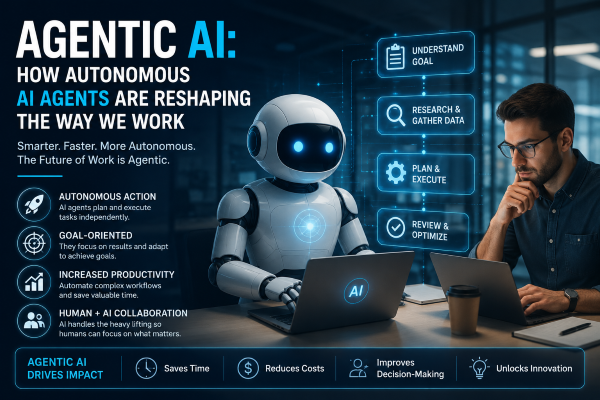
An agentic AI system, by contrast, is built around a reasoning-action loop. Given a goal — “refactor this codebase to remove a security vulnerability,” “research competitor pricing and build a comparison spreadsheet,” “book a flight that fits these constraints” — the system:
- Plans a sequence of steps to achieve the goal.
- Acts by invoking tools: running code, searching the web, calling an API, editing a file, sending a message.
- Observes the outcome of that action — did the code run without errors? Did the search return useful results?
- Reflects and adjusts its plan based on what it learned, correcting course if something failed.
- Repeats until the goal is judged complete, or until it determines it needs human input to proceed.
This loop is what separates “generative AI” from “agentic AI.” Generative AI produces content. Agentic AI produces outcomes, using generative capabilities as just one tool among many.
The Technology Stack Behind Agentic Systems
Building a system that can reliably operate with autonomy required advances across several layers of the AI stack, not just bigger models.
1. Tool Use and Function Calling
Modern LLMs can be given a list of “tools” — essentially APIs with descriptions — and trained to decide when and how to call them. A model might be given access to a code execution environment, a web search function, a calendar API, and a file system, and it learns to select the right tool for each sub-task, format the request correctly, and interpret the result. This capability, often called function calling or tool use, is the mechanical backbone of every agentic system.
2. Extended and Structured Reasoning
Complex, multi-step tasks require more than pattern completion; they require planning. Newer generations of models are trained or prompted to engage in explicit reasoning steps before acting — weighing options, anticipating failure points, and breaking a large goal into smaller, verifiable sub-goals. This “thinking before acting” behavior dramatically improves reliability on tasks that unfold over many steps, where a single early mistake can compound.
3. Memory and Context Management
Because agentic tasks can run for extended periods — sometimes hours — systems need ways to remember what they’ve already tried, what worked, and what the overall objective was, even as the amount of information involved grows far beyond what can fit in a single prompt. Techniques like retrieval-augmented memory, task checklists, and periodic summarization allow agents to stay coherent across long sessions without losing track of the original goal.
4. Sandboxed Execution Environments
Letting an AI system run code or interact with files is only safe if it happens somewhere contained. Agentic platforms typically execute actions inside sandboxes — isolated virtual machines or containers — where the agent can read and write files, install packages, or run scripts without risking the host system. This containment is also what allows agents to “fail safely”: if a plan goes wrong, the damage is limited to a disposable environment.
5. Orchestration and Multi-Agent Coordination
Some of the most capable systems don’t rely on a single model doing everything. Instead, they use an orchestrator that breaks a large task into pieces and assigns them to specialized sub-agents — one focused on research, another on writing code, another on reviewing output for errors — which then report back to a coordinating process. This mirrors how human teams divide labor, and it allows more of a task to happen in parallel.
From Chat to Action: A Timeline of the Shift
It’s worth briefly tracing how quickly this transition happened, because the pace itself is part of the story.
- 2020–2022: Large language models demonstrated impressive text generation, but interaction was almost entirely single-turn or simple back-and-forth conversation. Any “tool use” was bespoke and fragile.
- 2023: Function calling became a standard capability in major model APIs, enabling developers to connect models to external systems in a structured way. Early experimental agent frameworks appeared, capable of chaining a handful of actions together but prone to getting stuck in loops or losing track of their goal.
- 2024: Coding-focused agents matured rapidly, able to read a codebase, make multi-file changes, run tests, and fix their own errors — a task that requires sustained, accurate multi-step reasoning. This became one of the clearest proof points that agentic AI could handle real, economically valuable work.
- 2025: Agentic capability broadened beyond coding into general “computer use” — models that could operate a desktop environment, click through interfaces, fill out forms, and complete workflows that previously required a human at the keyboard. Enterprises began deploying agents for internal research, customer support triage, and data analysis at scale.
- 2026: Agentic systems are increasingly embedded directly into everyday professional tools — spreadsheets, presentation software, email clients, and browsers — rather than existing only as standalone chat interfaces. The conversation has shifted from “can AI do this task” to “how much of this workflow should be delegated, and how do we supervise it responsibly.”
Where Agentic AI Is Already Making an Impact
Software Development
Coding was the first domain where agentic AI proved genuinely transformative, and it remains the deepest use case. Developers now routinely delegate entire tasks — not just autocomplete suggestions — to AI agents: “add a new feature end-to-end,” “find and fix the bug causing this test to fail,” “migrate this module to the new API.” The agent reads the relevant files, writes the code, runs the test suite, interprets failures, and iterates, often completing in minutes work that would take a human engineer much longer.
This hasn’t eliminated the need for skilled engineers; if anything, it has raised the value of engineers who are good at specifying problems clearly, reviewing AI-generated code critically, and architecting systems that AI agents can work within safely.
Read Also: tech path america
Business Research and Analysis
Agentic systems can now conduct multi-step research projects: gathering information from dozens of sources, cross-referencing claims, organizing findings into a structured report, and flagging areas of uncertainty. What once required a research analyst to spend a day pulling together market data can be compressed into a focused session, with the human reviewing and refining the output rather than assembling it from scratch.
Customer Operations
Customer service has moved beyond scripted chatbots toward agents that can actually resolve issues — checking an order status, issuing a refund within policy limits, updating account details, or escalating to a human when a situation falls outside their authority. The key advance isn’t just better conversation; it’s the ability to take the actions needed to close the loop on a request.
Personal Productivity
On the individual level, agentic assistants are beginning to handle tasks like organizing a cluttered inbox, drafting and scheduling a series of communications, reconciling a personal budget from bank statements, or planning a multi-city trip with real-time price and availability checks — work that involves multiple steps and multiple tools, not a single lookup.
Scientific and Technical Work
In research settings, agentic systems are being used to run computational experiments, analyze large datasets, and even generate and test hypotheses within constrained domains, with human scientists reviewing results and guiding direction. While still early, this represents a meaningful acceleration in fields where iteration speed is a bottleneck.
The Case for Agentic AI: Why It Matters
The appeal of agentic AI comes down to a simple economic idea: it converts intention into outcome with less human effort in between. A manager who used to need to specify each individual step of a task can instead specify the goal and the constraints, and let the system figure out the path. This has a few significant implications.
It compresses the distance between idea and execution: A person with a good idea but limited technical skill — say, a small business owner who wants a booking system on their website — can describe the outcome they want and have an agent build a working version, rather than needing to hire a developer or learn to code themselves.
It changes what “productivity” means for knowledge workers: Much of white-collar work involves tasks that are conceptually simple but mechanically tedious: formatting a report, reconciling data across systems, drafting routine correspondence. Agentic AI is particularly well suited to exactly this category of work, freeing human attention for judgment calls, relationship-building, and strategic thinking that still require a human perspective.
It enables continuous operation: Unlike a human employee, an agent doesn’t need to sleep, and multiple agent instances can run in parallel. A single person can, in principle, supervise several ongoing agentic workflows simultaneously — reviewing outputs and giving new direction rather than performing every task personally.
The Risks, Limits, and Open Problems
None of this comes without serious caveats, and the industry has been candid that agentic AI is not yet a solved problem.
Reliability and Error Compounding
Because agentic systems act across many steps, small mistakes can compound. An agent that misinterprets an instruction early in a task may build an entire multi-step plan on that flawed premise, producing a confidently wrong result rather than a single bad response. This makes verification — checking not just the final output but the reasoning path that produced it — an essential discipline for anyone relying on agentic systems for consequential work.
Autonomy Versus Oversight
There’s an inherent tension between the value of autonomy (less human effort required) and the value of oversight (catching mistakes before they matter). Different tasks warrant different points on this spectrum. Booking a reasonably-priced flight within clear constraints might be safe to fully delegate; making an irreversible financial transaction or sending an external communication on someone’s behalf usually shouldn’t be. Most serious agentic platforms now build in checkpoints — moments where the agent pauses and asks for explicit confirmation before taking an action that sends, deletes, or spends something, and it’s consequential.
Security
An agent that can browse the web, execute code, and access files is also a system with a much larger attack surface than a simple chatbot. If an agent processes content from an untrusted source — a webpage, a document, an email — and that content contains hidden instructions designed to manipulate the agent (a technique known as prompt injection), the agent could be tricked into taking harmful actions, such as leaking private data or making unauthorized changes. Defending against this is an active area of research, and it’s a major reason why sandboxing, permission scoping, and human confirmation for sensitive actions remain standard practice.
Job Displacement and the Changing Nature of Work
It would be dishonest to discuss agentic AI without acknowledging the labor question directly. When software can complete tasks that used to require a trained professional, some roles inevitably shrink or change shape. Historically, technological shifts of this kind have both eliminated certain jobs and created new categories of work — often centered on building, supervising, and improving the new technology itself. What’s genuinely different this time is the breadth of tasks affected simultaneously, spanning entry-level and skilled knowledge work alike, and the speed at which capability is advancing.
Economists and policymakers are actively debating the scale and timeline of this transition, and reasonable people disagree about how disruptive it will ultimately be. What’s less contested is that the skills most likely to remain valuable are those centered on judgment, taste, accountability, and the ability to specify and evaluate work — rather than the mechanical execution of well-defined tasks.
Accountability
When an autonomous system takes an action with real-world consequences, who is responsible if something goes wrong — the person who deployed the agent, the company that built the underlying model, or the platform that provided the tools it used? This is not just a philosophical question; it has concrete legal and regulatory implications that are still being worked out across different jurisdictions, and the answer likely varies by context and degree of human oversight involved.
Designing for Safe Autonomy
Given these risks, the organizations building and deploying agentic AI have converged on a few recurring design principles:
- Scoped permissions: An agent should only have access to the specific tools and data it needs for its task, not blanket access to everything, limiting the damage any single mistake or manipulation can cause.
- Reversibility by default: Wherever possible, agent actions should be easy to undo, and irreversible actions (sending money, deleting data, publishing content publicly) should require explicit human sign-off.
- Transparent reasoning: Systems that show their work — the plan they formed, the steps they took, why they made a particular choice — are far easier for a human to audit and trust than ones that simply present a final answer.
- Graceful failure and escalation: A well-designed agent should recognize when it’s stuck or uncertain and hand control back to a human, rather than pressing forward with a low-confidence guess.
- Continuous evaluation: Because agentic tasks are open-ended, organizations are investing in systematic testing — running agents against realistic scenarios and measuring success rates — rather than assuming a system that worked once will keep working reliably as tasks and environments change.
What Comes Next
Several trends are likely to define the next phase of agentic AI.
Deeper integration into existing software, rather than standalone chat: Instead of opening a separate AI application, people will increasingly interact with agentic capability embedded directly inside the tools they already use — spreadsheets that can build their own models, browsers that can complete a purchase on request, presentation software that can restructure a deck based on a spoken note.
Longer time horizons: Early agentic systems typically operated over minutes; the frontier is shifting toward tasks that unfold over hours or days, with agents checking in periodically, handling interruptions, and picking up context after a pause — much closer to how a human employee manages an ongoing project.
Better collaboration between multiple agents, and between agents and humans: As more of the economy involves agents interacting with other agents — one company’s purchasing agent negotiating with another’s sales agent, for instance — new protocols and norms will be needed for how these interactions happen safely and verifiably.
More rigorous evaluation standards: As agentic systems take on higher-stakes work, the bar for demonstrating reliability before deployment is rising, with growing interest in independent testing, standardized benchmarks for real-world task completion, and clearer documentation of a system’s known limitations.
Regulatory attention: Governments in multiple regions are beginning to examine how existing rules around liability, data protection, and consumer protection apply to autonomous AI systems, and new rules specific to agentic deployments are likely as the technology becomes more embedded in critical processes.
Conclusion
Agentic AI represents a genuine inflection point in how software relates to human effort. It moves AI from a tool you consult to a collaborator you delegate to — one capable of independently pursuing a goal across many steps, using real tools, and adapting as it goes. The productivity upside is substantial and already visible in fields like software development, research, and business operations. But that same autonomy raises the stakes on reliability, security, and accountability in ways that simple chatbots never did.
The organizations and individuals who benefit most from this shift will likely be those who treat agentic AI neither with blind trust nor reflexive suspicion, but with the same discipline applied to any powerful new capability: understand what it does well, build in the right checks for what it doesn’t, and stay actively engaged in reviewing its work rather than assuming autonomy means the human’s job is done. The technology is moving fast, but the fundamentals of good judgment — knowing what to delegate, what to verify, and what to keep firmly in human hands — matter more than ever.
Read Also: golden tech consulting
Frequently Asked Questions
Is agentic AI the same thing as AGI (artificial general intelligence)?
No. Agentic AI refers to systems that can plan and take multi-step actions toward a goal using existing tools, within a defined scope. AGI is a much broader, more speculative concept referring to a system with human-level (or beyond) general intelligence across essentially any domain.
Do I need to be technical to use an agentic AI tool?
Increasingly, no. Many agentic products are designed so that a person can describe a goal in plain language — “organize my project files by client” or “draft replies to these emails” — without writing any code.
Can agentic AI be trusted with sensitive tasks, like financial transactions?
It depends heavily on the specific system, how it’s configured, and the safeguards in place. Reputable platforms build in confirmation steps for anything irreversible or high-stakes, and best practice is to keep a human explicitly in the loop for financial, legal, or otherwise consequential actions, even as the AI handles the preparatory work.
What skills become more valuable as agentic AI spreads?
Skills centered on framing problems clearly, evaluating output critically, exercising judgment in ambiguous situations, and taking accountability for outcomes tend to hold their value well, since these are precisely the things agentic systems still depend on humans to provide.
Will agentic AI replace most jobs?
This is genuinely contested, and reasonable experts land in different places. What seems clearer is that many jobs will change in composition — with more time spent specifying, reviewing, and directing work, and less spent on the mechanical execution of routine tasks — even in cases where the number of people employed in a given role doesn’t necessarily shrink.
