

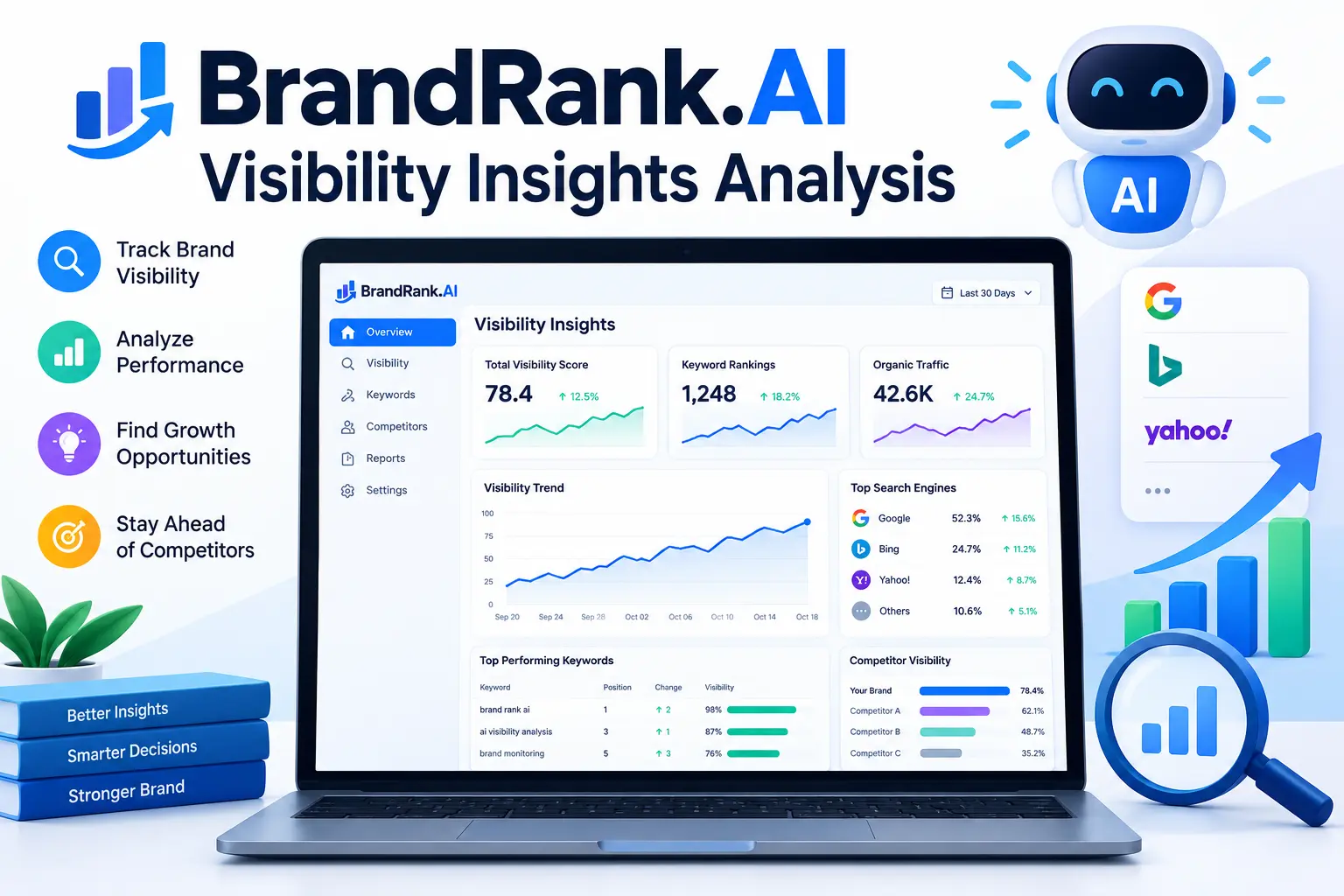
Introduction: Why AI Search Visibility Has Become a Board-Level Question
For twenty years, brand visibility online meant one thing: ranking on a page of blue links. If your page appeared in the first few results, you were found. If it did not, you were invisible. Marketing teams built entire departments around that reality, and an entire industry of tools grew up to measure it.
That model is now being rewritten. When a shopper asks ChatGPT which running shoe suits flat feet, when a procurement manager asks Gemini to shortlist payroll vendors, or when a patient asks Perplexity to compare two treatment options, there is often no page of links to scan. There is a single synthesized answer. Some brands are named in that answer. Some are described accurately, others inaccurately, and many are not mentioned at all.
This shift is the reason a new category of software has emerged, and it is the context in which brandrank.ai visibility insights analysis has attracted attention from enterprise marketers. The platform is built to show brands how they appear inside AI-generated answers, how those answers describe them, and what to do about the gaps.
This article is a detailed, people-first look at that proposition. It covers what the company says it does, how its approach to AI search visibility is structured, how to interpret the data a platform like this produces, where the approach is strong, where buyers should ask harder questions, and how to turn any brand visibility analysis into concrete work. It also covers the practical side of improving how AI systems represent you, which matters whether or not you ever buy a tool.
A note on method: the facts about the company come from public sources such as funding announcements, a launch press release and business-database profiles, all listed at the end. Where a detail could not be verified publicly, such as pricing, this article says so rather than guessing. Anything described as advice or interpretation is analysis, not a claim made by the company.
Key Takeaways
- BrandRank.AI is an enterprise-oriented SaaS platform: that tracks how brands appear in AI-generated answers across major answer engines, according to public company profiles and press coverage.
- Its framework rests on three measurable dimensions: AI search visibility, brand vulnerability and content readiness. Together they cover whether you are mentioned, whether you are described correctly, and whether your content is ready to be used as a source.
- The most distinctive angle is defensive: Many AI visibility tracking tools focus on counting mentions. BrandRank.AI frames visibility as a trust and reputation problem as well, with a monitoring layer for misrepresentation.
- Raw mention counts are not enough: The most useful BrandRank.AI visibility insights analysis are the ones that connect a visibility gap to a specific cause, such as a missing source, an outdated claim or weak content structure.
- No tool replaces good fundamentals: Google’s guidance on helpful, reliable, people-first content applies just as much to being cited by AI systems as it does to ranking in classic search.
- Buyers should verify details directly: Pricing, platform coverage and measurement methodology should be confirmed with the vendor before any purchase.
What Is BrandRank.AI? Company Background
BrandRank.AI is a software company based in Cincinnati, Ohio, that was founded in 2024. Its product is a software-as-a-service platform designed to help brands monitor and improve how they are represented in AI-powered search and answer engines. Business-database profiles describe it as measuring AI search visibility, evaluating content readiness, and monitoring brand reputation and vulnerability.
The founding team is drawn from brand and product leadership. Pete Blackshaw is listed as co-founder and chief executive officer, and Hank Hudepohl is listed as co-founder and chief operating officer, having previously held product leadership roles at TripAdvisor and Paycor. In the launch announcement, the company positioned itself as the first platform purpose-built to help brands measure brand health and trust across AI-driven search engines and large language models.
On the funding side, public reporting states that the company raised a seed round of about three million dollars, co-led by Grit Capital Partners and QCA Ventures. That same reporting says the platform runs daily tests on priority queries and serves enterprise clients, naming Nestlé, Procter & Gamble and Fifth Third Bank. Different data providers show slightly different funding totals and dates, which is common for early-stage companies, so treat any single figure as approximate.
The company describes the problem in large terms. Its leadership has argued that the brand marketing industry, which they size at about one trillion dollars, is being disrupted by AI search, and that most brands do not yet know how to measure the effect. Its COO has described the platform as a kind of GPS for brands in AI search, pointing marketers toward three metrics: visibility, vulnerability and content readiness.
It is worth noting what the company is not. Public profiles describe it as built for enterprise brands that need to defend reputation and visibility in AI answers. One third-party profile states it is not an obvious fit for startups building awareness from zero, small teams without a dedicated brand-monitoring budget, or companies that care primarily about traditional SEO. That honesty about fit is useful, and it shapes the rest of this analysis.
Why Visibility in AI Answers Is Different From Ranking in Search
To appreciate what brandrank.ai visibility insights analysis are trying to capture, it helps to understand why classic rank tracking cannot do the job.
Answers are generated, not retrieved
A traditional search engine retrieves documents and orders them. A large language model, by contrast, generates text. Even when it uses retrieval to pull in fresh sources, the final answer is composed, not listed. That means two users asking nearly identical questions can receive different wording, different brand lists and different emphasis.
This variability changes what “ranking” means. There is no fixed position number that applies to everyone. Instead, a brand has a likelihood of being mentioned, a typical position within the answer when it is mentioned, and a typical tone. Measuring those requires running many prompts repeatedly and aggregating the results, which is precisely why tools in this category describe daily or recurring testing rather than one-off checks.
Each platform behaves differently
The company’s COO has made the point publicly that each AI platform operates differently, weighting sources, prioritizing freshness and judging content authority in distinct ways. In practice this means a brand can be well represented in one assistant and nearly absent in another. A single blended score can hide that. Good brand visibility analysis therefore needs a per-platform breakdown as well as an overall view.
Visibility is not the same as favorability
In classic search, appearing in the top results was broadly positive. In AI answers, being mentioned is only the first question. The next questions matter just as much. Is the description accurate? Is it current? Is the brand recommended, merely listed, or mentioned as a cautionary example? Is it framed in terms that match how the brand wants to be understood? A brand that is mentioned often but described wrongly may be worse off than one that is mentioned rarely but accurately.
This is the gap that the company’s framing tries to fill, and it is why its public materials talk about trust and brand health rather than only mention counts.
Discovery is moving upstream
AI assistants increasingly handle the early, comparative stage of buying decisions. A user who gets a shortlist from an assistant may never visit a comparison site or run a second search. If your brand is not on the shortlist, you may never learn that you lost the opportunity. Visibility tracking is the only way to see that invisible leakage.
How BrandRank.AI Visibility Insights Work: The Three-Metric Framework
According to the company’s launch materials and third-party profiles, the platform is organized around three core measures, supported by a defensive monitoring layer. Understanding each one is the foundation for reading any report the platform produces.
1. AI search visibility
AI search visibility is the headline measure. In the company’s description, it tracks brand presence across AI search engines using a range of prompts, brand signals and answer-engine interactions, and shows how often a brand appears in AI-generated answers and where it ranks against competitors.
In practical terms, a visibility measure of this kind usually rests on a set of prompts that reflect how real buyers ask questions. These might include category questions (“best project management software for small agencies”), comparison questions (“Brand A vs Brand B”), problem questions (“how do I reduce churn in a subscription business”) and brand-direct questions (“is Brand A reliable”). Each prompt is run against each platform on a schedule, and the answers are parsed for brand mentions, order, context and cited sources.
From this, several useful numbers can be derived:
- Mention rate: the share of tested prompts where your brand appears at all.
- Share of voice: your mentions as a proportion of all mentions in the category, including competitors.
- Average position: where your brand tends to appear in a list or narrative when it is mentioned.
- Platform spread: how your mention rate differs across assistants.
- Trend: how all of the above move over time, which matters more than any single snapshot.
The public materials say the platform processes billions of AI tokens each month and runs daily tests on priority queries. For a buyer, the question to ask is how prompts are chosen, how many are run, and how variability between runs is handled, because these design choices determine how trustworthy the resulting AI visibility score really is.
2. Brand vulnerability
Brand vulnerability is the part of the framework that most clearly sets the company’s narrative apart. According to public descriptions, this function identifies when brand claims are misrepresented or omitted and flags emerging risks, including hallucinated claims, tonal misalignment and broken value alignment in AI responses. One third-party profile dates the launch of this function to September 2025.
Why does this matter? Large language models can state wrong things with confidence. They can attribute a product feature you do not offer, quote an outdated price, describe a discontinued service as current, or blend your brand with a competitor’s. They can also adopt a tone that does not fit your positioning, such as describing a premium brand as cheap or a safety-focused brand as risky.
For regulated industries, or any brand whose reputation depends on accuracy, these errors are not cosmetic. A vulnerability layer turns a vague worry into a monitored list of specific issues, each tied to a prompt, a platform and, ideally, a source that appears to have caused the error.
The company also lists adversarial AI analysis among its capabilities. In general terms, adversarial testing means probing how a model responds when prompts are framed skeptically or negatively, for example by asking about complaints, controversies or reasons not to choose a brand. This is valuable because real users do ask these questions, and the answers shape perception.
3. Content readiness
Content readiness addresses the “what do I do about it” question. The company describes it as pinpointing gaps in top-ranking content across AI search results and suggesting improvements so that brand messaging is optimized for, and discoverable by, AI systems.
The underlying logic is sound. AI systems that use retrieval draw on pages they can find, parse and trust. If the sources an assistant cites about your category are mostly third-party reviews, forum threads or competitor pages, and your own pages are thin, unstructured or hard to extract facts from, your visibility will suffer regardless of how strong your products are.
A content readiness assessment typically looks at questions such as:
- Do you have clear, factual pages that answer the questions buyers actually ask?
- Are key facts (features, pricing structure, eligibility, specifications) stated plainly rather than buried in images or scripts?
- Are your claims supported by evidence and consistent across your own properties?
- Which third-party sources are being cited for your category, and are you present on them?
The value of BrandRank.AI visibility insights analysis in this area is the connection between the gap and the fix. A report that says “you are mentioned in 18 percent of prompts” is a diagnosis. A report that says “the assistant cites these five sources for this prompt, and your brand is absent from all of them” is a treatment plan.
Beyond the Core Metrics: Archetypes, Custom Prompts and Answer-Engine Monitoring
Business-database listings for the platform name several additional capabilities beyond the three headline metrics: brand archetypes, custom prompts, monitoring of answer engines, and what the company calls insights and analysis on key prompts.
Brand archetypes
Brand archetypes are a familiar concept in marketing, describing the character a brand projects, such as the caregiver, the explorer, the sage or the rebel. Applied to AI, the idea is to check whether the personality an assistant ascribes to your brand matches the one you intend. If you position yourself as an approachable innovator and AI answers consistently describe you as a conservative incumbent, that mismatch is itself an insight, and it may point to which sources are shaping the description.
The public materials do not detail how archetype scoring is calculated, so this is an area where buyers should request a demonstration and ask how the classification is validated.
Custom prompts
No standard prompt library can fully represent a specific business. Custom prompts let a team add the questions that matter to its own customers, such as product-specific comparisons, regional queries or objections that sales teams hear often. A good AI visibility tracking programme blends a broad core set of category prompts with a smaller set of highly specific, business-critical ones.
Monitoring answer engines continuously
AI answers change as models are updated, as retrieval sources change and as new content is published. Continuous monitoring is therefore essential. A visibility report from three months ago may describe a different reality from today’s. Recurring tests also let teams link changes in visibility to specific actions, such as publishing a new resource, correcting a factual error or earning a new third-party citation.
Platform Coverage: Why Breadth Matters
Public profiles say the platform tracks brands across a set of major AI platforms, with ChatGPT, Gemini, Claude, Perplexity, Grok and Meta AI consistently named, and some profiles adding DeepSeek, bringing the list to seven. Because coverage lists vary between sources, verify the current list directly with the vendor before making a decision.
Breadth matters for three reasons.
Audience fragmentation: Different audiences prefer different assistants. A B2B software buyer might lean on one tool, a consumer shopper on another, and a technical audience on a third. Tracking only one platform gives a partial picture.
Different source preferences: Because each system weights sources differently, the content that earns a citation in one may be ignored in another. Cross-platform data reveals which of your assets work broadly and which work narrowly.
Early warning: An error that appears first in a smaller assistant can spread as sources are reused. Monitoring across platforms can surface problems before they reach the largest audiences.
When evaluating any provider, ask whether results come from the consumer-facing interfaces that real people use or from programmatic access, since the two can behave differently. Some competing platforms advertise tracking of real front-end interfaces specifically, which is a reasonable question to put to every vendor in the category.
How to Read a Visibility Insights Report: An Analysis Framework
Data without interpretation is just decoration. Here is a practical framework for reading BrandRank.AI visibility insights, or the output of any comparable platform, in a way that leads to decisions.
Step 1: Check the denominator
Before looking at any percentage, understand what it is a percentage of. How many prompts were tested? How were they selected? How many times was each run? A mention rate of 40 percent across 20 hand-picked prompts is a very different claim from 40 percent across 500 prompts built from real customer language. Ask for the prompt list and review it as if you were a customer.
Step 2: Segment by intent
Separate prompts into the stages of the buying journey. Awareness prompts (“what is the best way to…”), consideration prompts (“compare X and Y”) and decision prompts (“is X worth it”) each tell a different story. It is common for a brand to be strong at the decision stage, where its name is already in the question, and weak at the awareness stage, where the assistant must volunteer it. The awareness gap is usually where the largest opportunity lies.
Step 3: Compare against the right competitors
Share of voice only means something relative to a defined set. Include the competitors your sales team actually loses deals to, not only the ones the marketing team likes to benchmark against. Also look for unexpected entrants, such as publishers, marketplaces or review sites that are crowding brands out of answers entirely.
Step 4: Read the sources, not only the mentions
Source attribution is often the most actionable part of the report. If an assistant repeatedly cites the same handful of pages for your category, those pages are your real competitors for influence. Work out whether you can appear on them, improve them, or create something better that deserves to be cited.
Step 5: Triage vulnerabilities by severity
Not every inaccuracy is equally damaging. A suggested triage might look like this:
- Critical: factual errors about safety, legal status, pricing commitments, or compliance.
- High: wrong product capabilities, outdated offerings, or confusion with another brand.
- Medium: tonal mismatch or missing differentiators.
- Low: minor wording differences that do not change meaning.
Fix critical items first, and document each one with the prompt, platform, date and the suspected source.
Step 6: Look at trends and consistency
A single week’s number can swing for reasons unrelated to your actions. Look at several weeks, and pay attention to consistency: does the assistant describe you the same way across repeated runs, or does the description change? Inconsistent descriptions often indicate that the underlying evidence about your brand is thin or contradictory.
Step 7: Turn findings into a prioritized backlog
Every insight should end in an owner, an action and a date. Otherwise the report becomes a monthly ritual that changes nothing. The next section describes how to build that backlog.
Turning Visibility Insights Into Action
The real test of any brand visibility analysis is what changes afterward. Here is an eight-step workflow that works whether you use BrandRank.AI, another platform, or a manual process.
1. Establish a baseline
Run the full prompt set across all target platforms and record the starting position: mention rate, share of voice, sentiment, accuracy issues and cited sources. This is the benchmark against which all later effort will be judged.
2. Fix factual foundations first
Start with errors. Make sure your own website states the essential facts about your company clearly and consistently: what you offer, who it is for, where you operate, how you are different, and how to contact you. Update outdated pages, remove contradictions between pages, and ensure that official profiles on major directories and knowledge sources match.
3. Build answer-ready content
Create content that directly answers the questions in your prompt set. Use clear headings, concise definitions, comparison tables where appropriate, and plain-language explanations. Lead with the answer, then add depth. This helps human readers and also makes it easier for systems to extract accurate information.
4. Strengthen evidence
Assistants and search engines alike favor claims that are backed up. Add original data, case studies, named expert authors, citations to primary sources and transparent methodology. Content that demonstrates first-hand experience is both more useful to people and more likely to be treated as authoritative.
5. Earn presence on the sources AI already trusts
If your visibility report shows that assistants repeatedly cite certain industry publications, review platforms or reference sites, work out how to be legitimately present there. That may mean contributing expert commentary, supplying accurate product information to reviewers, or earning coverage through genuinely newsworthy work. Avoid paid schemes that try to manufacture mentions, which can backfire.
6. Address tone and positioning
If the vulnerability analysis shows tonal mismatch, trace it to its source. Often the cause is a body of older third-party content that frames the brand in a way you have outgrown. The fix is to publish and promote fresher, well-evidenced material that reflects your current positioning, and to ask reputable sources to update outdated descriptions.
7. Re-test and compare
After changes go live, wait long enough for them to be crawled and, where relevant, picked up by retrieval systems, then re-run the prompt set. Compare against the baseline. Record what moved and what did not.
8. Institutionalize the loop
Set a regular cadence, such as a monthly review with marketing, communications, product and legal in the room. Treat AI representation as a shared responsibility rather than a marketing side project.
Use Cases: How Different Teams Can Use BrandRank.AI Visibility Insights
AI representation touches more than one department. The following scenarios show how the same data can serve different goals.
Brand and marketing teams
Marketing leaders can use AI search visibility data to set goals the way they once set share-of-search or share-of-voice goals. Typical questions include: Are we named when buyers ask for recommendations in our category? Which competitors appear alongside us? Which messages are assistants repeating? The answers inform content planning, campaign messaging and budget allocation between channels.
Communications and reputation teams
For communications teams, the vulnerability dimension is the most relevant. They can use it to spot misstatements early, document them, and decide whether to correct the underlying sources, publish clarifying statements, or escalate to platform feedback channels. Having dated evidence of what an assistant said, and when, is also helpful in internal reporting.
SEO and content teams
Search teams are natural owners of generative engine optimization (GEO) work. Content readiness findings help them prioritize which pages to rewrite, which questions need new pages, and where structured, factual formatting would make content easier to cite. Many of the best practices overlap with classic SEO, so the work extends existing skills rather than replacing them.
Product and sales teams
Product marketers can check whether assistants describe features, integrations and limitations correctly. Sales teams can use the objection-style prompts to learn what prospects may already have heard before the first call, and to prepare accurate responses.
Legal, compliance and risk teams
In regulated sectors such as finance, healthcare and insurance, an incorrect AI-generated statement about eligibility, safety or pricing can create real exposure. Monitoring those statements creates an audit trail and an early-warning channel, even though responsibility for a model’s output ultimately lies with the model provider.
Executives and boards
Senior leaders increasingly ask what AI says about their company. A concise dashboard that shows visibility, accuracy and competitive position gives them a defensible, evidence-based answer, in place of anecdotes from someone who tried one prompt on one afternoon.
Who Is BrandRank.AI Best Suited For?
Based on public descriptions, the platform is designed for enterprise brands that are defending reputation and visibility in AI-generated answers. The named client examples in press coverage, including large consumer goods and financial services companies, fit that profile. Signals that you may be a good fit include:
- You operate in a competitive category where buyers frequently use AI assistants for research.
- Your brand has a large footprint of third-party content that AI systems may draw on.
- Accuracy and reputation matter enough that misstatements carry real cost.
- You have a team able to act on findings, across content, communications and product.
- You need governance-style reporting for executives or risk committees.
It is a less natural fit if you are a very early-stage startup with little public footprint, a small team with limited monitoring budget, or a business whose growth depends almost entirely on traditional search rankings. In those cases, a lightweight tool, a manual prompt-testing routine, or a focus on fundamentals may deliver better returns for the money.
The Competitive Landscape: How BrandRank.AI Fits Among AI Visibility Tools
The market for AI visibility software is young and crowded. Names that appear in public comparisons include Profound, Scrunch AI, Peec AI, Otterly.AI, Brandlight, Azoma, Visably and a range of newer entrants. Large SEO suites and marketing platforms have also begun adding answer-engine features to existing products.
Most of these products share a core idea: run prompts across assistants, record which brands appear, and report trends. Where they differ is in emphasis.
- Volume and breadth: some tools prioritize large prompt volumes, many regions and many platforms, aimed at agencies and performance marketers.
- Analytics depth: others focus on dashboards for position, share of voice and citation gaps.
- Workflow and action plans: some add AI agents or recommendations that turn findings into tasks.
- Trust and governance: a smaller group, which includes BrandRank.AI according to public profiles, emphasizes accuracy, reputation and brand safety alongside visibility.
Public commentary describes the company’s edge as its brand vulnerability function, a monitoring layer that flags hallucinated claims, tonal misalignment and broken value alignment. Press coverage also notes that it positions itself on trust scoring and strategic depth rather than on funding size or the sheer breadth of platform coverage.
How to compare vendors fairly:
- Define your job to be done: Is the priority share of voice, accuracy protection, content guidance, or all three?
- Run the same pilot with each vendor: Use an identical prompt set and time window, then compare the quality of insights, not only the number of charts.
- Inspect methodology: Ask how prompts are generated, how often they run, how answer variability is handled and how mentions are detected.
- Evaluate actionability: Does the platform tell you why you are absent and what to do, or only that you are absent?
- Check integrations and exports: Can data flow into your analytics stack and reporting tools?
- Review support and services: Some vendors combine software with consultative guidance, which may matter if your team is new to this discipline.
Because this is a fast-moving category, any comparison goes out of date quickly. Treat published rankings, including this article, as a starting point and verify current capabilities during a live demo.
Strengths and Limitations: A Balanced Assessment
An honest analysis names both sides. The following reflects what can be said from public information, not from hands-on testing of the product.
Apparent strengths
- A clear conceptual framework: Visibility, vulnerability and content readiness is an easy model to explain to executives, and it maps to three different questions: Are we found? Are we right? Are we ready?
- A defensive, trust-centered angle: Treating AI representation as a reputation and governance matter, not only a marketing metric, is a differentiated and arguably overdue perspective.
- Enterprise credibility: Named enterprise customers and institutional seed investors, as reported publicly, suggest the product has been taken seriously by large organizations.
- Experienced founders: Leadership with backgrounds in brand marketing and consumer-facing product strategy brings relevant domain knowledge.
- Continuous monitoring: Daily testing of priority queries aligns with how quickly AI answers can change.
Open questions and limitations
- Limited independent reviews: At the time of writing, one profile notes there are no independent user reviews on major software-evaluation platforms. That is normal for a young product but means buyers must rely on demos and references.
- Pricing is not widely published: Public pricing details were not easy to find. Request a written quote and clarify what is included.
- Enterprise focus: The same positioning that suits large brands may make the product less accessible to smaller teams.
- Inherent measurement noise: No platform can eliminate the variability of AI outputs. Any visibility score is an estimate based on sampling, and buyers should ask how confidence is expressed.
- Causation is hard: Even a strong platform can only suggest why a brand is or is not mentioned. Models are not fully transparent, so recommendations are informed hypotheses, not guarantees.
- A rapidly changing market: Features, coverage and competitors are all evolving, so any assessment has a short shelf life.
Questions to Ask Before You Buy
Use this checklist in demos and procurement conversations with BrandRank.AI or any competing vendor.
- How do you build and maintain the prompt set, and can we review and edit it?
- How many times is each prompt run per platform, and how do you handle differences between runs?
- Do results come from consumer-facing interfaces, programmatic access, or both?
- Which platforms and regions are covered today, and what is on the roadmap?
- How is the AI visibility score calculated, and what exactly does it include?
- How does the vulnerability function detect errors, and how are false positives handled?
- Can you show a real example where an insight led to a measurable improvement?
- What data can we export, and can we connect it to our analytics and reporting tools?
- What is the pricing structure, contract length and renewal policy?
- How is our data stored, who can access it, and how is it used?
- What onboarding and strategic support is included?
- Can we speak with a customer in a similar industry?
Best Practices for Improving AI Search Visibility (Aligned With Google’s Guidance)
A common mistake is to treat AI visibility as a trick to be gamed. The more durable approach is to build the kind of content and reputation that both people and systems have good reason to trust. Google’s published guidance on creating helpful, reliable, people-first content is a useful compass here, and its principles carry over directly.
Create content for people first
Google’s guidance asks creators to focus on content made to help people, not to manipulate rankings. Ask whether a page would still be worth reading if search and AI systems did not exist. If the honest answer is no, optimization will not rescue it.
Demonstrate experience, expertise, authoritativeness and trust
The E-E-A-T framework, which stands for experience, expertise, authoritativeness and trustworthiness, is a lens for evaluating quality. In practice:
- Show who wrote the content and why they are qualified.
- Include first-hand experience, original photos, data or testing where relevant.
- Cite reputable primary sources and link to them.
- Keep pages current and show when they were last updated.
- Make contact details, policies and company information easy to find.
Trust is the most important element, and accuracy is its foundation, which is exactly why vulnerability monitoring is a sensible complement to content work.
Write answer-first, well-structured pages
Use descriptive headings, short paragraphs, and plain language. State the direct answer early. Use lists and tables where they genuinely help comprehension. Clear structure benefits readers and makes information easier for machines to extract.
Keep technical foundations healthy
Pages that cannot be crawled, rendered or indexed cannot be used as sources. Confirm that important pages are accessible, load quickly, work on mobile, and are not accidentally blocked. Use clear internal linking and descriptive titles and meta descriptions. Where appropriate, use structured data that accurately reflects visible page content. Do not use markup to describe things users cannot see.
Avoid manipulative tactics
Google’s spam policies warn against practices such as keyword stuffing, scaled content abuse, and creating content mainly to manipulate rankings. Mass-producing thin AI-generated pages to flood a topic is risky in classic search and unlikely to build the kind of authority that assistants trust. Using automation to help produce content is acceptable when the result is original, accurate and genuinely helpful. Using it as a shortcut to publish unreviewed volume is not.
Be consistent everywhere
AI systems synthesize information from many places. Inconsistent facts between your website, social profiles, directories and press materials create room for confusion. A single source of truth for key brand facts, shared across teams, reduces contradictions.
Earn genuine third-party validation
Reviews, analyst coverage, academic references, industry awards and expert commentary all act as independent evidence. Earn them through quality and relationships. Do not buy or fake them.
Update, then prove you updated
Freshness can matter, particularly for questions where facts change. Revise important pages when information changes, note the update date honestly, and avoid cosmetic date changes that do not reflect real revisions.
How to Measure the Return on AI Visibility Work
Executives will ask whether the effort pays off. Measurement is still imperfect, but several approaches help.
Track leading indicators: Mention rate, share of voice, average position, accuracy rate and citation counts are leading indicators. They show whether your representation is improving.
Watch downstream signals: Look for changes in branded search volume, direct traffic, referral traffic from AI platforms where it is reported, demo requests, and the share of new leads who say they found you through an AI assistant. Add a field to forms or sales calls asking how prospects first heard of you, including AI tools.
Compare against a control: Where possible, compare prompt categories where you took action against categories where you did not. This helps separate your effect from market-wide shifts.
Quantify risk reduction: For vulnerability work, track the number of critical inaccuracies found, the time taken to resolve them, and how often they recur. Avoided harm is hard to price, but a trend line showing fewer severe errors is a credible indicator of value.
Be honest about uncertainty: Attribution in this area is noisy. Report ranges and trends instead of precise claims, and avoid promising results that the data cannot support.
Trends to Watch in AI Visibility and Brand Monitoring
Several developments are likely to shape this category in the coming years.
From visibility to recommendation quality: As more brands appear in answers, the competitive question shifts from being mentioned to being recommended, and from being recommended to being recommended for the right reasons.
Agentic commerce: Assistants are increasingly able to take actions, such as comparing options and completing tasks, on behalf of users. That raises the stakes of accurate product data and trustworthy signals.
Governance and standards: As AI answers influence decisions, expect more organizational policies about monitoring, documentation and escalation, plus growing expectations from regulators and boards.
Consolidation: With many vendors and large incumbents adding similar features, some consolidation is likely. Buyers should consider vendor stability and data portability.
Better measurement: Expect progress in methods for handling answer variability, personalization and multimodal answers, so that scores become more reliable.
Convergence of SEO and GEO: The distinction between classic SEO and answer engine optimization (AEO) will likely blur. The shared foundation of helpful, accurate, well-structured content is what will endure.
Frequently Asked Questions
What are BrandRank.AI visibility insights?
BrandRank.AI visibility insights are the findings produced by the company’s platform about how a brand appears in AI-generated answers. They cover how often the brand is mentioned, how it compares with competitors, whether descriptions are accurate, and how well the brand’s content is prepared to be used as a source.
What is AI search visibility?
AI search visibility describes how often, and how prominently, a brand is mentioned or recommended in answers generated by AI assistants and answer engines. It is the AI-era counterpart of search ranking, though it is measured probabilistically rather than as a single fixed position.
How is AI visibility tracking different from SEO rank tracking?
SEO rank tracking records where a page appears in a list of search results. AI visibility tracking records whether and how a brand appears inside generated answers, which vary between runs and platforms. It therefore relies on repeated sampling, and it also looks at sentiment, accuracy and cited sources.
What is brand vulnerability in AI search?
Brand vulnerability refers to the risk that AI systems misrepresent, omit or mischaracterize a brand. Examples include hallucinated claims, outdated facts, confusion with other companies and tone that conflicts with the brand’s positioning.
What does content readiness mean?
Content readiness describes how well a brand’s content is prepared to be found, understood and cited by AI systems. It looks at gaps between your content and the content that currently earns citations, and suggests improvements.
Which AI platforms does BrandRank.AI monitor?
Public profiles consistently list ChatGPT, Gemini, Claude, Perplexity, Grok and Meta AI, with some adding DeepSeek. Confirm the current list with the vendor, since coverage may change.
Is BrandRank.AI suitable for small businesses?
Public descriptions position it for enterprise brands. Small businesses with limited budgets may find lighter tools or a manual prompt-testing routine more practical, and should focus first on accurate, helpful content.
How much does BrandRank.AI cost?
Pricing was not clearly published in the sources reviewed for this article. Request a quote from the company and ask what is included.
Can any tool guarantee my brand will appear in AI answers?
No. AI answers are generated and variable, and no vendor controls them. Tools can measure and guide, but results depend on content quality, authority, and factors outside anyone’s direct control. Be cautious about any guarantee.
How often should I review my AI visibility?
Many teams review weekly dashboards for alerts and hold a deeper monthly review. High-risk or fast-changing categories may justify more frequent attention to vulnerability findings.
Does optimizing for AI hurt my Google rankings?
Not when the work consists of making content more helpful, accurate and clear. Those qualities align with Google’s own guidance. Problems arise only when tactics are manipulative, such as keyword stuffing or mass-produced low-value pages.
Conclusion: Making Visibility Insights Count
AI assistants have become a new front door to brands, and many companies are only beginning to look at who is standing there and what is being said. A platform like BrandRank.AI addresses that blind spot with a structured view: whether you are visible, whether you are represented accurately, and whether your content is ready to be used.
The lasting value of brandrank.ai visibility insights analysis, or of any comparable brand visibility analysis, will not come from the dashboard itself. It will come from what teams do next: correcting errors, building clear and evidence-backed content, earning legitimate third-party validation, and re-testing to learn what works. Those are the same habits that Google’s guidance rewards, and they are the habits that make a brand worth recommending to a person or a machine.
If you are evaluating tools, start with a clear goal, run a fair pilot, ask hard questions about methodology, and verify claims directly with vendors. If you are not ready to buy anything, begin by testing a few dozen realistic prompts yourself, recording what you see, and fixing the most important inaccuracies. Visibility in AI answers is earned the same way trust always has been: by being useful, accurate and consistent over time.
