

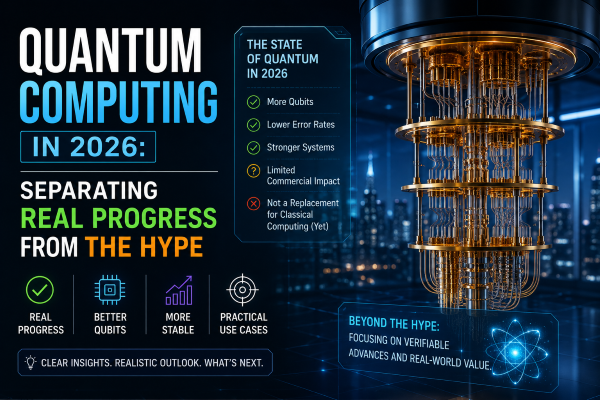
Introduction
Few technologies have been simultaneously as overhyped and as genuinely important as quantum computing. For years, headlines have promised a machine that will “break all encryption,” “cure diseases overnight,” or “make today’s supercomputers obsolete.” Meanwhile, the actual devices sitting in research labs are finicky, error-prone, and can only reliably solve a narrow set of problems — many of which have little practical value on their own.
Both of these things can be true at once. Quantum computing is not science fiction, and it is also not yet the world-altering force some coverage suggests. Understanding where the technology genuinely stands requires separating three things that get conflated constantly: theoretical potential, laboratory milestones, and practical, economically meaningful application. In this article, the team at Golden Tech Consulting walks through each of those layers — how quantum computers actually work, what real progress has been made, which industries are closest to seeing genuine benefit, and what the realistic timeline looks like from here.
The Basic Idea, Without the Jargon
Classical computers — everything from a phone to a data center server — process information as bits, each one strictly a 0 or a 1. Every calculation, no matter how complex, ultimately reduces to enormous numbers of simple operations on these bits.
Quantum computers use qubits instead. A qubit can exist in a state that is a combination of 0 and 1 simultaneously, a property called superposition. When multiple qubits are linked together through a phenomenon called entanglement, the system as a whole can represent and manipulate an enormous number of possible combinations at once, rather than working through them one at a time.
This doesn’t make quantum computers “faster” in the way a more powerful laptop is faster. For the vast majority of tasks — browsing the web, running a spreadsheet, even most scientific simulations — a quantum computer offers no advantage at all, and would in fact be far worse than an ordinary computer. Their potential value is narrow and specific: certain classes of problems, particularly those involving searching through vast possibility spaces or simulating quantum systems themselves, can in theory be solved dramatically faster on a quantum machine than on any classical computer, no matter how large.
The key word is theory. Turning that theoretical advantage into a working, reliable machine has proven to be one of the hardest engineering problems humanity has attempted.
Why Building One Is So Difficult
Qubits are extraordinarily fragile. Their quantum states can be disrupted by heat, vibration, electromagnetic interference, or even the act of being measured — a problem known as decoherence. Most current quantum processors must be cooled to temperatures colder than deep space, isolated from vibration, and shielded from stray electromagnetic fields, all just to keep qubits stable long enough to perform a calculation.
Even under these extreme conditions, qubits are noisy and error-prone. A useful quantum computation typically requires not just a handful of qubits, but many additional “helper” qubits dedicated purely to detecting and correcting errors introduced by that noise — a process called quantum error correction. Current estimates suggest that a single stable, error-corrected “logical qubit” might require anywhere from dozens to over a thousand noisy physical qubits, depending on the hardware approach and the target error rate. This is the central reason progress has felt slow relative to the pace of classical computing: adding more physical qubits is not the same as adding more usable computational power, if those qubits are too noisy to trust.
What “Quantum Supremacy” Actually Means
Periodically, a research lab announces that it has achieved “quantum supremacy” or “quantum advantage” — language that tends to generate enormous media attention. It’s worth being precise about what these claims typically mean, because it’s narrower than it sounds.
These milestones generally demonstrate that a quantum processor completed a specific, often deliberately obscure mathematical task faster than the best available classical supercomputer could. Crucially, the task itself is usually chosen because it’s a good showcase for quantum hardware, not because it’s useful. It proves the machine can, in principle, outperform classical computers at something — an important scientific and engineering milestone — but it does not mean the computer can now solve real-world problems like drug discovery or logistics optimization faster than existing methods. Those “supremacy” demonstrations are best understood as proof-of-concept experiments, roughly analogous to the Wright brothers’ first flight: a genuine breakthrough, and also nowhere near a commercial airliner.
Where the Technology Actually Stands Today
As of 2026, the field is best described as being in the “noisy intermediate-scale quantum” (NISQ) era — a term coined years ago that still describes the current state of the hardware reasonably well, even as the scale of devices has grown. Several major approaches to building qubits are being pursued in parallel, each with different tradeoffs:
- Superconducting qubits, cooled to near absolute zero, are the approach used by some of the largest and most publicized quantum processors. They benefit from being manufacturable with techniques adapted from the semiconductor industry, but they require substantial infrastructure to keep the necessary extreme cold stable.
- Trapped-ion qubits use individual charged atoms held in place by electromagnetic fields. They tend to have longer coherence times and lower error rates than superconducting qubits, though operations on them are often slower.
- Photonic qubits use particles of light, which have the advantage of being naturally resistant to some forms of environmental noise and can potentially operate at room temperature, though building the precise optical components needed at scale is its own significant challenge.
- Neutral-atom qubits use arrays of individual atoms manipulated with lasers, an approach that has shown promising scalability in recent demonstrations.
No single approach has yet established itself as the clear winner, and it’s plausible that different approaches will end up suited to different types of problems.
Industries Closest to Real Impact
Given the current state of the hardware, which fields are actually likely to see practical benefit first, and on what timeline?
Chemistry and Materials Science
Simulating molecules and chemical reactions is, in a sense, quantum computing’s home turf — the systems being simulated are themselves quantum mechanical, which is precisely the kind of problem classical computers handle inefficiently. Even relatively modest, noisy quantum processors have shown early promise in simulating specific molecular interactions relevant to catalysts, battery materials, and drug candidates, in some cases in collaboration with pharmaceutical and chemical companies exploring hybrid classical-quantum approaches. This is widely seen as one of the areas most likely to show clear commercial value before general-purpose quantum computing matures.
Cryptography
This is simultaneously one of the most consequential and most misunderstood areas. A sufficiently large, error-corrected quantum computer could, in theory, break the encryption schemes (like RSA and elliptic-curve cryptography) that currently secure much of the internet’s traffic, financial systems, and communications. However, this requires a scale of error-corrected quantum computing far beyond what exists today — most credible estimates put a cryptographically relevant quantum computer years away at minimum, and some experts believe it’s considerably further out than that.
The more immediate story is defensive: governments and standards bodies have already finalized new “post-quantum” encryption standards designed to resist future quantum attacks, and organizations handling long-lived sensitive data are beginning to migrate to these standards now, precisely because encrypted data intercepted today could theoretically be decrypted once sufficiently powerful quantum computers exist — a risk often referred to as “harvest now, decrypt later.”
Optimization Problems
Many industries — logistics, finance, manufacturing scheduling — involve searching for the best solution among an enormous number of possible combinations, such as the optimal delivery routes for a fleet of trucks. Quantum approaches to these problems have been tested by companies in aviation, automotive, and finance, generally in hybrid setups where a quantum processor handles part of the calculation and classical computers handle the rest. Results so far have been mixed and often haven’t yet outperformed the best classical optimization techniques, but the experimentation itself reflects real commercial interest rather than pure research curiosity.
Financial Modeling
Certain financial calculations, particularly those involving simulating a large number of possible future scenarios (Monte Carlo methods used in risk analysis and derivative pricing), have a mathematical structure that some researchers believe is well suited to quantum approaches. Several major financial institutions maintain dedicated quantum research teams exploring these use cases, though, as with optimization, practical advantage over classical methods has not yet been clearly demonstrated at scale.
Machine Learning
There’s active research into “quantum machine learning” — using quantum processors to accelerate parts of the training or inference process for AI models. This remains one of the more speculative areas; while there are theoretical arguments for potential speedups in specific narrow scenarios, it’s currently unclear whether quantum approaches will offer meaningful advantages over the rapid pace of improvement happening in classical AI hardware and algorithms.
The Role of Classical-Quantum Hybrid Systems
A common misconception is that quantum computers will eventually replace classical computers the way transistors replaced vacuum tubes. That’s not the direction the field is heading. Because quantum computers are useful only for specific types of calculations, the practical model emerging is a hybrid one: classical computers handle the vast majority of a workflow — data preparation, control logic, most of the computation — while a quantum processor is called on only for the narrow sub-task where it offers a genuine advantage, similar to how specialized graphics processors (GPUs) are used alongside general-purpose CPUs today rather than replacing them.
This hybrid framing also explains why cloud access to quantum hardware has become the dominant way most organizations interact with the technology. Rather than every company needing to build and maintain a quantum computer — an undertaking involving extreme cooling, vibration isolation, and specialized expertise — major cloud providers now offer quantum processing as a service, letting researchers and companies submit quantum computations for a specific sub-problem within an otherwise classical pipeline.
Realistic Expectations for the Next Several Years
Given everything above, what’s a grounded way to think about the coming years?
Error correction will continue to improve, but slowly and incrementally: Expect continued announcements of longer-lived logical qubits and larger error-corrected demonstrations, each representing genuine progress, without a single dramatic jump to a “universal, fault-tolerant” quantum computer capable of arbitrary large-scale computation. Most serious researchers in the field describe that milestone as being years away rather than around the corner, and timelines have shifted before.
Niche commercial value will arrive before general-purpose value: The most likely near-term outcome is quantum computers providing measurable advantage for a small number of well-matched problems — certain chemistry simulations, certain optimization tasks — used by specialized teams within research-intensive organizations, rather than quantum computing becoming a general tool that most businesses interact with directly.
Post-quantum cryptography migration will be a bigger near-term story than quantum computing itself: Because the defensive response to future quantum capability needs to happen well before that capability exists, expect continued regulatory and industry momentum around updating encryption standards, independent of how quickly the underlying quantum hardware improves.
Talent and investment will keep concentrating: Quantum computing remains a field requiring deep, specialized expertise across physics, materials science, and computer science, and the organizations able to attract and retain that talent — a mix of specialized startups, large technology companies, national research labs, and universities — will likely continue to pull ahead of the field more broadly.
How the Investment Landscape Is Shaping the Field.
The path from laboratory demonstration to practical technology rarely depends on physics alone — it also depends on who is willing to fund the years of expensive, uncertain engineering in between. Quantum computing has attracted a distinctive mix of funders, and that mix says something about how the field’s timeline is being shaped.
National governments have treated quantum research as a strategic priority comparable to early investments in semiconductors or space technology, funding large, long-horizon research programs on the view that leadership in quantum computing could carry both economic and national-security implications, particularly given the technology’s eventual relevance to cryptography. This kind of patient, mission-driven funding matters because quantum hardware research doesn’t follow the same short product cycles as most commercial software, and it can take many years of incremental engineering before a given approach proves out.
Large technology companies have taken a different but complementary approach, building dedicated quantum research divisions and offering cloud-based access to their hardware, partly to build scientific credibility and partly to seed a developer ecosystem for whenever the technology matures commercially. This mirrors, in some ways, the early cloud computing playbook: get infrastructure into the hands of developers and researchers well before mainstream demand exists, so that expertise and tooling are ready when it does.
A wave of specialized startups, meanwhile, has pursued a range of different qubit technologies and error-correction strategies, often betting on a single hardware approach and racing to demonstrate meaningful advantage before funding runs out. This diversity of approaches is generally healthy for the field — it’s still genuinely unclear which qubit technology will ultimately prove most scalable, and having multiple well-funded groups exploring different paths in parallel increases the odds that at least one approach reaches practical maturity in a reasonable timeframe.
Common Misconceptions Worth Retiring
“Quantum computers will make classical computers obsolete:” No — they’re suited to a narrow set of problems and will most likely coexist with, not replace, classical computing for the foreseeable future.
“Quantum computers are already breaking encryption:” No credible evidence supports this; the scale of error-corrected quantum computing required is far beyond current demonstrated capability.
“More qubits automatically means a better quantum computer:” Not necessarily — qubit quality (error rates, coherence time, connectivity between qubits) matters as much or more than raw qubit count, which is why comparing quantum processors by qubit number alone is misleading.
“Quantum computing will instantly solve climate change, cure cancer, etc:” These framings overstate both the timeline and the directness of the connection. Quantum computing may eventually accelerate specific pieces of research relevant to these problems — like simulating new materials or molecules — but it is one tool among many, not a standalone solution.
Conclusion
Quantum computing occupies an unusual place in the technology landscape: it is simultaneously one of the most scientifically important developments in progress today and one of the most persistently misrepresented in popular coverage. The honest picture is neither the breathless “quantum computers will change everything next year” narrative nor a dismissive “it’s all hype and nothing real is happening” take. Genuine, measurable progress is being made — in error correction, in qubit quality, in early hybrid applications — even as the timeline to broadly transformative, general-purpose quantum computing remains long and genuinely uncertain.
For businesses and researchers, the practical takeaway is to track the specific niches where quantum approaches show real promise for their domain, rather than waiting for a single dramatic breakthrough moment, or dismissing the technology because that moment hasn’t happened yet. For everyone else, the most concrete near-term impact is likely to be felt indirectly, through the migration to quantum-resistant encryption already underway — a reminder that in this field, the most important developments aren’t always the ones with the flashiest headlines.
At Golden Tech Consulting, we help organizations cut through exactly this kind of hype cycle — assessing which emerging technologies are worth acting on now, which are worth watching, and which are safe to set aside for the time being.
Frequently Asked Questions
How many qubits does a useful quantum computer need? There’s no single number, because it depends heavily on the problem and the error rate of the specific hardware. What matters more than raw qubit count is the number of stable, error-corrected “logical” qubits available, and today’s most advanced systems can only maintain a small number of those reliably.
Can I use quantum computing today for my business? Most major cloud providers offer access to quantum hardware as a service, so technically yes — but for the overwhelming majority of business problems, classical computing remains faster, cheaper, and more reliable. It only makes sense to explore quantum approaches today if you have a very specific problem (often in chemistry, materials science, or specialized optimization) where researchers have shown early promise.
Is my data at risk from quantum computers right now? Not from the computers themselves, since none currently in existence are powerful enough to break modern encryption. The relevant risk is that encrypted data intercepted and stored today could potentially be decrypted years from now once quantum computing matures, which is why organizations with long-lived sensitive data are encouraged to begin migrating to post-quantum encryption standards proactively.
Which country or company is “winning” the quantum computing race? Progress is happening across multiple countries and organizations simultaneously, using different hardware approaches, and no single entity has established a decisive, durable lead across all fronts. Given how early-stage the field remains, that competitive picture is likely to keep shifting for years to come.
