

If you have ever come across the term “B.Tech” while browsing college brochures, entrance exam websites, or job portals, you have probably wondered what it actually stands for and why it matters so much to millions of students in India and around the world. In this comprehensive guide, we break down the B.Tech full form, its meaning, eligibility criteria, course structure, specializations, top colleges, admission process, fees, salary prospects, and career scope — everything you need to make an informed decision about your engineering journey.
What Is the Full Form of B.Tech?
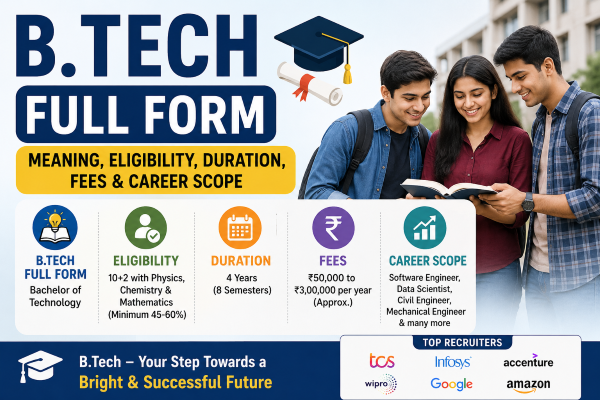
The full form of B.Tech is Bachelor of Technology. It is an undergraduate academic degree awarded to students who successfully complete a full-time engineering program, typically spanning four years, at a recognized university or technical institute. The degree is designed to provide students with strong theoretical foundations combined with practical, hands-on training across a wide range of engineering and technology disciplines.
In India, the B.Tech degree is generally awarded by premier institutions such as the Indian Institutes of Technology (IITs), National Institutes of Technology (NITs), Indian Institutes of Information Technology (IIITs), Government Funded Technical Institutes (GFTIs), other Centrally Funded Technical Institutes (CFTIs), and numerous private and deemed universities across the country. These institutions are recognized by the All India Council for Technical Education (AICTE), the regulatory body that oversees technical education standards in the country.
It is worth noting that the B.Tech degree is broadly equivalent to a Bachelor of Engineering (B.E.) offered by many affiliated engineering colleges under state universities, and it corresponds closely to a Bachelor of Science in Engineering or Bachelor of Engineering degree awarded in the United States and Europe. While the naming convention differs slightly from institution to institution, the core academic value and industry recognition of both degrees remain largely similar.
Understanding the Meaning of B.Tech Beyond the Acronym
While the literal expansion of B.Tech is straightforward, the real value of the degree lies in what it represents: a structured, industry-oriented academic pathway that molds students into competent engineers and technologists. Unlike purely theoretical degree programs, B.Tech courses place heavy emphasis on application-based learning. Students work through laboratory sessions, real-world projects, internships, and industrial training, all of which are designed to bridge the gap between classroom theory and on-the-job problem solving.
The degree is structured to nurture analytical thinking, technical proficiency, and innovation. Whether a student chooses to specialize in computer science, mechanical engineering, civil engineering, electronics, or an emerging field like artificial intelligence and data science, the underlying goal remains the same: to prepare graduates who can design, build, and manage technology-driven solutions across industries such as information technology, manufacturing, infrastructure, energy, healthcare, and telecommunications.
B.Tech Course Duration and Structure
A B.Tech program is typically a four-year, full-time undergraduate course, divided into eight semesters. Each academic year usually consists of two semesters, and each semester includes a combination of core subjects, elective courses, laboratory work, seminars, and practical assessments.
The course structure generally follows this broad pattern:
- First Year: Foundational subjects common to all engineering branches, including mathematics, physics, chemistry, basic electrical and electronics engineering, engineering mechanics, and introductory programming.
- Second Year: Branch-specific core subjects begin, along with a deeper focus on the fundamentals of the chosen specialization.
- Third Year: Advanced technical subjects, electives, minor projects, and often the first exposure to internships or industrial training.
- Fourth Year: Specialized electives, a major project or capstone thesis, and in many cases, a semester-long internship or industry placement that helps students transition smoothly into the workforce.
Some institutions, particularly those offering distance or part-time B.Tech programs, may extend the duration slightly, but the standard, full-time, on-campus B.Tech remains a four-year commitment.
Eligibility Criteria for B.Tech Admission
To be eligible for a B.Tech Full Form program in India, candidates typically need to fulfill the following requirements:
- Educational Qualification: Candidates must have completed their higher secondary education (10+2) from a recognized board, with Physics, Chemistry, and Mathematics (PCM) as mandatory subjects. Some institutions have relaxed the compulsory nature of Chemistry in recent years, allowing students with Computer Science or Biology as an additional subject to apply for select branches.
- Minimum Marks Requirement: Most institutions, including the IITs and NITs, require candidates to secure a minimum aggregate score in their 12th-grade examinations — commonly around 75% for general category students, with relaxed criteria for reserved categories.
- Entrance Examination: Admission to most reputed B.Tech programs is based on performance in national, state-level, or university-level entrance examinations rather than 12th-grade marks alone.
Popular B.Tech Entrance Exams
- JEE Main (Joint Entrance Examination – Main): The most widely recognized national-level exam, used for admission to NITs, IIITs, and other centrally funded technical institutions, and as a qualifying exam for JEE Advanced.
- JEE Advanced: Required specifically for admission into the prestigious IITs, and only candidates who qualify JEE Main are eligible to appear.
- State-Level Exams: Examinations such as MHT-CET (Maharashtra), WBJEE (West Bengal), and others conducted by individual states for admission to state engineering colleges.
- University-Level Exams: Private universities often conduct their own entrance tests, such as SRMJEE, VITEEE, LPUNEST, and similar exams, for admission to their engineering programs.
Some private and distance-learning institutions also offer direct or merit-based admission without requiring an entrance exam, which can be a suitable option for students who prefer a flexible or part-time route into engineering education.
How to Prepare for B.Tech Entrance Exams
Given the intense competition surrounding engineering admissions in India, especially for top-tier institutions, structured preparation is essential. Some practical tips include:
- Start early: Ideally, begin preparation at least six to eight months before the exam date, as competition is fierce and cut-offs tend to be high.
- Understand the syllabus thoroughly: Focus your efforts on the core subjects — Physics, Chemistry, and Mathematics — since these form the backbone of most entrance exams.
- Create a realistic study schedule: A weekly timetable helps balance revision, practice, and rest.
- Practice previous years’ question papers: This builds familiarity with question patterns and time management.
- Take regular mock tests: Simulated exam conditions help identify weak areas and improve speed and accuracy.
- Prioritize conceptual clarity over rote memorization: Entrance exams are designed to test application of concepts, not just recall.
- Maintain a balanced routine: Adequate sleep, breaks, and a healthy lifestyle significantly improve retention and exam-day performance.
Popular B.Tech Specializations
One of the biggest strengths of the B.Tech degree is the sheer variety of specializations available to students. Choosing the right specialization is one of the most important decisions an aspiring engineer will make, as it shapes both the learning experience and future career trajectory. Here are some of the most popular and in-demand B.Tech branches:
Computer Science and Engineering (CSE)
This is consistently the most sought-after B.Tech specialization in India. It focuses on coding, software development, databases, algorithms, and operating systems. CSE graduates typically find employment as software developers, system designers, and data analysts, and the branch is known for offering some of the most attractive salary packages among all engineering disciplines.
Mechanical Engineering
One of the oldest and most versatile branches, mechanical engineering deals with the design, analysis, manufacturing, and maintenance of mechanical systems. Graduates find roles in automotive companies, manufacturing plants, aerospace firms, and heavy industries.
Civil Engineering
Civil engineering focuses on the design, construction, and maintenance of infrastructure such as buildings, roads, bridges, and dams. It remains a stable and consistently in-demand field, particularly given ongoing infrastructure development across India.
Electrical and Electronics Engineering
This branch covers the study of electrical systems, circuits, power generation, and electronic devices. Graduates often work in power companies, electronics manufacturing, telecommunications, and embedded systems development.
Electronics and Communication Engineering (ECE)
ECE blends electronics with communication technologies, covering areas like signal processing, VLSI design, and networking. It opens doors to careers in telecommunications, semiconductor design, and consumer electronics.
Emerging Specializations
In recent years, newer and increasingly popular specializations have emerged to match evolving industry demands, including:
- Artificial Intelligence and Machine Learning
- Data Science
- Robotics
- Biotechnology
- Internet of Things (IoT)
- Cybersecurity
These fields reflect the growing importance of automation, connected devices, and data-driven decision-making across virtually every industry, and they often command premium starting salaries due to high demand and limited supply of specialized talent.
B.Tech Admission Process
While specifics vary by institution, the general admission process for a B.Tech program follows these steps:
- Application Submission: Candidates fill out an application form through the official portal of the exam-conducting body or the individual institution, providing accurate academic and personal information.
- Entrance Examination: Candidates appear for the relevant entrance exam (JEE Main, JEE Advanced, state-level, or university-level exams).
- Result Declaration and Rank List: Based on exam performance, a merit list or rank list is published.
- Counseling and Seat Allocation: Centralized or institution-specific counseling processes allow candidates to choose their preferred colleges and branches based on their rank.
- Document Verification and Fee Payment: Once a seat is allotted, candidates must complete document verification and pay the requisite admission fees to confirm their seat.
Some private universities also offer merit-based direct admissions, bypassing the entrance exam route altogether, which can make the process more accessible for certain students.
B.Tech Fees in India
B.Tech fees can vary dramatically depending on the type of institution:
- Government Institutions (IITs, NITs, GFTIs): These tend to have relatively subsidized fee structures compared to private colleges, although IIT fees have risen in recent years and can still amount to a significant sum over four years.
- Private Universities: Fees at private engineering colleges are generally higher and can vary widely based on the institution’s reputation, infrastructure, and specialization offered.
- State Government Colleges: These often fall in the middle range, offering a balance between affordability and quality.
Additionally, many institutions offer scholarships, fee waivers, and education loan facilities to support meritorious or financially disadvantaged students, making the degree more accessible across different economic backgrounds.
B.Tech Salary and Career Scope
The career prospects following a B.Tech degree are extensive and continue to grow as technology becomes further embedded into every sector of the economy. According to industry data, the average starting salary for B.Tech graduates in India typically falls in the range of approximately ₹6 lakh to ₹6.5 lakh per annum, though this varies significantly based on specialization, college, and individual skill set. At the senior or highly specialized end, salaries can range from roughly ₹29 lakh to ₹38.5 lakh per annum, particularly for graduates in high-demand fields like computer science, AI, and data science who join top-tier companies.
Popular Career Roles After B.Tech
- Software Developer / Software Engineer
- Data Scientist or Data Analyst
- Mechanical or Electrical Design Engineer
- Civil / Structural Engineer
- Network and Systems Engineer
- AI or Machine Learning Engineer
- Construction and Project Engineer
- Automobile and Aeronautical Engineer
- Research and Development Specialist
Industries Hiring B.Tech Graduates
B.Tech graduates are recruited across an incredibly diverse set of industries, including information technology, banking and financial services, automobile manufacturing, construction and infrastructure, energy and power, telecommunications, aerospace, and research institutions. This broad applicability is one of the key reasons the degree remains so popular among students pursuing higher education after Class 12.
Higher Studies After B.Tech
A B.Tech degree also serves as a strong foundation for further academic pursuits. Common higher education pathways include:
- M.Tech (Master of Technology): A postgraduate degree that allows students to specialize further in a particular engineering discipline.
- MBA (Master of Business Administration): Popular among engineering graduates who wish to move into managerial or leadership roles.
- MS Abroad: Many students pursue a Master of Science degree at international universities, particularly in the United States, Canada, Germany, and Australia.
- Short-Term Certifications and Diplomas: Specialized certifications in areas like cybersecurity, ethical hacking, robotics, cloud computing, and software testing can further enhance employability.
B.Tech vs. B.E.: What’s the Difference?
Many students often wonder whether B.Tech and B.E. (Bachelor of Engineering) are different degrees. In practice, both are considered largely equivalent in terms of academic value and industry recognition. The primary difference lies in curriculum orientation: B.Tech programs tend to be slightly more application and skill-oriented, with an emphasis on practical training, while B.E. programs are often seen as marginally more theory-focused, rooted in fundamental engineering science. However, this distinction has blurred considerably over time, and employers generally do not differentiate significantly between the two when evaluating candidates.
Why Choose a B.Tech Degree?
There are several compelling reasons why B.Tech remains one of the most popular undergraduate choices in India, with lakhs of students enrolling every year:
- High Demand Across Sectors: Engineers are needed across IT, software development, research, manufacturing, construction, and management functions.
- Diverse Specializations: Students can choose from a wide array of traditional and emerging branches based on their interests and career goals.
- Strong Global Recognition: The degree is recognized internationally, opening doors to global employment and higher education opportunities.
- Excellent Career Growth: With the right skills and specialization, B.Tech graduates often experience rapid career progression and strong earning potential.
- Foundation for Entrepreneurship: Many successful entrepreneurs and startup founders hold B.Tech degrees, using their technical knowledge to build innovative products and companies.
Top B.Tech Colleges in India
Choosing the right institution can significantly influence the quality of education, exposure, and placement opportunities a student receives during their B.Tech journey. While there are thousands of engineering colleges across India, some consistently rank among the top choices for aspiring engineers:
- Indian Institutes of Technology (IITs): Including IIT Bombay, IIT Delhi, IIT Madras, IIT Kanpur, and IIT Kharagpur, these institutions are widely regarded as the most prestigious engineering colleges in the country, known for rigorous academics, world-class faculty, and outstanding placement records.
- National Institutes of Technology (NITs): Institutions such as NIT Trichy, NIT Surathkal, and NIT Warangal offer excellent infrastructure and strong industry connections, making them highly sought-after alternatives to the IITs.
- Indian Institutes of Information Technology (IIITs): Focused primarily on information technology and computer science-related disciplines, IIITs like IIIT Hyderabad and IIIT Delhi have built strong reputations, particularly in software and technology domains.
- Delhi Technological University (DTU) and Netaji Subhas University of Technology (NSUT): Leading state-run technical universities known for strong academic programs and healthy industry ties.
- Birla Institute of Technology and Science (BITS Pilani): A top private institution offering flexible curricula and strong placement outcomes, admitting students through its own entrance exam, BITSAT.
- Vellore Institute of Technology (VIT) and SRM Institute of Science and Technology: Prominent private universities offering a wide range of B.Tech specializations with growing industry recognition.
When shortlisting colleges, it is advisable to consider factors such as accreditation, faculty quality, laboratory and research infrastructure, industry partnerships, average and highest placement packages, and alumni network strength, rather than relying on institutional reputation alone.
Skills That Complement a B.Tech Degree
While the B.Tech curriculum provides a strong technical foundation, employers increasingly look for graduates who bring additional skills to the table. Building the following competencies alongside your coursework can significantly boost employability:
- Programming and Coding Proficiency: Even outside core computer science branches, basic coding knowledge in languages like Python, Java, or C++ has become valuable across disciplines.
- Data Analysis and Visualization: With data-driven decision-making becoming standard practice across industries, familiarity with tools like Excel, SQL, or data visualization platforms is a strong asset.
- Communication and Teamwork: Engineering projects rarely happen in isolation; the ability to collaborate effectively and communicate technical ideas clearly is highly valued by recruiters.
- Problem-Solving and Critical Thinking: These core engineering skills are best developed through hands-on projects, hackathons, and internships during the course of study.
- Industry Certifications: Credentials in cloud computing (AWS, Azure, Google Cloud), cybersecurity, or specific software tools can differentiate a candidate in a competitive job market.
Participating in internships, technical clubs, coding competitions, and research projects during the four years of B.Tech can make a substantial difference when it comes to placements and long-term career growth.
Frequently Asked Questions About B.Tech
Q1. What is the full form of B.Tech? The full form of B.Tech is Bachelor of Technology, a four-year undergraduate engineering degree.
Q2. How many years does a B.Tech course take to complete? A standard full-time B.Tech program takes four years, divided into eight semesters.
Q3. What is the eligibility for B.Tech admission? Candidates must complete their 10+2 education with Physics, Chemistry, and Mathematics as core subjects, and typically need to qualify a relevant entrance examination such as JEE Main.
Q4. Which is the most popular B.Tech specialization? Computer Science and Engineering (CSE) remains the most popular and highly sought-after specialization due to strong industry demand and attractive salary packages.
Q5. Can I switch colleges after starting my B.Tech? Yes, in many cases students can transfer colleges after completing their first year, provided they meet the receiving institution’s requirements and submit the necessary documentation.
Q6. What can I do after completing a B.Tech degree? Graduates can either enter the workforce directly in roles suited to their specialization or pursue higher studies such as M.Tech, MBA, or a master’s degree abroad.
Q7. Is B.Tech the same as B.E.? Both degrees are broadly equivalent in terms of academic and industry recognition, though B.Tech programs tend to place slightly more emphasis on practical, application-based learning.
Conclusion
The B.Tech full form — Bachelor of Technology — represents far more than just an academic label. It stands for a comprehensive, four-year journey that equips students with the technical knowledge, practical skills, and problem-solving mindset needed to thrive in today’s technology-driven world. Whether your interest lies in coding, mechanical design, civil infrastructure, electronics, or emerging fields like artificial intelligence and data science, a B.Tech degree can open doors to a wide range of rewarding career opportunities, both in India and internationally. With careful planning, the right specialization choice, and consistent preparation for entrance exams, aspiring engineers can set themselves up for long-term academic and professional success.
