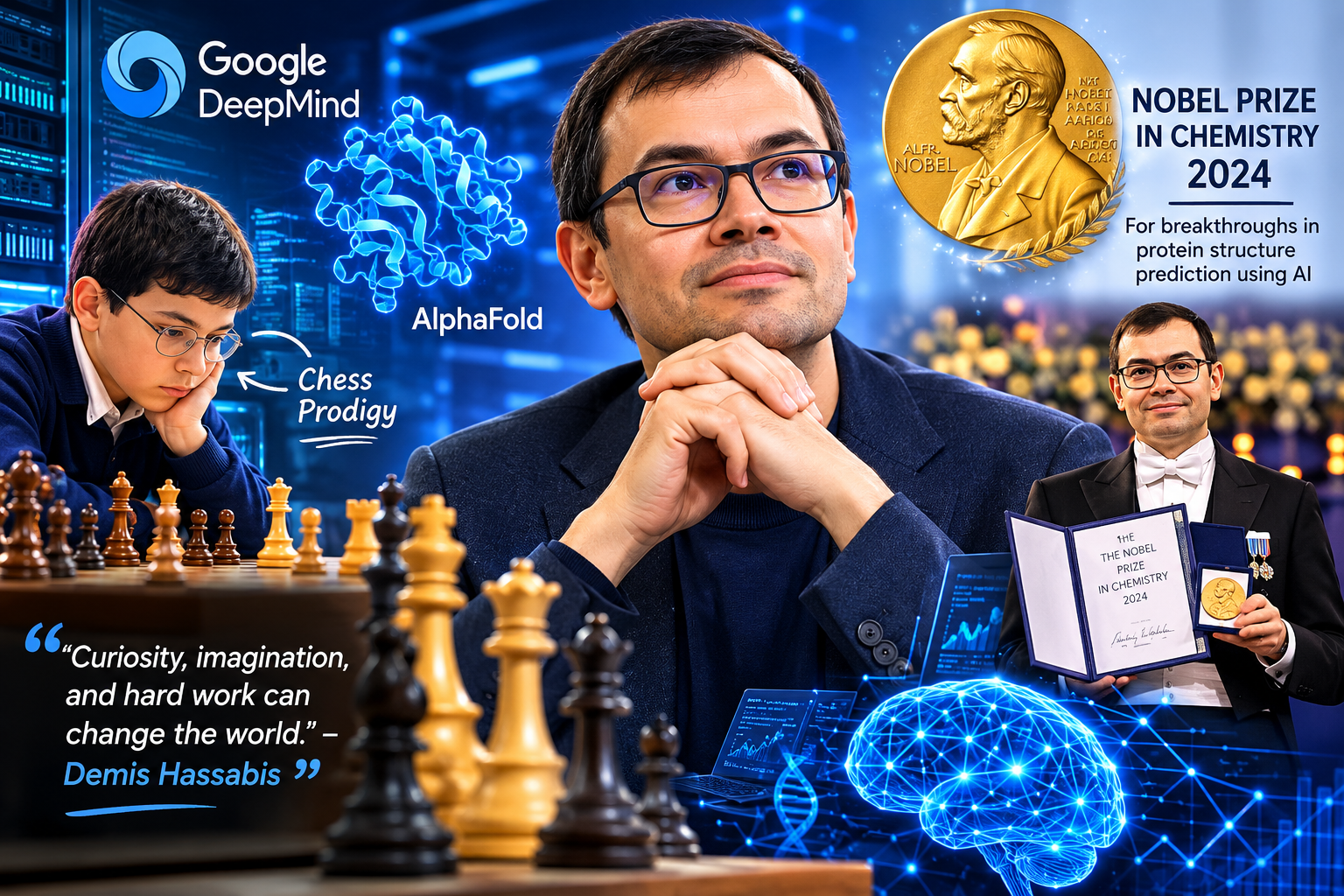
If you follow AI news, you’ve likely heard the name Demis Hassabis. He isn’t just another tech CEO. In fact, he went from being a childhood chess star to a Nobel Prize-winning scientist. In this article, we’ll cover his full story. This includes his early life, the start of DeepMind, the AlphaFold breakthrough, and his plans for the future of AI.
Who Is Demis Hassabis?
Sir Demis Hassabis was born on 27 July 1976 in London. He’s a British AI researcher and business owner. Today, he runs Google DeepMind and Isomorphic Labs as CEO. He also gives AI advice to the UK Government. His father, Costas, is Greek Cypriot. His mother, Angela, is Chinese-Singaporean. People who worked with him call his parents “free-spirited.” His father wrote songs, and his mother ran a small shop.
In 2024, Hassabis and his co-worker John M. Jumper won the Nobel Prize in Chemistry. They won it for using AI to predict protein shapes. This made Hassabis one of the youngest Nobel winners ever.
From Chess Star to AI Pioneer
Demis Hassabis’s story is truly amazing. He became a chess master at just 13. At the same time, he was already writing hit computer games as a teen. At 17, he built the award-winning game “Theme Park.”
But his skills went beyond games. He earned a top degree in Computer Science from Cambridge University. After that, he studied brain science for his PhD at University College London (UCL). His research looked at how memory and imagination work together. In fact, the journal Science picked it as one of the best science finds of 2007.
The Start of DeepMind
In 2010, Demis Hassabis started DeepMind. He built it with two friends, Shane Legg and Mustafa Suleyman. Together, they mixed brain science with computer learning. Their goal was to build machines that learn the way humans do.
Then, in 2014, Google bought DeepMind. At the time, it was Google’s biggest deal in Europe. Hassabis stayed on as CEO after the sale.
AlphaGo: When AI Beat a World Champion
DeepMind’s first big win was AlphaGo. This AI played the world’s best Go player, Lee Sedol, in a famous 2016 match in Seoul. AlphaGo won 4 games out of 5. The match was such a big deal that it got its own film, “AlphaGo” (2017).
Later, a new version called AlphaGo Zero beat the original. It learned to play by itself, with no human help at all. It beat the first AlphaGo 100 games to 0. Using this same method, AlphaZero learned to master chess and shogi too.
AlphaFold: Cracking a 50-Year-Old Puzzle
Hassabis’s biggest win is AlphaFold. This AI tool predicts a protein’s shape just from its building blocks. Scientists call this the “protein folding problem.” It had stumped them for 50 years.
In 2020, AlphaFold 2 got results so accurate that scientists said the puzzle was solved. DeepMind then gave AlphaFold away for free. This let researchers see the shapes of over 200 million proteins. Today, more than 2 million scientists in 190 countries use this tool.
The Thinking Game: A Film About His Life
A film tells the story of Hassabis and DeepMind. It’s called “The Thinking Game,” and it came out at the 2024 Tribeca Festival. The same director also made the AlphaGo film. In 2026, writer Sebastian Mallaby wrote a full book about him too. It’s called “The Infinity Machine: Demis Hassabis, DeepMind and the Quest for Superintelligence.”
Awards and Honors
Hassabis has won many top honors over the years:
- 2018: Named Commander of the Order of the British Empire (CBE)
- 2017 & 2025: Made the Time 100 Most Influential People list twice
- 2025: Named part of Time’s “Architects of AI” group
- Elected to the Royal Society and the Royal Academy of Engineering
- Won the Breakthrough Prize and the Canada Gairdner International Award
Net Worth and Family Life
As of 2026, experts guess Hassabis is worth $500 million to $1 billion. Some guesses go as high as $3 billion, but no exact number is public. He’s married to Teresa Hassabis, who studies the brain and has researched Alzheimer’s disease. They have two sons, and they keep their family life very private.
Here’s a fun fact: Hassabis loves Liverpool Football Club. Watching their games is one of his few hobbies outside work.
His Big Goal: AGI
Demis Hassabis wants to build Artificial General Intelligence (AGI). This means AI that can solve any hard problem, in any field. He hopes to use it to fix big issues like disease, climate change, and energy. In one interview, he said his real goal isn’t just building tech. Instead, he wants to learn “how the universe works” — and answer big questions about the mind and life itself.
After ChatGPT came out in 2022, Google rushed to compete with its own AI, Gemini. Through all of this, Hassabis has led the way.
Frequently Asked Questions
Q: Who is Demis Hassabis?
A: Demis Hassabis is a British AI researcher and CEO of Google DeepMind. In 2024, he won the Nobel Prize in Chemistry for AlphaFold.
Q: What did Demis Hassabis win the Nobel Prize for?
A: He shared the 2024 Nobel Prize in Chemistry with John M. Jumper. They won it for building AlphaFold, an AI tool that predicts protein shapes.
Q: What is DeepMind?
A: DeepMind is an AI company that Hassabis started in 2010. Google bought it in 2014. It’s now called Google DeepMind.
Q: Has Demis Hassabis written a book?
A: No, he hasn’t written one himself. But there’s a film about him (“The Thinking Game”) and a book by Sebastian Mallaby (“The Infinity Machine”).
Q: What is Demis Hassabis’s net worth?
A: As of 2026, experts guess his net worth is between $500 million and $1 billion. Some reports say it could be as high as $3 billion.
Related Reads
- What is AlphaFold? How AI Solved a 50-Year Biology Problem
- Top AI Nobel Prize Winners: How AI is Changing Science
- [Add links to your other cluster articles here]
Conclusion
Demis Hassabis’s story shows how a love for games and chess can lead to real science that helps the whole world. From chess star to Nobel winner, his path proves that AI can do more than power chatbots. It can also solve some of science’s toughest problems. As the race toward AGI speeds up, Hassabis will stay one of the most watched people in the field.
This article is based on public sources (Wikipedia, Britannica, and official Google DeepMind statements). AI news changes fast, so check Google DeepMind’s website for the latest updates.