



Technology is evolving faster than ever before. Every year, new innovations transform the way we communicate, work, learn, shop, and entertain ourselves. While some technologies become global success stories, others disappear after only a few years. This continuous cycle of innovation, growth, competition, and decline is what many people describe as Tech Demis.
Although Tech Demis is not an officially recognized technology term, it is commonly used online to describe the rise, evolution, transformation, and eventual decline of technologies, products, and technology companies. Understanding this concept helps businesses, developers, investors, students, and technology enthusiasts prepare for future innovations and changing market trends.
In this comprehensive guide, we’ll explore what Tech Demis means, why technologies become obsolete, how leading companies adapt to survive, and what lessons individuals and businesses can learn from the technology lifecycle.
What Is Tech Demis?
Tech Demis refers to the natural lifecycle of technology—from its creation and rapid growth to maturity, transformation, or eventual decline.
Technology never remains the same. Every innovation has a limited lifespan because newer and better solutions eventually replace existing ones. Whether it’s a smartphone operating system, a social media platform, or an AI-powered application, every digital product follows a lifecycle.
Think about products that once dominated the market:
- Nokia mobile phones
- BlackBerry smartphones
- DVD players
- MP3 players
- Internet Explorer
- Adobe Flash
Each of these products enjoyed massive popularity before newer technologies replaced them.
This ongoing cycle is what people generally associate with the idea of Tech Demis.
Is Tech Demis a Real Technology Term?
One important point to understand is that Tech Demis is not an official academic or industry-standard term.
Instead, it is an informal phrase used to explain how technologies evolve, compete, and eventually become obsolete or transform into something new.
The underlying concept, however, is well established in technology and business through ideas such as:
- Technology Lifecycle
- Product Lifecycle
- Creative Destruction
- Digital Transformation
- Innovation Cycle
Therefore, when discussing Tech Demis, we’re essentially talking about how innovation continuously reshapes the technology landscape.
Understanding the Technology Lifecycle
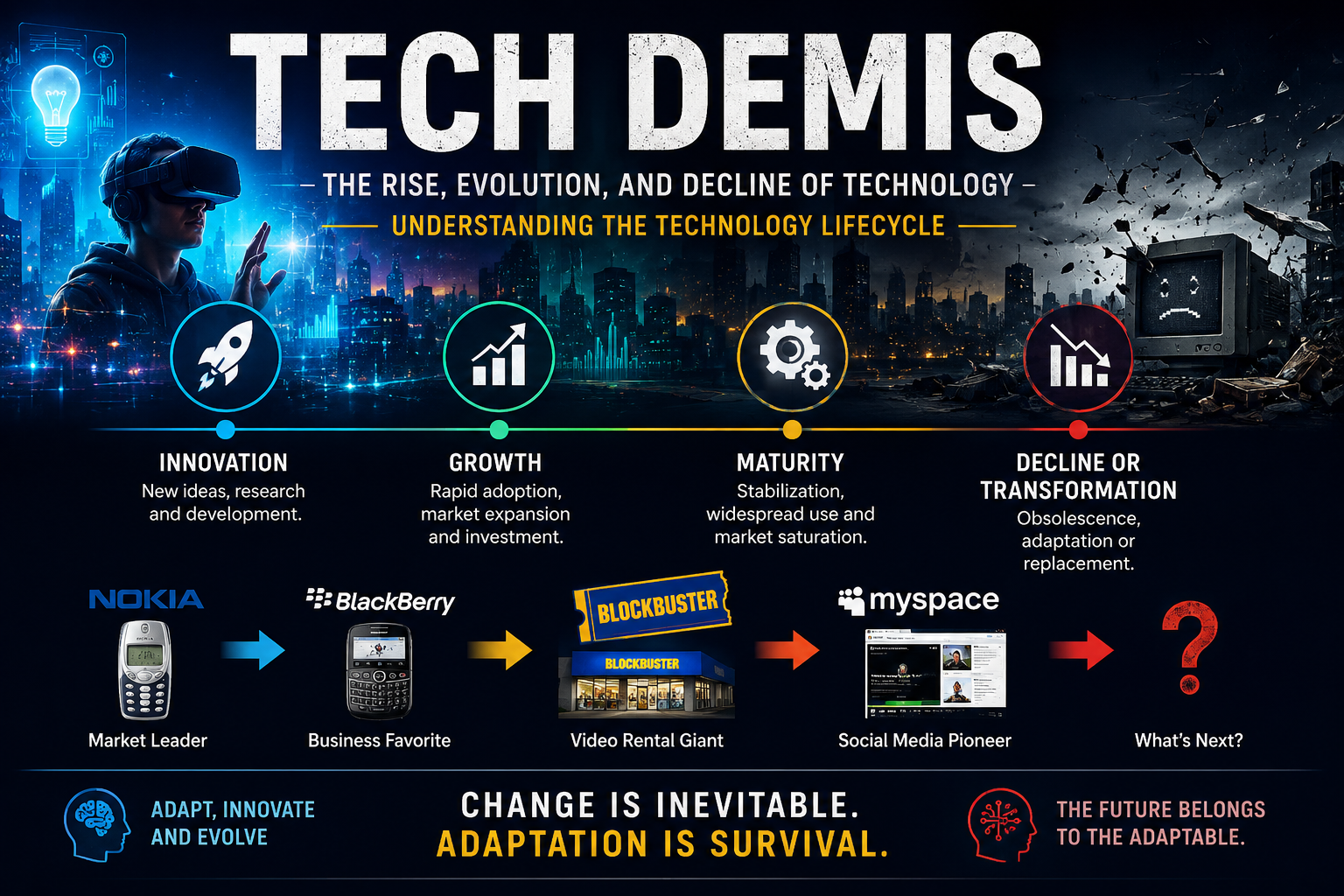
Every successful technology follows a predictable pattern. While the timeline varies depending on the industry, most products experience four major stages.
1. Innovation Stage
Everything starts with an idea.
Researchers, entrepreneurs, engineers, and startups identify a problem and develop a solution. During this phase, technology is usually expensive, experimental, and adopted only by early users.
Characteristics include:
- High development costs
- Limited customer base
- Continuous testing
- Frequent updates
- Strong investment requirements
Examples include:
- Early Artificial Intelligence systems
- First-generation smartphones
- Initial blockchain projects
- Quantum computing research
At this stage, success is never guaranteed. Many technologies fail before reaching mainstream adoption.
2. Growth Stage
If users find the technology valuable, it enters the growth phase.
Demand increases rapidly.
Investors become interested.
Competitors launch similar products.
Companies expand into international markets.
This is often the fastest period of development.
Common characteristics include:
- Rapid customer growth
- Increased competition
- Better user experience
- Falling prices
- New product versions
- Strong media attention
Examples:
- ChatGPT after public release
- Zoom during remote work expansion
- Cloud computing services
- Food delivery applications
Companies that successfully navigate this stage often become industry leaders.
3. Maturity Stage
Eventually, growth slows down.
Most potential customers already use the product, and innovation becomes more incremental instead of revolutionary.
Businesses focus on:
- Customer retention
- Performance improvements
- Security
- Cost optimization
- Ecosystem development
During maturity:
- Revenue stabilizes
- Competition intensifies
- Profit margins shrink
- Marketing becomes more aggressive
Examples include:
- Android operating system
- Microsoft Windows
- Apple iPhone
- Google Search
These technologies continue evolving, but improvements are generally smaller compared to earlier years.
4. Decline or Transformation Stage
This is the stage most closely associated with Tech Demis.
A technology reaches decline when:
- Better alternatives emerge.
- Consumer preferences change.
- Innovation slows.
- Maintenance becomes expensive.
- New business models replace old ones.
However, decline doesn’t always mean complete failure.
Some technologies successfully transform into new products or services.
For example:
- Physical software → Cloud-based Software-as-a-Service (SaaS)
- DVDs → Streaming platforms
- Traditional banking → Digital banking
- Cable television → On-demand streaming
Many companies survive not by protecting old products but by reinventing themselves.
Why Does Tech Demis Happen?
Technology rarely disappears overnight.
Instead, multiple factors gradually reduce its relevance until customers begin switching to better alternatives.
The most common reasons include:
Failure to Innovate
Innovation is the driving force behind every successful technology company.
Businesses that stop improving eventually lose customers to competitors offering better performance, lower prices, or improved user experiences.
Innovation isn’t only about creating new products—it also means improving existing ones.
Changing Customer Expectations
Modern consumers expect:
- Faster performance
- Better security
- Mobile compatibility
- AI-powered features
- Cloud accessibility
- Simple user interfaces
Companies unable to meet these expectations often struggle to remain competitive.
Strong Competition
Every successful technology attracts competitors.
Large corporations, startups, and open-source communities constantly introduce new solutions.
Healthy competition benefits consumers but creates enormous pressure on businesses to keep improving.
Poor User Experience
A technically advanced product can still fail if users find it difficult to use.
Common UX problems include:
- Complicated interfaces
- Slow performance
- Frequent bugs
- Poor customer support
- Limited updates
Today’s users quickly switch to alternatives that provide a smoother experience.
Rapid Technological Innovation
Innovation cycles are becoming shorter every year.
Artificial Intelligence, cloud computing, automation, 5G, edge computing, and machine learning accelerate technological change.
As a result, products become outdated much faster than they did a decade ago.
Real-Life Examples of Tech Demis
Understanding real companies helps explain why technology leaders sometimes disappear while others continue growing.
Nokia: A Lesson in Missing Market Shifts
For many years, Nokia dominated the global mobile phone industry.
Its phones were known for their durability, battery life, and affordability. In several countries, owning a Nokia phone was almost synonymous with owning a mobile phone.
However, the smartphone revolution changed everything.
As touchscreen devices and app-based ecosystems gained popularity, competitors like Apple and Android manufacturers quickly captured consumer attention. Nokia struggled to adapt its software strategy and lost its leadership position.
The company’s story highlights one of the biggest lessons in Tech Demis:
Market leadership today does not guarantee success tomorrow.
BlackBerry: From Business Favorite to Market Decline
BlackBerry was once the preferred smartphone brand for professionals, government organizations, and corporate executives.
Its physical keyboard, secure messaging, and enterprise features made it a market leader.
But consumer expectations changed rapidly.
Users began prioritizing touchscreen displays, app stores, multimedia capabilities, and modern operating systems. BlackBerry was slow to respond, allowing competitors to dominate the market.
Instead of disappearing entirely, the company shifted its focus toward cybersecurity and enterprise software—an example of transformation rather than complete failure.
Tech Demis Explained: Technology Evolution, Decline & Future Trends
Blockbuster vs Netflix: Ignoring Digital Innovation
One of the most well-known examples of Tech Demis is the story of Blockbuster.
During the late 1990s and early 2000s, Blockbuster dominated the movie rental industry with thousands of stores worldwide. Customers visited physical stores to rent DVDs and VHS tapes.
However, consumer behavior began to change as internet speeds improved and online entertainment became more accessible.
Netflix recognized this shift early. It first introduced DVD-by-mail services and later invested heavily in online streaming.
Blockbuster underestimated the importance of digital transformation. Instead of adapting quickly, it continued relying on its traditional retail model.
Eventually, Netflix became one of the world’s largest entertainment companies, while Blockbuster almost completely disappeared.
Key Lesson:
Businesses that ignore changing customer behavior risk becoming obsolete.
MySpace: Losing the Social Media Race
Before Facebook became the world’s largest social networking platform, MySpace was the leader.
Millions of users created personalized profiles, shared music, and connected with friends.
Despite its popularity, MySpace struggled with:
- Slow website performance
- Cluttered user interface
- Poor user experience
- Limited innovation
- Growing competition
Facebook introduced a cleaner design, stronger privacy controls, and continuous feature updates.
As users migrated to Facebook, MySpace gradually lost relevance.
Lesson:
A large user base alone cannot guarantee long-term success.
Companies That Successfully Avoided Tech Demis
Not every company declines. Some organizations successfully reinvent themselves by embracing innovation.
Apple: Reinventing Through Innovation
In the late 1990s, Apple faced significant financial challenges.
The company responded by focusing on innovation rather than competing on price alone.
Products such as:
- iMac
- iPod
- iPhone
- iPad
- Apple Watch
completely transformed the company’s future.
Apple also built a powerful ecosystem by integrating hardware, software, and services.
Today, it remains one of the world’s most valuable technology companies.
Lesson:
Continuous innovation is the strongest defense against Tech Demis.
Microsoft: From Software Giant to Cloud Leader
Microsoft built its success on Windows and Microsoft Office.
As cloud computing became increasingly important, Microsoft shifted its strategy.
Major investments in:
- Microsoft Azure
- Microsoft 365
- Artificial Intelligence
- Enterprise Cloud Solutions
allowed the company to remain competitive despite changing market trends.
Instead of relying only on desktop software, Microsoft embraced subscription services and cloud technology.
This transformation made Microsoft one of today’s most influential technology companies.
How Artificial Intelligence Is Reducing Tech Demis
Artificial Intelligence has become one of the most powerful tools helping businesses stay competitive.
Instead of making decisions based only on intuition, companies now use AI to analyze massive amounts of data.
AI helps businesses:
- Predict customer behavior
- Improve decision-making
- Automate repetitive tasks
- Personalize user experiences
- Detect cybersecurity threats
- Optimize supply chains
- Increase productivity
Companies that effectively integrate AI often adapt faster to market changes.
How Startups Can Avoid Tech Demis
Startups operate in highly competitive markets where innovation happens rapidly.
To improve long-term survival, startups should focus on:
1. Solve Real Problems
Successful businesses solve meaningful customer problems rather than simply following trends.
2. Listen to Customer Feedback
Early user feedback often reveals opportunities for product improvement.
3. Continue Innovating
Never assume the first successful product will remain successful forever.
4. Monitor Competitors
Understanding competitors helps businesses identify new opportunities and emerging threats.
5. Build Scalable Products
Technology should grow alongside customer demand without sacrificing quality.
How Tech Demis Affects Careers
Technology doesn’t only impact companies—it also affects individual careers.
As industries evolve, some jobs disappear while new opportunities emerge.
Examples include:
| Declining Roles | Growing Roles |
|---|---|
| Data Entry | AI Specialists |
| Manual Testing | Automation Engineers |
| DVD Rental Staff | Streaming Platform Experts |
| Traditional Print Designers | UX/UI Designers |
| Basic IT Support | Cloud Engineers |
Professionals who continuously learn new skills remain more competitive.
Useful skills include:
- Artificial Intelligence
- Cybersecurity
- Data Analysis
- Cloud Computing
- Digital Marketing
- Programming
- Prompt Engineering
How Individuals Can Stay Ahead
Even if you don’t own a business, technological change affects your daily life.
To stay competitive:
- Learn new digital skills regularly.
- Read trusted technology news.
- Understand AI tools.
- Stay updated with industry trends.
- Experiment with new software.
- Build problem-solving abilities.
- Develop adaptability.
Continuous learning is becoming one of the most valuable career skills.
Emerging Technologies That Could Shape the Future
Today’s emerging technologies may become tomorrow’s industry standards.
Some of the most promising innovations include:
- Artificial Intelligence (AI)
- Generative AI
- Robotics
- Quantum Computing
- Blockchain
- Extended Reality (XR)
- Internet of Things (IoT)
- Edge Computing
- Green Technology
- Autonomous Vehicles
Some of these technologies will become mainstream, while others may eventually experience their own version of Tech Demis.
Future Trends
The pace of technological innovation continues to accelerate.
Experts expect several long-term trends:
- Faster product development cycles
- Greater AI integration
- Increased automation
- More cloud-based services
- Stronger cybersecurity requirements
- Sustainable technology solutions
- Personalized digital experiences
Businesses that remain flexible and customer-focused will be better positioned for future success.
Key Lessons from Tech Demis
- Innovation never stops.
- Market leaders can lose their position.
- Customer expectations constantly evolve.
- Artificial Intelligence is reshaping industries.
- Adaptability matters more than size.
- Continuous learning benefits both businesses and individuals.
- Technology decline often creates opportunities for new innovation.
Conclusion
Technology is constantly evolving, and every innovation eventually reaches a point where it must adapt, transform, or be replaced. This ongoing cycle—often referred to as Tech Demis—demonstrates that long-term success depends not on market dominance alone but on the ability to innovate and respond to changing customer needs.
Real-world examples such as Nokia, Blockbuster, MySpace, Apple, and Microsoft show that success is never permanent. Companies that embrace change, invest in research, and prioritize user experience are far more likely to remain competitive.
For businesses, developers, students, and technology enthusiasts alike, understanding Tech Demis offers valuable insights into how technology evolves and what it takes to succeed in an increasingly digital world.
Frequently Asked Questions (FAQs)
1. What is Tech Demis?
Tech Demis is an informal term used to describe the rise, growth, transformation, or decline of technologies and technology companies over time.
2. Is Tech Demis an official technology term?
No. It is not an official industry or academic term. It is commonly used online to explain the technology lifecycle and digital transformation.
3. Why do successful technology companies fail?
Companies may decline due to slow innovation, changing customer expectations, poor user experience, increased competition, or failure to adapt to new technologies.
4. Can companies avoid Tech Demis?
Yes. Businesses that continuously innovate, invest in research, embrace AI, and respond to customer needs have a much better chance of long-term success.
5. How does Artificial Intelligence help businesses?
AI helps companies improve decision-making, automate processes, analyze customer behavior, enhance security, and deliver personalized experiences.
6. Which companies are examples of Tech Demis?
Examples include Nokia, BlackBerry, MySpace, and Blockbuster, all of which lost market leadership due to changing technology and consumer preferences.
7. What skills help individuals stay relevant?
Learning AI, cloud computing, cybersecurity, digital marketing, programming, and data analysis can help professionals adapt to future technological changes.
8. Why is understanding the technology lifecycle important?
It helps businesses make better strategic decisions, enables professionals to prepare for future careers, and allows consumers to understand how innovation shapes everyday life.