

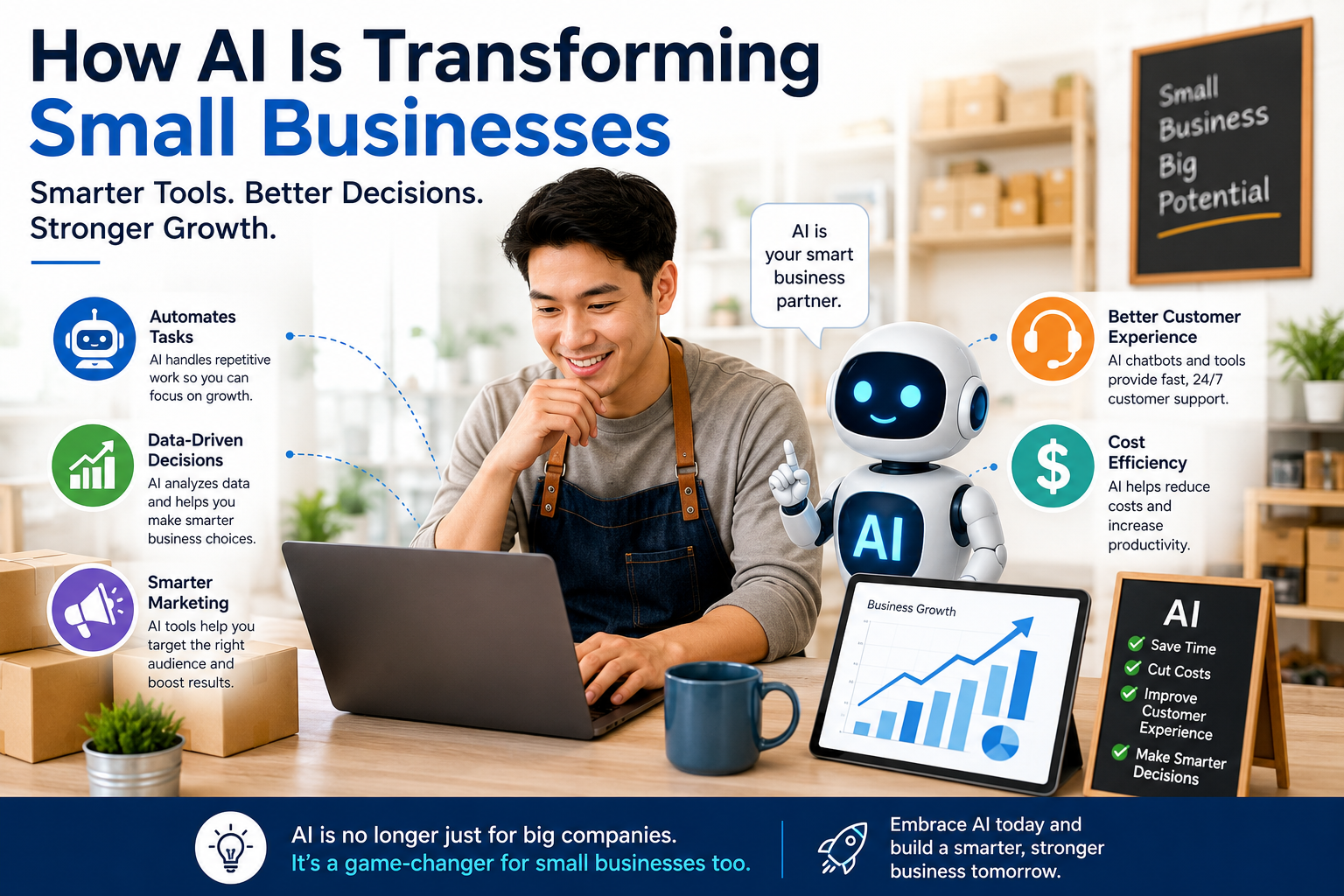
For decades, cutting-edge technology was a luxury reserved for large corporations with deep pockets and dedicated IT departments. Small business owners watched from the sidelines as enterprise giants automated their operations, personalized their marketing, and scaled with precision — all while independent shops and startups relied on spreadsheets, gut instinct, and sheer hustle to keep up.
That gap is closing fast, and artificial intelligence is the reason why.
Today, a solo entrepreneur running an online boutique can access the same caliber of customer insights that once required a team of data analysts. A neighborhood accounting firm can automate bookkeeping tasks that used to eat up entire weekends. A small marketing agency can generate weeks of content ideas in minutes. AI has effectively democratized capabilities that were once exclusive to companies with massive budgets, and it’s reshaping what it means to run a small business in the process.
This isn’t a distant, futuristic trend — it’s happening right now, in real businesses, with real results. In this guide from Tech Demis, we’ll explore exactly how AI is transforming small businesses across every major function, look at practical examples, address common concerns, and offer a roadmap for owners who want to start using these tools without feeling overwhelmed.
Why This Moment Matters for Small Businesses
Small businesses have always faced a fundamental challenge: doing more with less. Limited staff, tight budgets, and no room for costly mistakes mean owners often wear five or six hats at once — marketer, accountant, customer service rep, and operations manager, all rolled into one exhausted person.
AI tools are uniquely suited to solve this problem because they don’t require massive upfront investment or specialized technical teams to implement. Many of the most powerful AI applications today are available through simple subscriptions, browser extensions, or built directly into software small businesses already use. The barrier to entry has dropped dramatically, while the value delivered has increased just as dramatically.
This combination — low cost, low technical barrier, high impact — is exactly why AI adoption among small businesses has accelerated so quickly. It’s not about replacing the human touch that makes small businesses special. It’s about freeing up owners and employees from repetitive, time-consuming tasks so they can focus on the things that actually require human judgment, creativity, and relationships.
1. Smarter, More Personalized Marketing
Marketing has traditionally been one of the hardest areas for small businesses to compete in. Big brands can afford agencies, expensive ad campaigns, and teams of copywriters and designers. Small businesses often can’t.
AI is leveling this playing field in several concrete ways.
- Content creation at scale: Writing tools powered by AI can help generate blog posts, social media captions, email newsletters, and product descriptions in a fraction of the time it used to take.
- Personalized customer targeting: AI-driven marketing platforms analyze customer behavior — browsing patterns, purchase history, engagement with previous campaigns — to segment audiences and deliver highly targeted messages.
- Smarter ad spending: Platforms like Google Ads and Meta Ads have built AI directly into their bidding and targeting systems. These systems analyze enormous amounts of data in real time to determine which audiences are most likely to convert, adjusting bids and placements automatically.
- Visual content generation: AI image and design tools allow business owners without graphic design skills to create professional-looking social media graphics, product mockups, and marketing materials. What used to require hiring a freelance designer can now be prototyped in-house, saving both time and money.
The net effect is that a two-person team can now execute marketing campaigns that would have previously required a much larger staff — not by working harder, but by working smarter with AI handling the repetitive, data-heavy parts of the job.
2. Revolutionizing Customer Service
Customer service is often the make-or-break factor for small businesses. A single bad experience can drive a customer away permanently, while responsive, helpful service builds the kind of loyalty that keeps people coming back.
AI-powered chatbots and virtual assistants have transformed how small businesses handle customer inquiries. These tools can:
- Answer frequently asked questions instantly, 24 hours a day, without requiring a human to be on call
- Handle simple transactions like booking appointments, processing returns, or tracking orders
- Escalate complex issues to a human team member with full context already gathered
- Respond in multiple languages, opening up service to a broader customer base
For a small business, this means customers no longer have to wait until business hours to get help with a simple question. A bakery can let customers check order status any time. A local service provider can let potential clients book consultations without anyone having to answer the phone during dinner. This around-the-clock availability used to be something only large companies with call centers could offer — now it’s accessible to businesses with a handful of employees.
Beyond chatbots, AI is also helping human customer service reps work more efficiently. Tools that automatically summarize customer interactions, suggest responses, and flag urgent issues mean support staff can handle more inquiries with the same quality of care, reducing burnout and improving response times.
Importantly, the businesses seeing the best results aren’t using AI to eliminate the human element of customer service entirely — they’re using it to handle the repetitive, low-value interactions so that human staff can focus their energy on the conversations that truly need a personal touch. That balance matters enormously for small businesses whose reputation often rests on genuine relationships with customers.
3. Streamlining Operations and Administrative Work
Perhaps the least glamorous but most impactful way AI is transforming small businesses is through operational efficiency. Every business, regardless of industry, has a mountain of administrative work: scheduling, invoicing, inventory tracking, data entry, and reporting.
Automated bookkeeping and accounting. AI-powered accounting software can now automatically categorize transactions, flag anomalies, reconcile accounts, and even predict cash flow issues before they become a problem. What used to require hours of manual entry — or an expensive bookkeeper — can now be handled largely automatically, with human oversight focused on reviewing and approving rather than manually inputting data.
- Inventory management: Retail and e-commerce businesses are using AI to forecast demand, automatically reorder stock before it runs out, and identify slow-moving inventory that should be discounted or discontinued. This kind of predictive inventory management used to require sophisticated supply chain software that only large retailers could afford. Now it’s built into affordable point-of-sale and e-commerce platforms.
- Scheduling and resource allocation: Service-based businesses — salons, contractors, medical practices, consultants — are using AI scheduling tools that optimize appointment booking based on staff availability, travel time, and customer preferences, reducing gaps and double-bookings.
- Document processing: AI tools can extract data from invoices, receipts, and contracts automatically, eliminating hours of manual data entry. A small business that used to spend an afternoon each week processing paperwork can now have that work done in minutes, with the AI flagging anything unusual for human review.
These operational gains might not be as visible as a flashy marketing campaign, but they often deliver the most consistent return on investment. Time saved on administrative work is time an owner can redirect toward growing the business, serving customers, or simply reclaiming some work-life balance — something small business owners rarely have enough of.
4. Data-Driven Decision Making
One of the biggest historical disadvantages small businesses faced compared to larger competitors was access to data and the expertise to interpret it. Large companies employ data scientists and analysts to study customer behavior, market trends, and operational metrics. Small businesses typically had neither the data infrastructure nor the personnel to do the same.
AI is closing this gap by making data analysis accessible to non-experts. Modern AI-powered analytics tools can:
- Automatically identify trends and patterns in sales data without requiring statistical expertise
- Generate plain-language summaries and recommendations from complex datasets
- Predict future sales or demand based on historical patterns
- Highlight which products, services, or customer segments are most profitable
- Flag early warning signs of problems, such as declining customer retention or unusual expense patterns
This matters enormously because decisions that used to be based on gut feeling or incomplete information can now be grounded in actual data. A restaurant owner can see exactly which menu items are most profitable and adjust their offerings accordingly. A retail shop can identify which products to stock more of before a seasonal rush. A service business can spot which marketing channels are actually generating paying customers versus just website traffic.
The democratization of data analysis means small businesses can make the kind of informed, strategic decisions that were once the exclusive domain of companies with dedicated analytics teams.
5. Enhancing Product and Service Development
AI isn’t just changing how small businesses operate behind the scenes — it’s also influencing what they sell and how they design their offerings.
Businesses are using AI to analyze customer feedback at scale, pulling insights from reviews, survey responses, and social media comments to identify what customers love and what needs improvement. This kind of sentiment analysis used to require manually reading through hundreds of reviews. Now it can be summarized and categorized automatically, giving business owners a clear picture of customer sentiment in minutes.
AI is also helping with prototyping and design. Small manufacturers and product-based businesses are using AI-assisted design tools to speed up product development cycles, test variations virtually before committing to physical prototypes, and reduce the cost of experimentation.
For service-based businesses, AI can help identify gaps in current offerings by analyzing customer inquiries and support tickets to see what people are asking for that isn’t currently being provided — essentially surfacing new service or product opportunities that might otherwise go unnoticed.
6. Leveling the Hiring and HR Playing Field
Small businesses often struggle with hiring because they lack dedicated HR departments and the resources to sift through large volumes of applications. AI-powered recruiting tools are changing this by:
- Automatically screening resumes for relevant qualifications
- Drafting job descriptions optimized to attract the right candidates
- Scheduling interviews without the back-and-forth email exchanges
- Providing onboarding assistance and answering new employee questions
For existing staff, AI tools are also assisting with training. Small businesses can now create AI-assisted training materials and simulations that would have previously required expensive external consultants or extensive in-house development time.
This is particularly valuable for small businesses because hiring mistakes are costly — both financially and in terms of team morale and productivity. Better screening and onboarding tools help small teams make more informed hiring decisions and get new employees up to speed faster.
Real-World Examples of AI Adoption
To understand the tangible impact of these changes, it helps to look at how different types of small businesses are actually using AI today:
- A local coffee shop uses an AI-powered point-of-sale system that predicts busy periods based on historical data and weather forecasts, helping the owner schedule staff more efficiently and reduce both understaffing during rushes and overstaffing during slow periods.
- An independent law firm uses AI document review tools to quickly scan contracts for potential issues, cutting review time significantly and allowing attorneys to take on more clients without sacrificing quality.
- A boutique clothing retailer uses AI-driven email marketing to send personalized product recommendations based on past purchases, resulting in higher email open rates and repeat purchase rates compared to generic newsletters.
- A small HVAC company uses an AI chatbot on its website to handle initial customer inquiries and schedule service calls, freeing up the owner from having to answer the phone constantly while out on jobs.
- A freelance graphic design studio uses AI tools to generate initial design concepts and mockups quickly, then focuses their creative energy on refining and personalizing the final product for each client — completing more projects without sacrificing quality.
These examples share a common thread: AI isn’t replacing the core value these businesses provide. It’s removing friction, saving time, and enabling owners and employees to focus on what actually differentiates their business — expertise, creativity, and genuine customer relationships.
Common Concerns and How to Think About Them
Despite the clear benefits, many small business owners remain hesitant to adopt AI tools. These concerns are legitimate and worth addressing honestly.
- Cost: While some AI tools carry a subscription fee, many are surprisingly affordable, and the time saved often far outweighs the cost. It’s worth starting with free or low-cost tools to test the waters before committing to more expensive platforms.
- Complexity: The good news is that most AI tools designed for small businesses are built with non-technical users in mind. You generally don’t need to understand how the underlying technology works any more than you need to understand how a car engine works to drive one.
- Job displacement fears: Many small business owners worry that adopting AI means eliminating jobs. In practice, most small businesses use AI to handle overflow work or repetitive tasks that were previously outsourced or simply left undone due to time constraints — not to replace existing employees. AI tends to change what employees spend their time on rather than eliminating the need for people altogether.
- Data privacy and security: This is a legitimate concern, especially for businesses handling sensitive customer information. It’s worth researching any AI tool’s data handling practices before adopting it, reading privacy policies, and choosing reputable providers with clear security commitments.
- Losing the personal touch: Small businesses often build their reputation on personal relationships and hands-on service. The key is using AI to handle the tasks that don’t require personal interaction — data entry, scheduling, initial customer inquiries — while preserving and even enhancing the human interactions that matter most.
Getting Started: A Practical Roadmap
For small business owners feeling overwhelmed by the pace of change, here’s a practical way to begin adopting AI without disrupting daily operations:
- Start with one pain point: Rather than trying to overhaul your entire business at once, identify the single most time-consuming or frustrating task in your business and look for an AI tool designed to address it specifically.
- Choose tools with free trials: Most reputable AI tools offer free trials or freemium tiers. Test a tool thoroughly before committing to a paid subscription to make sure it actually fits your workflow.
- Involve your team: If you have employees, involve them in the process of evaluating and adopting new tools. They’re the ones who will use these tools daily, and their buy-in will determine whether adoption actually succeeds.
- Measure the results: Track time saved, cost reduced, or revenue generated before and after adopting a new tool. This helps you understand which investments are actually paying off and which aren’t worth continuing.
- Scale gradually: Once you’ve successfully integrated one AI tool into your workflow, move on to the next pain point. Trying to adopt too many new systems at once often leads to confusion and abandoned efforts.
- Stay informed but skeptical: The AI tool landscape changes quickly, and not every new product lives up to its marketing claims. Read reviews, ask other small business owners in your network what’s actually working for them, and don’t feel pressured to adopt every new trend.
Looking Ahead: What This Means for the Future of Small Business
The transformation AI is bringing to small businesses isn’t a temporary trend — it represents a fundamental shift in what’s possible for businesses without massive resources. As these tools continue to improve and become more affordable, the gap between what small businesses and large enterprises can accomplish will likely continue to narrow.
This doesn’t mean small businesses will start operating like miniature versions of large corporations. If anything, the opposite is true. By offloading repetitive, data-heavy, and administrative work to AI, small business owners are freed up to double down on the things that made their businesses special in the first place: personal relationships, community connection, craftsmanship, and the kind of flexible, responsive service that large companies often struggle to replicate.
The small businesses that thrive in this new landscape won’t necessarily be the ones that adopt every new AI tool available. They’ll be the ones that thoughtfully choose the tools that genuinely solve their problems, while preserving the human qualities that keep customers coming back.
Final Thoughts
AI is no longer a futuristic concept reserved for tech giants — it’s a practical, accessible set of tools that small businesses are using right now to market smarter, serve customers better, run more efficient operations, and make more informed decisions. Here at Tech Demis, we believe the businesses that embrace this shift thoughtfully, starting small and scaling as they see results, stand to gain a meaningful competitive advantage.
For small business owners who have felt like they’re constantly racing to keep up with larger, better-resourced competitors, AI represents something genuinely valuable: a chance to compete on more equal footing, without needing a massive budget or technical team to do it. The tools are here. The question now is simply how — and how thoughtfully — small businesses choose to use them.
At Tech Demis, we’ll keep tracking these shifts and bringing small business owners practical, jargon-free guidance on which AI tools are actually worth adopting — so you can focus on running your business, not chasing every new trend.

1 Comment
Pingback: Is ChatGPT Plus Worth It in 2026? A Complete Breakdown