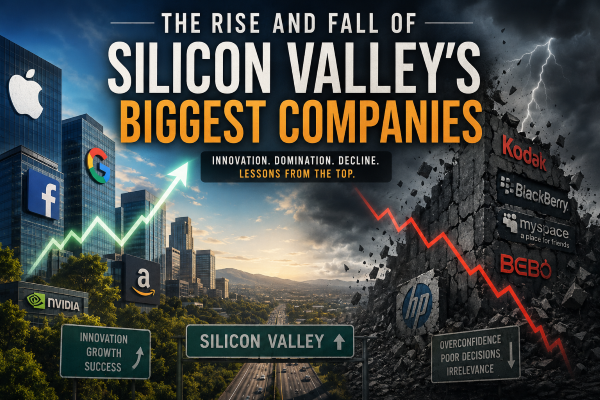





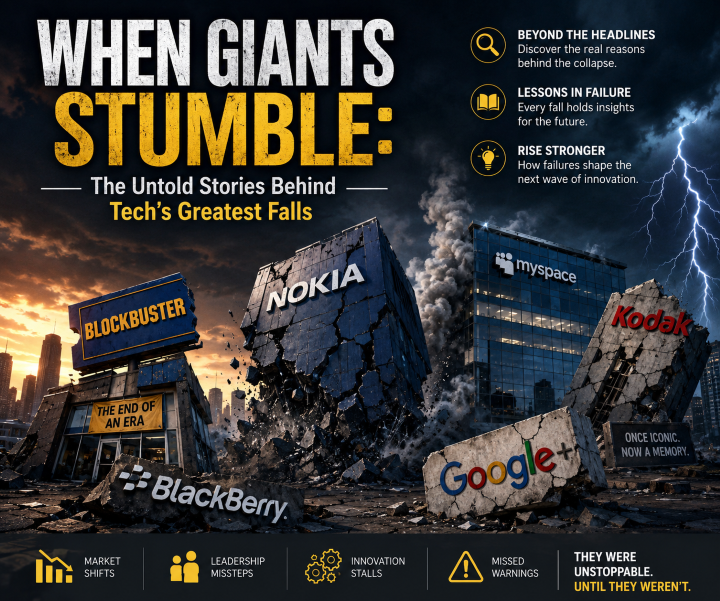
There was a time when Kodak owned photography. A time when Nokia phones were in nearly every pocket on Earth. A time when BlackBerry was the undisputed king of business communication, and MySpace was the place where the internet’s social life happened. Today, these names survive mostly as footnotes, cautionary tales told in business school lecture halls and marketing case studies.
What happened to them? How does a company that once controlled an entire industry end up irrelevant, bankrupt, or absorbed into a competitor within a decade or two? The answers are rarely as simple as “they got unlucky.” Behind every major corporate collapse in the technology world lies a pattern — a set of decisions, blind spots, and missed signals that, in hindsight, seem almost inevitable.
This is the story of technology’s fallen giants: what built them, what broke them, and what every founder, executive, and product leader today can learn from their mistakes.
The Illusion of Permanence
Success in the tech industry has always created a dangerous illusion: the belief that dominance, once achieved, is self-sustaining. When a company captures a majority of its market, it’s easy for leadership to assume the hard part is over. Distribution is in place, brand recognition is high, revenue is flowing, and the competition looks laughably small in the rearview mirror.
But technology markets don’t reward past performance. They reward whoever solves the customer’s next problem first. The companies chronicled in this piece all shared a moment of near-total market control, and all of them mistook that control for permanence. That single misjudgment — believing the throne was secure — is arguably the common root cause of nearly every story of tech demis in modern business history.
Case Study: Kodak and the Camera That Killed Its Creator
Few stories illustrate corporate self-sabotage as clearly as Kodak’s. In 1975, an engineer at Kodak named Steven Sasson built the world’s first digital camera. It was clunky, low-resolution, and took 23 seconds to capture a black-and-white image onto a cassette tape. When Sasson demonstrated it to executives, the reaction wasn’t excitement — it was concern. Digital photography, if it ever took off, would cannibalize Kodak’s enormously profitable film business.
So Kodak did something remarkable: it buried its own breakthrough. The company continued pouring resources into film, chemicals, and processing labs, treating digital imaging as a side project rather than the future of the industry. By the time digital cameras became mainstream in the late 1990s and early 2000s, Kodak was years behind competitors like Canon and Sony, who had no legacy film business to protect and therefore no reason to hold back.
Kodak filed for bankruptcy in 2012. The company that invented digital photography was ultimately destroyed by it, not because the technology surprised them, but because they understood it perfectly and chose to suppress it anyway. It remains one of the most studied examples of the “innovator’s dilemma” — the tendency of successful companies to avoid disrupting their own most profitable products, even when disruption is inevitable.
Case Study: Nokia and the Smartphone Blind Spot
At its peak in 2007, Nokia controlled roughly 50% of the global mobile phone market. Its devices were famous for their durability, battery life, and simplicity. Nokia wasn’t a scrappy underdog blindsided by a random shift in taste — it was the single most dominant hardware manufacturer in mobile history.
Then Apple released the iPhone in 2007, and Google followed with Android a year later. Nokia’s leadership initially dismissed the iPhone as a niche product for wealthy early adopters, unsuitable for the mass market because of its price and its lack of a physical keyboard. Internally, engineers reportedly recognized the threat, but Nokia’s software platform, Symbian, was aging, fragmented, and slow to evolve. Corporate bureaucracy made it difficult to pivot quickly, and by the time Nokia partnered with Microsoft to build Windows Phone in 2011, the smartphone war had already been decided.
Nokia’s mobile division was eventually sold to Microsoft in 2014 for a fraction of what the company had once been worth. The core failure wasn’t a lack of engineering talent — Nokia had plenty. It was an organizational inability to treat a genuine external threat as more dangerous than internal politics and legacy commitments.
Case Study: BlackBerry and the Cost of Underestimating the Consumer
BlackBerry, once the gold standard for secure business communication, made a similar mistake to Nokia’s, but from a different angle. Its physical keyboard and enterprise-grade security had made it indispensable to executives, government agencies, and anyone who needed to type emails quickly and securely on the go.
When touchscreen smartphones arrived, BlackBerry’s leadership assumed that professional users would never abandon a physical keyboard for a glass screen. This assumption revealed a deeper misunderstanding: BlackBerry saw itself as a business tool company, while the market was rapidly becoming about consumer experience, apps, and lifestyle integration. Executives at rival firms understood that people didn’t want two devices — one for work and one for entertainment — they wanted a single device that did everything well.
BlackBerry’s market share collapsed from being nearly ubiquitous in enterprise settings to a rounding error within a few years. Its attempt to launch touchscreen models came too late and lacked the app ecosystem that iOS and Android had already built. The lesson here is subtle but important: even a genuinely superior feature (security, keyboard reliability) cannot save a product if the surrounding experience falls behind what customers now expect as standard.
Case Study: MySpace and the Cost of Standing Still
Before Facebook became a global phenomenon, MySpace was the largest social network on the planet. It let users customize their profile pages with music, colors, and layouts, giving it a personality that felt more expressive than anything else online at the time.
But that customization came at a cost. Pages became cluttered, slow to load, and visually chaotic. Meanwhile, Facebook launched with a clean, consistent interface, real identity verification (originally requiring a college email), and a relentless pace of feature development, including the News Feed, which fundamentally changed how people consumed social content.
MySpace, owned by News Corporation after a 2005 acquisition, became weighed down by corporate priorities focused on advertising revenue rather than user experience. Internal decision-making slowed, technical debt piled up, and the platform failed to modernize its infrastructure quickly enough to compete. Users migrated to Facebook in droves between 2008 and 2011, and MySpace never recovered its former relevance. It is now often cited alongside Kodak and Nokia in any serious discussion of tech demis case studies, precisely because its downfall wasn’t caused by a single catastrophic event, but by a slow accumulation of small, deferred decisions.
Case Study: Yahoo and the Danger of Indecision
Yahoo’s decline is less about a single missed technology shift and more about a decade of strategic drift. In the early 2000s, Yahoo was one of the most visited websites in the world, and it had the opportunity to acquire both Google and Facebook at early stages. Yahoo reportedly offered to buy Google in 2002 for around $3 billion, and Google declined. In 2006, Yahoo again nearly closed a deal to acquire Facebook for roughly $1 billion before backing out.
Rather than committing to a clear identity — search engine, media company, or portal — Yahoo tried to be everything at once. It cycled through multiple CEOs, each with a different strategic vision, which meant the company rarely stuck with any single direction long enough to see it succeed or fail definitively. Its search business was overtaken by Google and Its media ambitions never matched dedicated publishers. Its email service, once dominant, was overtaken by Gmail.
Yahoo was eventually sold to Verizon in 2017 for about $4.5 billion, a steep drop from its peak market valuation of over $125 billion during the dot-com boom. Yahoo’s story is a reminder that a company doesn’t need a dramatic external disruptor to fail. Sometimes indecision and a lack of strategic focus are enough on their own.
Case Study: AOL and the Trap of a Single Business Model
America Online defined the early consumer internet experience for millions of households, with its dial-up service and the iconic “You’ve Got Mail” notification becoming cultural touchstones. AOL’s entire business model depended on being the gateway to the internet, charging subscribers for access.
The problem was structural. As broadband internet became widely available through cable and telephone companies, the need for a dial-up gateway evaporated. AOL had built an empire around solving a problem — internet access — that technology itself was about to make obsolete. Its 2001 merger with Time Warner, once celebrated as visionary, is now widely regarded as one of the worst corporate mergers in history, as the culture clash between old media and new media never resolved into a coherent strategy.
AOL attempted several reinventions, including a pivot toward advertising and media content, but it never regained anything close to its former relevance. Its story illustrates a distinct category of failure: a company whose core value proposition was made irrelevant not by a competitor doing the same thing better, but by the underlying infrastructure of the industry evolving past the need for its service entirely.
Case Study: Palm and the Innovator That Couldn’t Scale
Palm deserves particular attention because, unlike some of the other companies on this list, it wasn’t slow to innovate — quite the opposite. Palm essentially created the modern PDA (personal digital assistant) market with the PalmPilot in the mid-1990s, and later developed webOS, a mobile operating system that many technologists still describe as ahead of its time in terms of multitasking and design elegance.
Palm’s failure wasn’t a lack of vision. It was a failure of execution, funding, and timing. The company went through multiple corporate splits and ownership changes, was starved of the capital needed to compete with Apple and Google’s massive resources, and struggled to build a developer ecosystem robust enough to attract third-party apps. Hewlett-Packard eventually acquired Palm in 2010, hoping to use webOS to compete in mobile and tablets, but shut the product line down within about a year.
Palm’s case is a reminder that great ideas alone don’t guarantee survival. Execution speed, financial backing, and ecosystem-building matter just as much as the underlying technology.
The Common Threads
Looking across these stories, a handful of recurring patterns emerge, regardless of industry or era.
- Protecting the past over building the future: Kodak’s suppression of digital photography and Nokia’s reluctance to abandon Symbian both stemmed from a desire to protect existing revenue streams rather than cannibalize them proactively.
- Underestimating the new entrant: BlackBerry dismissed the iPhone’s lack of a physical keyboard as a fatal flaw rather than recognizing the broader shift toward touchscreen, app-driven experiences.
- Slow, bureaucratic decision-making: Large organizations often develop layers of internal process that make fast pivots difficult, even when the right strategic direction is clear to engineers and product teams on the ground.
- Neglecting user experience for short-term revenue: MySpace’s focus on advertising monetization at the expense of page speed and usability opened the door for a cleaner, faster competitor to take over.
- Lack of strategic focus: Yahoo’s inability to commit to a clear identity meant that even talented teams within the company were working against each other rather than toward a unified goal.
- Structural obsolescence: AOL’s dial-up business model became irrelevant not because of a direct competitor, but because the broader technology landscape evolved past the need for its core service.
- Execution and resourcing gaps: Palm’s webOS proved that even genuinely innovative products can fail without the capital and ecosystem support needed to compete against better-funded rivals.
Why These Stories Still Matter Today
It’s tempting to treat these examples as relics of a bygone technological era, but the underlying dynamics are more relevant now than ever. The pace of technological change has only accelerated. Artificial intelligence, cloud computing, and shifting consumer expectations are reshaping industries at a speed that makes the smartphone transition of the late 2000s look almost gradual by comparison.
Every current market leader — whether in cloud infrastructure, social media, search, or consumer electronics — faces the exact same structural risks that toppled Kodak, Nokia, BlackBerry, MySpace, Yahoo, AOL, and Palm. Dominant market position creates organizational incentives to protect the status quo, and those incentives are often strongest at exactly the moment when bold action is most necessary. New entrants rarely announce themselves loudly; they usually look unthreatening at first, easy to dismiss as a niche product or a passing trend, right up until the moment they aren’t.
Lessons for Avoiding the Next Tech Demis
For founders, product leaders, and executives who want to avoid becoming the next chapter in this ongoing story of tech demis, a few practical principles stand out.
First, treat internal cannibalization as a strategic tool rather than a threat. If a new technology could make your current product obsolete, it’s far better for your own team to build that replacement than to wait for a competitor to do it for you.
Second, build organizational structures that can act quickly on emerging threats. Decision-making bottlenecks, excessive layers of approval, and internal politics all slow down the kind of rapid response that market shifts demand.
Third, prioritize user experience even when it conflicts with short-term monetization goals. A cluttered, slow, or frustrating product creates an opening for a simpler competitor to win over your audience, no matter how strong your brand recognition currently is.
Fourth, commit to a clear strategic identity. Trying to be everything to everyone, as Yahoo discovered, often means excelling at nothing in particular.
Fifth, pay attention to structural shifts in the broader technology landscape, not just direct competitors. Sometimes the biggest threat to a business model isn’t another company doing the same thing better — it’s the underlying infrastructure of the industry changing in a way that makes your entire category unnecessary.
Finally, remember that innovative technology alone isn’t enough. Execution speed, financial resourcing, and ecosystem development are just as critical to survival as the underlying idea, as Palm’s story demonstrates so clearly.
Conclusion
The history of technology is often told as a story of triumphant founders and breakthrough products, but it is equally a history of decline, missed opportunities, and organizations that failed to adapt quickly enough. Kodak, Nokia, BlackBerry, MySpace, Yahoo, AOL, and Palm were not run by incompetent leaders. In most cases, they were staffed with talented engineers and executives who, in hindsight, made understandable — even rational — decisions given the information and incentives in front of them at the time.
That’s precisely what makes these stories so valuable. They aren’t tales of obvious stupidity; they’re tales of the subtle, human tendencies that lead successful organizations toward decline: the reluctance to disrupt a profitable business, the underestimation of an unfamiliar competitor, the slow drift of strategic focus, and the comfort of believing that today’s dominance guarantees tomorrow’s survival.
For any company operating in a fast-moving industry today, the real question isn’t whether these patterns could happen again. It’s whether leadership is paying close enough attention to recognize the warning signs before they harden into an irreversible decline. The next great tech company will eventually face its own version of this test — and history suggests that its outcome will depend less on the strength of its technology and more on the humility of its leadership to act before it’s too late.