
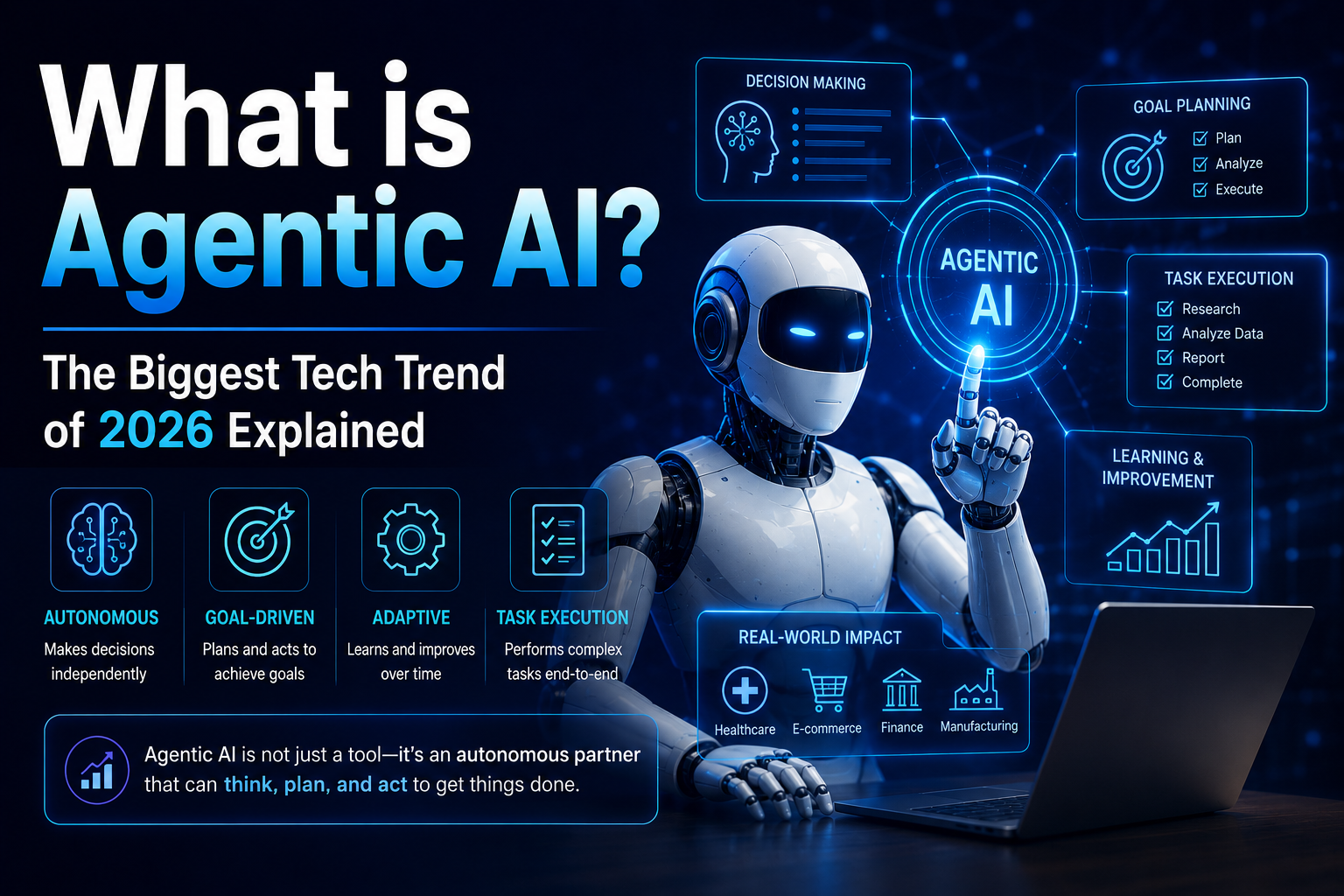
For the past few years, “AI” mostly meant chatbots — you typed a question, and a model typed back an answer. That was useful, but it was still just a conversation. In 2026, that’s no longer the whole story. Businesses are moving away from simple chatbots toward agents capable of completing entire projects with minimal human involvement — and this shift is what everyone in tech is now calling Agentic AI.
If you’ve been hearing this term everywhere — in tech news, on LinkedIn, in your company’s all-hands meeting — but still aren’t quite sure what it means, this guide breaks it down in plain language: what agentic AI actually is, how it’s different from the chatbots you already know, real tools already using it, and why analysts are calling it the defining technology story of the year. (If you’re tracking 2026’s other big tech story, our breakdown of Quantum Computing in 2026: Separating Real Progress from the Hype is worth a read too.)
What Exactly is Agentic AI?
At its core, agentic AI is artificial intelligence that can plan, decide, and act toward goals on its own, without needing a human to approve every single step. Instead of you giving a step-by-step instruction, you give it an outcome you want — and it figures out the “how.”
Think of the difference this way:
- A traditional chatbot answers your question and stops. You have to ask the next question yourself.
- Agentic AI takes a goal — like “research this topic and hand me a summary” — and works through the entire process independently: gathering sources, organizing findings, checking its own work, and adjusting course if something doesn’t work, much like an AI agent breaking a big task into smaller ones and deciding what to do first.
Industry analysts frame this as an evolution rather than a replacement. MIT Sloan describes it as the next evolution of generative AI, and Gartner has named it among the top strategic technology trends for 2026. Companies like OpenAI, Google DeepMind, and Anthropic are all racing to build the most capable agentic systems — a rivalry we cover in more depth in our DeepMind vs OpenAI: Which AI Company is Winning the Race in 2026 comparison. Importantly, older AI capabilities don’t disappear — predictive AI still powers things like fraud detection, and generative AI still drafts content, while agentic AI uses both as components inside larger systems that actually take action.
The “Agent Loop”: How Agentic AI Actually Works
Under the hood, nearly every agentic AI system — regardless of which company built it — follows the same basic cycle: Perceive → Reason → Act → Learn. In simple terms:
- Perceive – The system gathers information, whether that’s reading a message, checking a database, or pulling live data from an API.
- Reason – It plans out the steps needed to reach the goal, using its underlying language model as a kind of decision-making engine.
- Act – It actually does something: writes code, clicks buttons in a browser, sends an email, updates a spreadsheet.
- Learn – It checks whether the action worked, and adjusts its next steps if it didn’t.
This is supported by an architecture that typically includes planning modules, memory systems for keeping track of context over time, natural language processing, and interfaces that let the AI actually use external tools and APIs. That “tool use” piece is what separates agentic AI from a system that just talks — it can genuinely reach out and interact with the digital world around it.
Agentic AI vs. AI Agents vs. Chatbots: Clearing Up the Confusion
These terms get used interchangeably online, but they aren’t quite the same thing.
“AI agent” is the noun, referring to a specific software system, while “agentic AI” describes a property — essentially, how autonomously that system is able to act. Agenticness isn’t a simple yes-or-no label either; it exists on a spectrum, and most real-world tools fall somewhere between a basic chatbot and a fully autonomous operator.
A helpful way to think about the spectrum, as described by industry writers covering the space, is in three rough levels:
- Level 1: A plain chatbot that only answers questions when asked.
- Level 2: An assistant that can use one or two tools when instructed — searching the web, running a calculation.
- Level 3: A true agent that strings many of these abilities together toward a goal set once, working through the necessary steps without being prompted at each stage.
2026 is widely seen as the year this third level became genuinely practical for everyday use, rather than just an experimental research concept. The key word throughout all of this is autonomy — but it’s limited autonomy. Most agentic systems today still require a human to set the goal and, in higher-stakes situations, approve the final action.
Why 2026 is Being Called “The Year of Agentic AI”
The numbers behind this shift are genuinely striking, and they explain why this trend has jumped from tech-conference buzzword to boardroom priority.
Adoption is accelerating fast. Gartner expects 40% of enterprise applications to embed task-specific AI agents by the end of 2026, up from under 5% in 2025 — one of the fastest technology integration shifts in recent enterprise history. Mid-2026 data suggests roughly 31% of enterprises now run at least one AI agent in production, with banking and insurance leading adoption at around 47%.
The market is growing rapidly. Estimates vary by research firm, but they all point the same direction: the global agentic AI market was valued around $7.6 billion in 2025 and is projected to exceed $10.9 billion in 2026, and looking further ahead, agentic AI could generate nearly 30% of all enterprise application software revenue by 2035 in a best-case scenario.
But adoption isn’t the same as success. This is the part that often gets left out of the hype. Only about 23% of organizations are actually scaling their agent deployments into production, and most AI proofs-of-concept never make it to widescale deployment. Gartner projects that more than 40% of agentic AI projects will be canceled by the end of 2027, often due to unclear business value, security concerns, or integration problems rather than the technology itself failing outright.
The practical takeaway: agentic AI is real and scaling fast, but it’s still early enough that a lot of organizations are learning through trial and error.
Real-World Examples: Where Agentic AI is Already Working
This isn’t just theoretical. Agentic AI is already embedded in tools many people use daily:
Coding and software development is one of the most mature areas. Devin, built by Cognition, takes a feature brief and independently builds the implementation, writes tests, and submits a pull request — functioning close to an autonomous software engineer. Developer-focused tools like Claude Code and Cursor let programmers describe a task in plain language and watch an agent plan and execute it across multiple files, automatically detecting errors and applying fixes along the way.
Web browsing and research agents can now do more than just search — tools like Google’s Deep Research in Gemini and Anthropic’s Research feature in Claude can browse the web and pull information from personal documents to compile a full report. Similarly, browser-based agents can click, type, navigate pages, fill out forms, and complete multi-step workflows on a person’s behalf, while letting the person watch and step in whenever they want.
Customer support and business operations are seeing measurable impact too. Tools like Intercom Fin operate as autonomous customer support agents, while one study found professionals using an AI agent saw a 42% reduction in documentation time, saving roughly 66 minutes a day.
General-purpose “super agents” like Manus are built to handle broad, hosted tasks — research, browser-based execution, and multi-step deliverables like reports and spreadsheets — while more specialized tools focus tightly on one job, like engineering tickets or SEO content pipelines.
Across industries, McKinsey research cited by industry analysts suggests early adopters of agentic AI are already seeing roughly a 20% increase in operational efficiency — a meaningful number for any business considering the shift.
The Benefits: Why Companies Are Racing to Adopt It
The appeal is straightforward. Agentic AI offers operational efficiency, faster adaptability, cross-domain intelligence, and support for humans doing complex, multi-step work. Instead of an employee manually stitching together five different tools to complete a task, an agent can do that stitching itself — end to end, and often much faster than a person could.
It also frees up human employees from repetitive tasks, letting them focus more on strategy, problem-solving, and creative work, while some organizations are beginning to treat AI agents less like tools and more like collaborative team members that track project progress and flag issues before they escalate. Marketing teams in particular are already putting this to work — if you want a closer look at how, check out our guide on AI-Powered Marketing Strategies That Actually Work.
The Risks: What Nobody Should Ignore
For all the excitement, agentic AI comes with real, well-documented risks — and security researchers are sounding the alarm loudly heading into 2026.
It’s now considered the top cybersecurity threat of the year. A widely cited industry poll found that 48% of cybersecurity professionals identify agentic AI and autonomous systems as the top attack vector for 2026, ahead of deepfakes and other emerging threats. Separate research found the average AI agent-related data breach now costs roughly $4.7 million, and in controlled security tests, autonomous agents have been walked through entire enterprise systems in under two hours.
The core problem is permissions. Because agents need broad access to files, tools, and systems to actually get things done, they create what security teams call a much larger “attack surface.” Prompt injection, excessive permissions, data exfiltration, and situations where an agent misuses its elevated access are all common challenges organizations are grappling with.
Impersonation is an emerging concern. Some security researchers warn that if an attacker fully compromises an internal agent, they could use it to impersonate a senior executive within internal systems and request actions like fund transfers, with employees who are used to interacting with AI potentially not questioning the request.
And job disruption is a real conversation, not just speculation. Some projections suggest AI agents could automate a significant share of office and knowledge-work tasks by 2030, with junior, entry-level roles facing disruption first while senior employees shift into new roles overseeing and managing AI systems. That said, most researchers describe this as a reshaping of work rather than mass unemployment — new roles like “AI orchestrator” are emerging even as some existing ones shrink.
So, Is Agentic AI Actually Worth the Hype?
The honest answer: it depends on the use case. Agentic AI is delivering genuine results in narrow, well-defined domains — coding, research, customer support, documentation — where the task is repetitive enough to automate safely and measurably. It’s far less proven in high-stakes, open-ended business processes, where the gap between an impressive demo and a reliable, secure production system is still wide.
For everyday users, the practical impact is already visible: your coding assistant increasingly finishes tasks instead of just suggesting code, your research tool increasingly compiles a report instead of just answering one question, and your browser assistant increasingly completes a form instead of just explaining how to fill it out. That shift — from AI that talks to AI that does — is exactly what makes 2026 the breakout year for agentic AI.
Frequently Asked Questions
Is agentic AI the same as ChatGPT or Claude?
Not exactly. ChatGPT and Claude are AI models that can operate in different modes — as a basic chatbot, or as an agent when given tools like web browsing, code execution, or browser control. The “agentic” part refers to the mode of operation, not the model itself.
Do I need to be a programmer to use agentic AI tools?
No. Many consumer-facing agentic tools — like Deep Research features, Manus, or browser-based assistants — are designed for non-technical users and require no coding at all.
Is agentic AI safe to use for personal tasks?
For everyday, low-stakes tasks like research or organizing information, generally yes. For anything involving sensitive data, financial transactions, or system-level access, it’s worth understanding the permissions you’re granting before letting an agent act on your behalf.
Will agentic AI replace jobs?
It will reshape many jobs rather than eliminate work outright, with entry-level and repetitive tasks most exposed. Most analysts expect new roles focused on managing and overseeing AI agents to emerge alongside the disruption.

[…] pages as though everyone already knows exactly what it means. That’s exactly why we wrote a plain explanation of what agentic AI actually means, with no assumed background knowledge required to follow […]
[…] tools that don’t just generate content but actively manage entire workflows — the same agentic AI shift reshaping AI more […]
[…] of thousands of AI agents coordinating autonomously on a task sounds unfamiliar, our explainer on what agentic AI actually means breaks down the concept behind this kind of […]