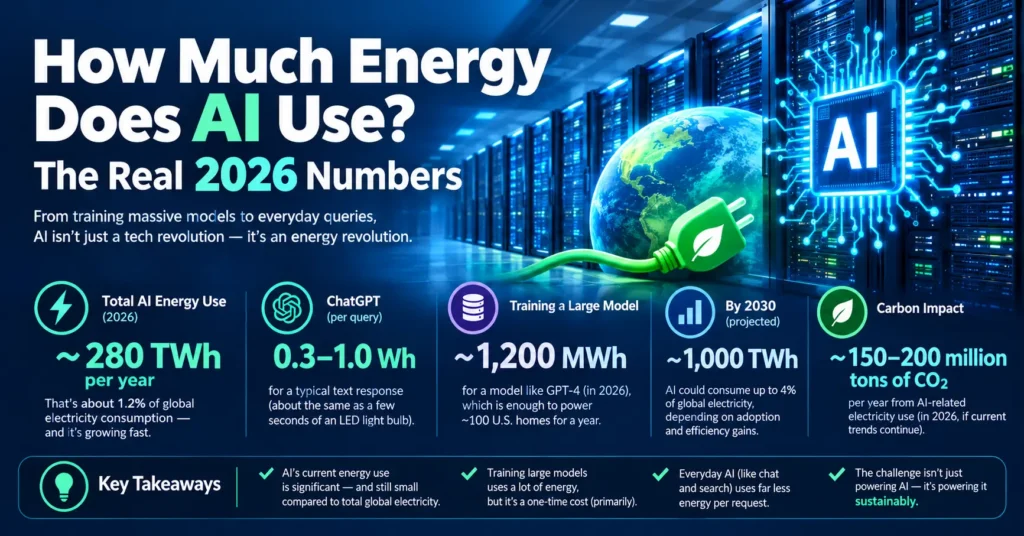
Every time you use an AI tool like ChatGPT, Gemini, or Claude, your request travels to a data center where powerful servers and GPUs process it before sending the answer back to you. This everyday AI use may seem simple, but it requires real computing power and electricity behind the scenes.
As AI use continues to grow, so does the amount of energy needed to run these systems. However, exactly how much energy AI consumes has become one of the most debated questions in technology. Estimates can vary significantly depending on the AI model, the type of task, the hardware being used, and what researchers include in their calculations. Here’s what the latest available data tells us about AI energy use in 2026.
How Much Energy Does a Single AI Query Use?
A typical ChatGPT text query uses somewhere around 0.3 to 0.34 watt-hours of electricity — a figure that comes from OpenAI’s own disclosures and closely matches independent analysis by Epoch AI. Tech companies haven’t historically been very transparent about these numbers, but recent estimates from multiple sources now converge around that 0.3 watt-hour mark for a typical text query, which works out to roughly 10 seconds of microwaving or a few seconds in the shower.
If you’re weighing which AI coding tool to use day to day, it’s worth knowing that this per-query baseline applies to simple chat use — our comparison of Claude Code, Cursor, and GitHub Copilot covers tools that often run far more agentic, multi-step workloads than a single chat message.
Google reports a lower figure for a median Gemini prompt — around 0.24 watt-hours — and has said that number fell dramatically over just twelve months, dropping by a factor of roughly 33 as the company optimized its infrastructure and models. That drop matters a lot, because many of the alarming energy figures still circulating online are based on outdated estimates from before these efficiency gains.
Is a ChatGPT Query Really 10x a Google Search?
This comparison shows up constantly, and it’s directionally accurate, though it deserves context. A Google search uses roughly 0.03 to 0.04 watt-hours, versus roughly 0.3 watt-hours for a typical ChatGPT query — putting the AI query at somewhere around ten times the energy cost of a traditional search. The gap comes down to fundamentally different computational work: search matches a query against a pre-built index in milliseconds, while a language model generates original text by running the input through billions of parameters across many layers, a sequential process that simply demands more compute per request.
That said, per-query cost isn’t the same as total impact. Google still processes a far larger volume of searches globally than ChatGPT processes queries, so despite the per-query gap, Google Search’s total global electricity footprint remains larger in absolute terms than ChatGPT’s.
How Much Electricity Do AI Data Centers Use Overall?

Data center electricity consumption overall is estimated at around 415 terawatt-hours (TWh), or about 1.5% of global electricity consumption as of 2024, and has been growing at roughly 12% per year over the preceding five years. That figure covers all data centers, not just AI-specific ones — but AI is now the dominant driver of new growth in that number.
Looking specifically at AI-focused infrastructure, the IEA estimates AI-focused data centers consumed around 155 TWh in 2025, about half a percent of global electricity generation that year. Growth in this specific category has been sharp — electricity use at AI-focused data centers reportedly surged 50% in 2025 alone, while overall data center demand grew a comparatively modest 17% that same year.
Looking ahead, total data center consumption is projected to climb from that 415 TWh baseline in 2024 to nearly 945 TWh by 2030 — roughly 3% of global electricity consumption — at an annual growth rate of about 15%, a pace that significantly outstrips overall global electricity demand growth. More recent industry tracking puts the near-term trajectory even higher: one widely cited 2026 estimate puts global data center electricity consumption at 565 TWh, up 26% from the prior year.
What About Training a Model Like GPT or Grok?
Training gets most of the public attention, but it’s actually a shrinking share of total AI energy use compared to inference — the electricity used every time someone actually runs a query. One estimate for training Grok 4, a fairly large model, puts the electricity cost at around 0.31 terawatt-hours — roughly 0.2% of total AI electricity demand in 2025. Most analysts now expect the ratio to keep shifting further toward inference: as more people use AI tools daily, and as tasks get more complex, running the models will consume far more cumulative energy than training them ever did.
Not All AI Queries Are Equal
This is the part that gets glossed over in most headline comparisons. A simple text response and an AI agent booking flights, comparing hotels, and cross-referencing a map are not remotely comparable in energy cost, even though both start with typing a request. According to a 2026 IEA report, video generation, reasoning, and agentic tasks can use hundreds to thousands of times more energy per query than a basic text response. An agent running multiple tool calls in a loop — the same category of system covered in our explainer on what agentic AI actually means — draws meaningfully more power than a single text completion, precisely because it’s doing meaningfully more computational work behind the scenes.
This isn’t a small distinction. OpenAI’s own recent claim of directing roughly 10,000 coordinating AI agents to work on a math proof for 88 straight hours — covered in our reporting on the resulting credit dispute — is a real-world example of exactly the kind of large-scale, multi-agent workload that falls into this far more energy-intensive category, well beyond what a single chat response costs.
What About Water Usage?
Electricity isn’t the only resource in play. Data centers generate substantial heat, and large facilities commonly use evaporative cooling, where water absorbs heat and evaporates — efficient, but water-intensive. Researchers at UC Riverside estimated that roughly every 5 to 50 prompts sent to ChatGPT use about 500 milliliters of water for cooling, though the figure varies significantly depending on data center location and outside temperature.
The scale of this adds up regionally. In Texas specifically, one water-footprint analysis projects data center water use could reach nearly 400 billion gallons by 2030, up roughly eightfold from 2025 levels, as more large-scale AI infrastructure gets built in the state.
So Is AI’s Energy Footprint a Big Deal or Not?
Both things are true at once, depending on which number you’re looking at. At the level of a single query, AI’s footprint is genuinely small — a handful of ChatGPT questions costs roughly as much energy as a few seconds of showering. But at the aggregate, infrastructure level, the growth trajectory is real and fast: AI-specific data center electricity use jumping 50% in a single year is not a rounding error, and the water and land footprint of new data center construction has already triggered organized local resistance in a number of U.S. communities.
The most accurate summary is that individual AI usage isn’t what’s straining power grids — the sheer scale of global build-out, running around the clock to serve billions of daily queries plus a fast-growing share of far more energy-intensive agentic and video-generation tasks, is where the real story lives.
Frequently Asked Questions
How much energy does one ChatGPT query use?
Roughly 0.3 to 0.34 watt-hours for a typical text query, based on OpenAI’s own figures and independent estimates from Epoch AI — equivalent to a few seconds of using a microwave.
Does ChatGPT use more energy than a Google search?
Yes, roughly ten times more per query — about 0.3 watt-hours versus 0.03 to 0.04 watt-hours for a typical search — because generating original text requires substantially more computation than matching a query against a search index.
What percentage of global electricity does AI use?
AI-focused data centers consumed an estimated 155 TWh in 2025, about 0.5% of global electricity generation. All data centers combined (AI and non-AI) account for a larger share, estimated at around 1.5% of global electricity in 2024, projected to reach roughly 3% by 2030.
Do AI agents use more energy than a simple chatbot response?
Significantly more. Reasoning, video generation, and agentic tasks that run multiple tool calls can use hundreds to thousands of times more energy per query than a basic text response, according to 2026 IEA analysis.
How much water does AI use?
Estimates suggest roughly 500 milliliters of water — about one bottle — gets used for cooling for every 5 to 50 ChatGPT prompts, though this varies widely by data center location and climate.
This article reflects publicly available data and industry estimates as of 2026. AI energy figures are updated frequently by the IEA, Epoch AI, Google, and other sources as infrastructure and model efficiency continue to change — check primary sources for the most current numbers.