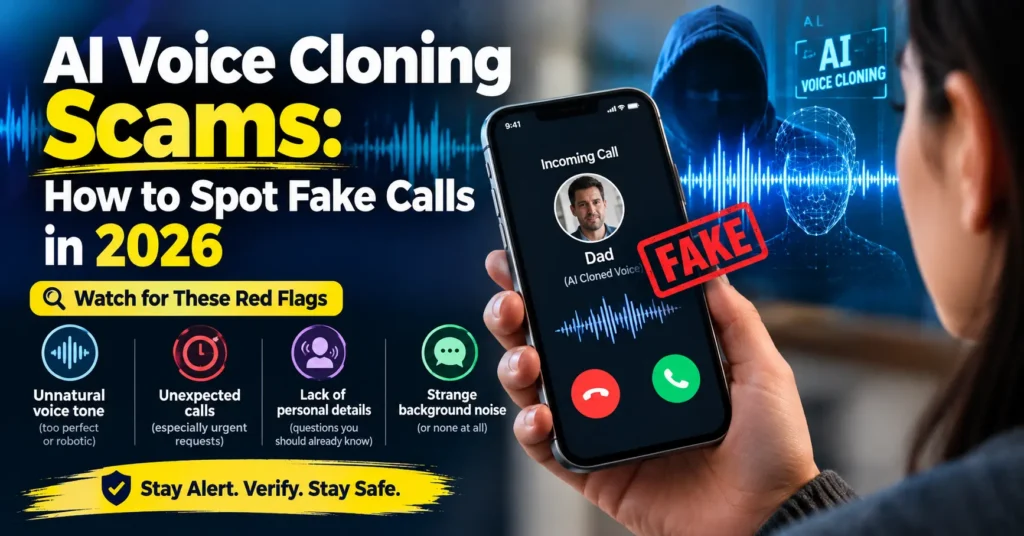
A phone rings. It’s your daughter’s voice, panicked, saying she’s been in an accident and needs money sent immediately. Except it isn’t her — it’s an AI Voice Cloning Scams, built from a few seconds of audio pulled off a video she posted online weeks ago. This isn’t a hypothetical anymore. It’s happening at a scale large enough that industry trackers now describe it as one of the fastest-growing fraud categories of 2026.
Here’s what’s actually changed, why your instincts can no longer be trusted to catch it, and what genuinely works to protect yourself and your family.
How Much Audio Does It Take to Clone Someone’s Voice?
As little as three seconds. That’s down from roughly 60 seconds required just a few years ago, and open-source voice models can now produce a usable clone from a single voicemail greeting, a TikTok comment reply, or a short Instagram Story. Anyone who has posted even minimal audio of themselves online — which describes most people with any social media presence — has enough of a voice sample circulating publicly for a scammer to work with.
Can People Actually Tell a Cloned Voice From a Real One?
Not reliably, and this is the part that makes 2026’s scam landscape genuinely different from the past. Voice cloning technology has crossed what researchers describe as the “indistinguishable threshold” — the point where ordinary human listeners can no longer consistently tell a cloned voice apart from the real thing. Peer-reviewed testing on detection accuracy found people correctly identified AI Voice or AI-generated audio only around 57% of the time on scripted clips, rising to about 77–83% under more favorable conditions like unscripted or combined audio samples.
In practical terms, your ear is only slightly better than a coin flip at catching this on a stressful, unexpected call. This same difficulty applies beyond audio — our guide on how to spot AI-generated content and deepfakes covers the equivalent challenge for images, video, and text.
How Common Are These Scams Right Now?
More common than most people realize. A 2026 survey of over 12,000 American consumers found that 1 in 4 respondents had personally received a deepfake voice call within the past year — a scale that puts this well past the “rare, unlucky victim” framing that older scam-awareness campaigns relied on. Separately, industry fraud trackers recorded deepfake-enabled voice phishing (vishing) attacks surging over 1,600% in a single quarter compared to the one before it, and broader AI Voice-driven scam activity increasing more than tenfold across 2025 alone.
Can You Trust Caller ID?
No — and this is the detail that catches even cautious people off guard. Caller ID spoofing lets scammers display any number they choose, including the real phone number of the family member or institution they’re impersonating. Seeing a familiar name or number on your screen tells you nothing about who’s actually on the other end of the call. Call authentication systems designed to flag this (known as STIR/SHAKEN attestation) currently cover only a minority of calls reliably, and calls originating overseas — where a large share of these scams are run from — frequently bypass the system entirely.
What Do These Scam Calls Usually Look Like?
A few patterns show up repeatedly:
- The fake emergency call — a “family member” claiming to be in an accident, arrested, or in a foreign jail, urgently asking for money before you have time to think it through
- The fake executive call — a cloned voice of a company’s CEO or a senior manager instructing an employee to authorize an urgent wire transfer, bypassing normal approval steps
- The fake kidnapping call — a manufactured crisis designed to trigger panic and prevent the person receiving the call from pausing to verify anything
All three rely on the same mechanism: manufactured urgency that discourages verification. A cloned voice combined with a time-pressured, emotionally charged scenario is specifically designed to short-circuit the instinct to double-check. Some of the more advanced 2026 operations go further still, using autonomous systems to identify targets and time calls without a human operator directing each step — the same underlying shift covered in our explainer on what agentic AI actually means.
What Actually Works to Protect Yourself?
Set a family safe word
Agree on a word or phrase in advance with close family members — something a scammer would have no way of knowing — that gets used to verify identity during any unexpected, urgent call involving money or danger. This single step defeats the vast majority of voice-cloning scam attempts, because the entire scam depends on you not having a way to independently verify who you’re actually talking to.
Hang up and call back manually
Don’t hit redial, and don’t call a number the caller gives you. Independently look up the person’s or institution’s number from your own contacts or records and call that instead. This breaks any spoofing or call-forwarding trick the scammer might be relying on.
Treat urgency itself as a warning sign
Legitimate emergencies rarely require an irreversible financial decision within minutes, and legitimate authority figures don’t object to a brief verification step. Resistance to verification, or pressure to act before you can confirm anything, is one of the clearest signals something is wrong.
Never send money through gift cards, wire transfers, or cryptocurrency during a “crisis” call
These payment methods are effectively untraceable and unrecoverable once sent, which is exactly why scammers favor them.
Be selective about what audio of yourself is public
Every video, voicemail greeting, or voice note posted publicly is a potential training sample. This doesn’t mean disappearing from social media, but it’s worth knowing that public audio, however brief, is no longer “safe” simply because it seems too short or mundane to be useful to anyone.
Are There Tools That Can Detect Cloned Voices for Me?
A handful exist, mostly aimed at carriers, banks, and enterprises rather than individual consumers. Detection systems from providers like Hiya, Pindrop, and Reality Defender are increasingly integrated at the carrier level and, in controlled testing, cut fraud success rates significantly. For everyday consumers, though, dedicated real-time voice-clone detection during a live personal call remains limited — carrier-level spam and scam-likely labeling helps filter some attempts, but the strongest defense available to an individual right now is still procedural: a safe word and a callback on a known number, not a piece of software running in the background.
Is Law Enforcement Doing Anything About This?
Yes, and there has been real enforcement activity. In 2025, the FBI’s Internet Crime Complaint Center supported roughly 175 arrests across more than a dozen joint international operations targeting the infrastructure behind AI-driven call fraud. That’s meaningful, but the scale of the broader problem — with projected global losses from deepfake-enabled scams reaching an estimated $40 billion by 2027 — makes clear that enforcement alone isn’t going to outpace how cheap and accessible this technology has become.
Frequently Asked Questions
How much audio does a scammer need to clone someone’s voice?
As little as three seconds of clear audio, down from around 60 seconds a few years ago. A short voicemail greeting or a brief social media clip is enough for current voice-cloning tools.
Can I trust caller ID to know who’s really calling?
No. Caller ID can be spoofed to display any number, including a real family member’s or a legitimate institution’s actual phone number. A familiar number on your screen doesn’t confirm who is actually calling.
What’s the single best way to protect against an AI voice cloning scam?
Agree on a family safe word or phrase in advance, and use it to verify identity on any unexpected call involving money or a crisis. Combined with hanging up and calling the person back on a number you already have, this defeats most voice-cloning scam attempts.
How common are AI voice cloning scams in 2026?
Very common. A 2026 survey found 1 in 4 Americans had received a deepfake voice call in the past year, and industry data shows deepfake-driven voice phishing attacks increasing by well over 1,000% year over year.
Can people reliably tell a cloned voice from a real one just by listening?
No. Testing shows human listeners correctly identify AI-generated voice audio only around 57 to 83% of the time depending on conditions — not reliable enough to depend on for a high-stakes decision.
This article reflects publicly available research and industry data as of 2026. If you believe you’ve been targeted by a voice cloning scam, report it to the FTC or your local authorities, and contact your bank immediately if any payment was made.