
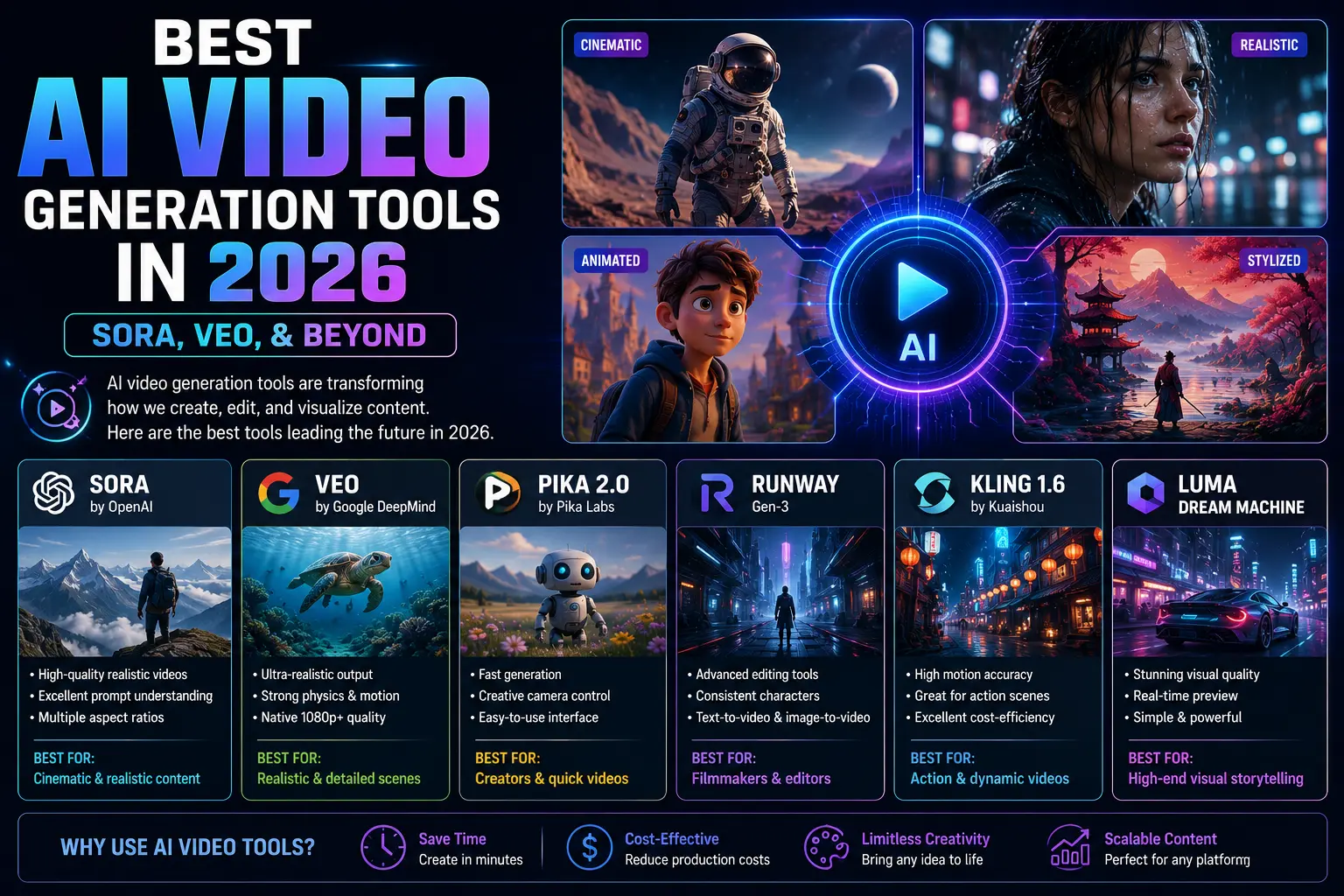
A year ago, “best AI video generator” was a two-horse race between OpenAI’s Sora and Google’s Veo — a rivalry that mirrors the broader DeepMind vs OpenAI race playing out across the AI industry. In 2026, that framing is already outdated — and not just because new competitors showed up. The single biggest story in AI video this year is that Sora, the tool that arguably started the mainstream AI video conversation, is being shut down. OpenAI has confirmed that the Sora web and app experiences were discontinued on April 26, 2026, with the Sora API scheduled to follow on September 24, 2026.
That means anyone searching for the “best AI video tool” in mid-to-late 2026 isn’t really choosing between Sora and its rivals anymore — they’re choosing a replacement. This guide covers exactly that: what happened to Sora, which tools have stepped up to fill the gap, and how to actually pick the right one for your specific use case, whether that’s cinematic storytelling, marketing content, or fast social clips.
What Happened to Sora?
To be clear about the timeline: OpenAI didn’t quietly deprecate Sora — it made a public, dated announcement. The free tier was removed first, on January 10, 2026, pushing Sora 2 behind a ChatGPT Plus ($20/month) or ChatGPT Pro ($200/month) subscription, with geographic access limited to the United States and Canada. Then, a few months later, OpenAI announced the full discontinuation of the web and app experiences on April 26, 2026, with the API following on September 24, 2026.
For a tool that had, at its peak, been genuinely regarded as the quality benchmark for AI video — praised for film-grade output and exceptional prompt adherence — this is a significant shift in the competitive landscape. Millions of creators who had built workflows around Sora have spent 2026 actively searching for alternatives that offer comparable quality without OpenAI’s access restrictions or, now, its outright unavailability.
The Bigger Trend: A Geopolitical Shift, Not Just a Technical One
Here’s what makes 2026’s AI video landscape genuinely different from a year ago: it isn’t simply that Sora has a worthy rival now. On leaderboards like the Artificial Analysis Video Arena, the top of the text-to-video-with-audio rankings is now dominated by Chinese models — from ByteDance, Alibaba, and Kuaishou — while the most famous Western product is being switched off entirely. What was a two-or-three-player market in early 2025 has become a genuinely crowded field of roughly a dozen frontier-level models, and native synchronized audio generation, once a standout feature, is now table stakes across most serious competitors.
The quality gap has also narrowed dramatically between price tiers. Blind testers reportedly now struggle to reliably tell the difference between output from a roughly $10/month prosumer plan and an enterprise-grade API in several of these tools — a meaningful shift for creators who assumed premium pricing was still the only path to genuinely good results.
The Tools That Matter Most in 2026
Google Veo 3.1 — Best for Native Audio and Cinematic Quality
Google’s Veo 3.1 is consistently ranked among the top active cinematic AI video generators available in 2026, particularly praised for synchronized audio generation, strong prompt-following, and overall cinematic polish. It’s frequently recommended as the safest starting point for creators specifically focused on narrative-driven, film-style content — largely because Google has continued actively developing and supporting it, unlike Sora.
Pricing is also a genuine strength here: Veo 3.1 Lite is considered the cheapest Western option among vendors offering enterprise-grade infrastructure, with per-second API pricing starting around $0.15/second in fast mode — a meaningfully more accessible entry point than several premium competitors.
Best for: Cinematic storytelling, marketing content requiring native audio, and creators who want strong quality without the highest price tier.
Runway Gen-4.5 — Best for Creative Control and Editing Precision
Runway has positioned itself less as a pure video-generation model and more as a full production workspace — and Gen-4.5 reflects that. It’s repeatedly recommended as the “safest production pick” for teams that need genuine editing control alongside raw generation quality, rather than a one-shot text-to-video tool. Notably, Runway’s platform has also integrated Google’s Veo 3/3.1 models directly, letting users access multiple frontier models within a single workspace rather than juggling separate subscriptions.
Best for: Professional creative teams and cinematographers who need director-level control over shots, character consistency, and multi-scene continuity — not just a single impressive clip.
Kling 3.0 — Best for Motion Quality and Budget Pricing
Kling, from Kuaishou, has emerged as one of the strongest risers in the 2026 landscape, specifically noted for photorealistic motion quality at genuinely budget-friendly pricing. Kling 3.0 Standard is currently the cheapest credible per-clip price among major tools — roughly $0.84 for a ten-second clip with audio included — making it a standout choice for creators or marketing teams who need high output volume without enterprise-level spending.
Best for: Marketing teams and creators producing high volumes of short-form social content who need the most output per dollar without sacrificing visual quality.
Seedance 2.0 / 2.5 (ByteDance) — Strongest Cinematic Challenger
ByteDance’s Seedance 2.0, which launched in early 2026, immediately positioned itself as one of the strongest challengers to Sora specifically for cinematic-style generation, and the follow-up Seedance 2.5 has continued to be recognized — alongside Veo 3.1 — as one of the few tools offering genuinely reliable native synchronized audio generation, reducing the need for a separate audio production pipeline entirely.
Best for: Creators specifically chasing cinematic quality who want native audio without stitching it together in post-production.
HeyGen — Best for Business and Presenter-Led Content
Not every video need is a cinematic B-roll shot — a huge amount of practical business content requires a consistent, believable presenter talking directly to camera. This is where HeyGen stands out from the cinematic-focused tools above, offering an AI spokesperson workflow, support for 120+ languages and accents, and an intuitive script-to-video editor built specifically for creators who aren’t chasing visual perfection so much as fast, professional, presenter-driven output. It’s part of a broader shift toward tools that don’t just generate content but actively manage entire workflows — the same agentic AI shift reshaping AI more broadly.
Best for: Product demos, corporate training content, and any project that specifically needs a consistent AI presenter rather than pure cinematic B-roll.
Luma Dream Machine (Ray 3) — Best for Speed
Luma continues to be recommended specifically for creators who prioritize speed — generating eye-catching clips quickly for fast-moving social media content, even if it doesn’t always lead the pack on raw cinematic quality benchmarks.
Best for: Social media managers and creators who need to move fast and iterate quickly over chasing the absolute highest production value.
Hedra, InVideo AI, and Kapwing — Multi-Model Platforms
Rather than betting on a single video-generation engine, an increasingly popular category of tools bundles access to multiple underlying models — including, in some cases, continued indirect access to Sora 2 — within one workspace, often at lower effective cost than subscribing to each model directly. Hedra, for example, pairs this multi-model access with additional creative tools like face swap and AI image generation in the same interface, while also offering brand-kit support for consistent output across a content library.
Best for: Teams and creators who don’t want to commit to a single model’s strengths and weaknesses, and who value workflow consistency and brand control across multiple video engines.
PixVerse V6 and MiniMax Hailuo 2.3 — Budget and Workflow-Friendly Options
Rounding out the practical alternatives are tools like PixVerse V6 and MiniMax Hailuo, frequently mentioned as strong runner-up or budget-friendly picks worth testing depending on your specific storyboard, ad-concept, or API-integration needs.
Pricing Snapshot: What Things Actually Cost in 2026
Normalized to a 10-second, 1080p clip as of mid-2026:
- Kling 3.0 Standard: The cheapest credible option, at roughly $0.84 for a 10-second clip with audio — the strongest per-dollar value in this comparison.
- Veo 3.1 Lite: The cheapest Western option among enterprise-grade vendors, with per-second API pricing starting around $0.15/second in fast mode.
- Runway and Luma: Positioned at the premium end of pricing — a reasonable tradeoff only if you’re specifically paying for Runway’s editing tooling or Luma’s generation speed, rather than raw per-clip cost efficiency.
- Sora 2 Pro: Notably, even before its discontinuation, Sora 2 Pro had become the single most expensive option in most 2026 comparisons, at roughly $0.75 per second — a detail that makes its sunset somewhat less painful for cost-conscious creators than its reputation might suggest.
If you’re specifically looking for a free tier to learn and experiment on, most major tools in this comparison — Kling included — offer a usable free option, a notable exception being Sora, which had already removed its free tier before its full discontinuation was announced. Students and beginners looking for other genuinely free AI tools beyond video generation can check out our guide on Best Free AI Tools for Students in 2026, covering everything from research and writing to studying from your own notes.
How to Choose the Right Tool for Your Use Case
If you need cinematic storytelling with strong narrative control: Google Veo 3.1 (via Google Flow) and Runway Gen-4.5 are the most consistently recommended options, with Runway specifically preferred by teams that need granular editing control alongside generation quality.
If you’re a marketing team producing high-volume social content: Kling 3.0 Standard and Veo 3.1 Lite offer the strongest output-per-dollar ratio, and both include native audio generation, reducing post-production overhead.
If your content specifically needs a consistent AI presenter or spokesperson: Veo and Sora-style cinematic tools generally aren’t built for this — HeyGen’s dedicated presenter workflow is the more reliable choice for business and training content.
If you want maximum creative flexibility without committing to one model: Multi-model platforms like Hedra or InVideo AI let you access several underlying engines from a single workspace, which is particularly useful if different projects call for different tools’ specific strengths.
If speed matters more than polish: Luma Dream Machine remains a strong pick for creators who need to move fast on social content without waiting on longer, more computation-heavy cinematic renders.
What This Means If You Were Relying on Sora
If Sora was part of your existing production, storyboard, ad-concept, or API workflow, the practical task now isn’t mourning its shutdown — it’s picking a replacement that fits your next job, budget, and access path before the API sunset date arrives. Based on the comparisons above, Runway and Veo are most frequently recommended as the closest match for cinematic-quality work, while HeyGen remains the stronger choice specifically for business and presenter-led content that Sora’s cinematic focus was never really built for in the first place.
It’s also worth noting that several platforms — including Hedra, InVideo AI, and Kapwing — continue to offer some form of indirect Sora 2 access alongside other engines, at least until the underlying API is fully retired in September 2026, which could be a useful bridge option if you need more time to migrate an existing workflow.
Final Thoughts
The AI video generation space in 2026 looks almost nothing like it did even twelve months ago. The tool that many considered the category’s defining product is being shut down, Chinese models have taken over the top of major performance leaderboards, and the practical gap between budget and enterprise-tier output has narrowed enough that most creators no longer need to pay premium prices just to get genuinely good results.
The real takeaway for anyone choosing a tool right now: there’s no single universal “best” AI video generator anymore, and treating this as a simple one-tool decision misses how specialized the leading options have become. Match the tool to your actual use case — cinematic storytelling, high-volume marketing content, presenter-led business video, or fast social clips — and you’ll likely land on a genuinely capable replacement for whatever gap Sora’s discontinuation leaves behind.
Frequently Asked Questions
Is Sora still usable in 2026?
The Sora web and app experiences were discontinued on April 26, 2026. The Sora API remains active only until September 24, 2026, after which it will be fully retired. If you’re starting a new project, Sora is no longer a viable starting point — it’s strictly a migration consideration for existing users on a deadline.
What is the best free AI video generator in 2026?
Most major tools compared here, including Kling, offer a usable free tier for learning and experimentation. Sora is a notable exception, having removed its free tier back in January 2026, before its full discontinuation was announced.
Which AI video tool has the best audio generation?
Google Veo 3.1 and ByteDance’s Seedance 2.5 are the two tools most consistently praised for native, synchronized audio generation — sound effects, dialogue, and ambient noise generated directly alongside the video, without needing a separate audio pipeline.
Which AI video generator is cheapest for high-volume content?
Kling 3.0 Standard currently offers the cheapest credible per-clip pricing among major tools, at roughly $0.84 for a ten-second clip including audio, making it a strong choice for marketing teams generating large volumes of short-form content.
Can AI video tools generate a consistent presenter or spokesperson?
Cinematic tools like Veo and Runway aren’t primarily built for this. HeyGen is the more reliable choice specifically for presenter-led business and training content, offering a dedicated AI spokesperson workflow with support for 120+ languages and accents.
Do I need to use multiple AI video tools instead of just one?
Increasingly, yes, for teams with varied needs. No single AI video model excels at everything — this is exactly why multi-model platforms like Hedra and InVideo AI, which bundle access to several underlying engines in one workspace, have grown in popularity throughout 2026.
Note: Pricing, product availability, and discontinuation dates referenced in this article reflect publicly available information as of mid-2026. AI video tools and their pricing structures continue to evolve rapidly — always check official vendor sources for current details before committing to a workflow.



[…] remains one of the most widely adopted AI tools for small business owners, largely because of its flexibility. It’s used for drafting content, analyzing data, coding […]
[…] Gemini itself, and that same underlying progress now extends well beyond text into tools like the AI video generators reshaping how content gets […]