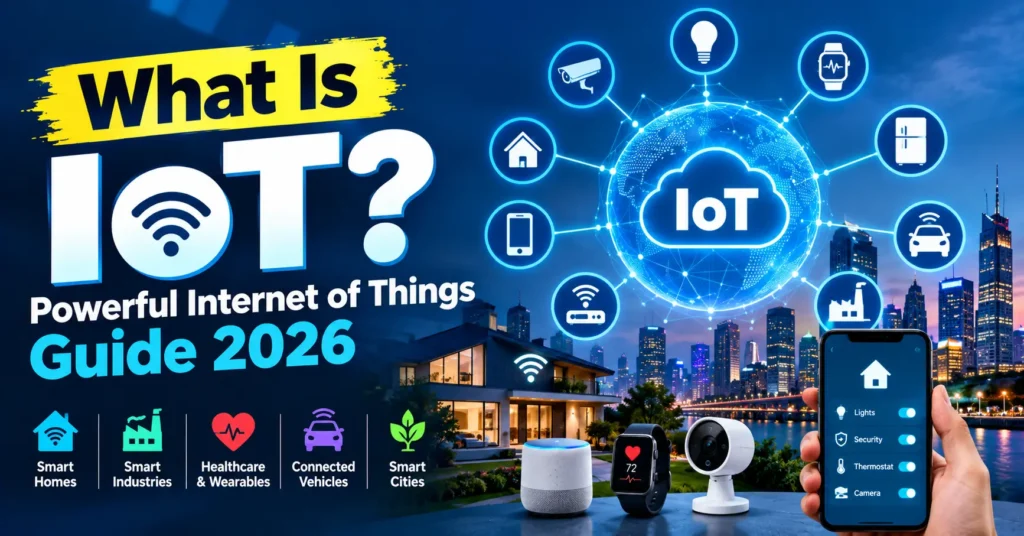
Imagine your smartwatch tracking your heart rate, your smart TV connecting to the internet, a security camera sending alerts to your phone, or a factory machine warning engineers before it fails.
These are all examples of the Internet of Things, commonly called IoT.
But what is IoT exactly? How does it work? What makes a normal device an IoT device? And why are businesses, homes, healthcare systems, factories, farms, and cities investing in connected technology?
In simple terms, IoT is a network of physical devices that use sensors, software and network connectivity to collect, exchange and sometimes act on data. NIST describes IoT devices as systems that can include hardware, software, firmware and actuators that allow devices to connect, interact and exchange information.
This guide explains what is IoT, how IoT works, its components, types, examples, applications, benefits, limitations, security risks, IoT vs IIoT, and the role of AI and edge computing.
What Is IoT? Quick Answer
IoT stands for Internet of Things.
It refers to connected physical devices that can collect data through sensors, communicate through a network, process or send that data, and in many cases perform an action using an actuator.
Examples include:
- Smartwatches
- Smart thermostats
- Smart speakers
- Smart TVs
- Security cameras
- Connected cars
- Industrial machines
- Agricultural sensors
- Medical monitoring devices
- Smart electricity meters
- Connected appliances
The important point is that IoT is not simply about putting an internet connection into a device.
A useful IoT system connects the physical world with digital systems so that data can be collected, analyzed and used for monitoring, automation or decision-making. NIST specifically notes that IoT systems can interact with physical entities through sensors and actuators, which distinguishes them from many conventional IT systems.
What Does IoT Stand For?
IoT stands for Internet of Things.
The phrase has two simple parts:
Internet
The devices use networks to communicate and exchange information.
Things
The “things” are physical objects such as sensors, appliances, vehicles, machines, wearables and other equipment.
Therefore:
Internet + Connected Physical Things = Internet of Things
However, an IoT system can be more complex than just a collection of internet-connected gadgets. It may include the device itself, networking hardware, mobile applications, cloud services, databases, analytics systems and other backend infrastructure. NIST’s IoT product definition specifically recognizes components such as companion apps, gateways and backend services as part of an IoT product ecosystem.
How Does IoT Work?
The easiest way to understand IoT is to follow the journey of data.
A typical IoT system works through these stages:
Sense → Connect → Process → Analyze → Act
Let’s understand each step.
1. Sensors Collect Data
An IoT device usually has one or more sensors.
A sensor can measure things such as:
- Temperature
- Humidity
- Motion
- Light
- Pressure
- Location
- Heart rate
- Air quality
- Energy consumption
- Machine vibration
For example, a smart thermostat can measure the temperature inside a room.
A fitness tracker can collect movement and other health-related measurements.
An industrial sensor can monitor machine temperature or vibration.
2. The Device Sends Data
After collecting information, the IoT device needs a way to communicate.
Depending on the system, connectivity can include:
- Wi-Fi
- Bluetooth
- Ethernet
- Cellular networks
- Zigbee
- Thread
- LoRaWAN
- Other specialized networking technologies
NIST’s IoT guidance recognizes network interfaces such as Ethernet, Wi-Fi, Bluetooth, LTE, Zigbee and UWB among technologies that can connect IoT devices to the digital world.
The right connection depends on factors such as range, power consumption, bandwidth, reliability and cost.
3. Data Is Processed
Once the data reaches another computing system, it can be processed.
Processing may happen:
- Inside the device
- On a local gateway
- At the network edge
- In a cloud platform
- Across multiple systems
For example, a smart security camera may detect movement locally and then send an alert to a smartphone.
An industrial IoT system might send machine data to a cloud platform for deeper analysis.
4. Data Is Analyzed
Raw data becomes more useful after analysis.
For example:
Raw data:
Machine temperature = unusually high
Analysis:
Temperature has increased continuously over several hours.
Possible conclusion:
The machine may require inspection.
This is where analytics, machine learning and AI can become valuable.
5. The System Takes Action
An IoT system may simply display information.
But more advanced systems can also trigger actions.
For example:
- A smart light turns on.
- A thermostat adjusts temperature.
- A security system sends an alert.
- A machine changes its operating state.
- A sprinkler system activates.
- A vehicle sends a maintenance warning.
This ability to connect digital information with physical action is one of the most important characteristics of IoT.
Main Components of an IoT System
A complete IoT ecosystem usually contains several layers.
1. IoT Devices
These are the physical objects collecting information or performing actions.
Examples:
- Sensors
- Cameras
- Smart appliances
- Wearables
- Vehicles
- Industrial equipment
2. Sensors
Sensors collect information from the physical environment.
For example:
Temperature sensor → temperature data
Motion sensor → movement data
Pressure sensor → pressure data
3. Actuators
An actuator allows a system to perform a physical action.
For example:
- Opening a valve
- Switching on a motor
- Adjusting a thermostat
- Locking a door
This creates the connection between digital instructions and physical activity.
4. Network
The network allows devices and systems to communicate.
The network may be local or internet-based depending on the architecture.
5. Gateway
An IoT gateway can sit between devices and other networks or cloud services.
It may help with:
- Data aggregation
- Protocol conversion
- Security
- Local processing
- Device management
6. Cloud or Backend
Many IoT systems use backend infrastructure to store and process data.
This can include:
- Databases
- Analytics platforms
- Device management systems
- APIs
- Cloud services
7. Application
Users need a way to interact with the system.
This could be:
- Smartphone app
- Web dashboard
- Desktop software
- Business analytics platform
For example, your smart camera may send data to a cloud service, while you view alerts through a smartphone app.
IoT Architecture Explained
IoT architecture can be represented in a simple four-layer model:
Layer 1: Perception
This is where sensors and devices interact with the physical world.
Layer 2: Network
This layer moves data between devices, gateways and other systems.
Layer 3: Processing
This layer stores, filters and analyzes information.
Layer 4: Application
This is where the processed information becomes useful to the user or organization.
For example:
Temperature Sensor
↓
Wi-Fi/Gateway
↓
Cloud Processing
↓
Mobile App
↓
User Gets Alert
This is a simplified model. Real IoT architectures can contain many additional components and security controls.
Real-World IoT Examples
IoT is already used in many areas.
Smart Home IoT
Smart homes are one of the easiest ways to understand IoT.
Examples include:
- Smart bulbs
- Smart locks
- Smart cameras
- Smart speakers
- Smart thermostats
- Smart doorbells
- Smart appliances
Imagine a smart thermostat detecting that the house has become too cold and adjusting the temperature automatically.
That is a simple IoT use case.
IoT in Healthcare
Healthcare is another important IoT application.
Connected devices can be used for:
- Remote monitoring
- Wearable devices
- Patient measurements
- Equipment tracking
- Hospital asset management
For example, a wearable device can collect measurements and transmit information to a connected application or healthcare system.
However, healthcare IoT requires particularly strong privacy and cybersecurity controls because sensitive information may be involved.
NIST identifies healthcare and other connected environments as areas where IoT cybersecurity and privacy risks require careful management.
IoT in Agriculture
IoT can help farmers monitor environmental conditions.
Connected sensors can measure:
- Soil moisture
- Temperature
- Humidity
- Weather conditions
- Water levels
A smart irrigation system can use sensor information to help determine when watering is needed.
This can potentially reduce unnecessary water usage while improving monitoring.
IoT in Manufacturing
Manufacturing is one of the most important areas for IoT.
Factories can use connected sensors to monitor:
- Machine temperature
- Vibration
- Pressure
- Production conditions
- Energy consumption
- Equipment performance
The collected information can help identify unusual patterns before they become major problems.
This is closely related to predictive maintenance, where data is analyzed to identify signs that equipment may need attention.
What Is IIoT?
IIoT stands for Industrial Internet of Things.
IIoT is essentially the application of IoT technologies in industrial environments.
Traditional IoT examples include:
- Smartwatch
- Smart TV
- Smart thermostat
IIoT examples include:
- Factory machinery
- Industrial sensors
- Energy infrastructure
- Mining equipment
- Manufacturing systems
The difference is primarily the environment and purpose.
IBM describes IIoT as the use of smart sensors, devices and software to collect and analyze data in industrial operations, particularly where reliability, safety and operational efficiency are important.
IoT vs IIoT
| Feature | IoT | IIoT |
|---|---|---|
| Main environment | Homes, consumers, businesses | Industrial environments |
| Examples | Smartwatch, smart TV | Factory machines, industrial sensors |
| Main focus | Convenience, monitoring, automation | Efficiency, safety, reliability |
| Data | Personal/consumer data | Operational/industrial data |
| Risk | Privacy and security | Security, safety and operational disruption |
IIoT is therefore not a completely separate technology. It is a specialized application of IoT concepts in industrial environments.
IoT and Artificial Intelligence: How Are They Connected?
IoT and AI can complement each other.
IoT is good at collecting data.
AI is good at analyzing patterns and generating predictions or decisions from data.
A simplified model is:
IoT → Collect Data
AI → Analyze Data
System → Take Action
For example, industrial sensors could collect vibration data from a machine.
AI could analyze that information and identify a pattern associated with potential equipment problems.
The system could then notify an engineer.
This combination is sometimes discussed as AIoT, or Artificial Intelligence of Things.
For readers interested in the broader AI ecosystem, Tech Demis also covers current AI tools and artificial intelligence technologies, including AI assistants, research tools, coding tools and AI-powered applications.
IoT and Edge Computing
Another important technology connected to IoT is edge computing.
Normally, a connected device might send data to a remote cloud system for processing.
Edge computing moves some processing closer to the device or data source.
For example:
IoT Sensor → Local Edge Device → Immediate Decision
instead of:
IoT Sensor → Internet → Cloud → Decision → Device
Edge processing can be useful when:
- Low latency is important
- Internet connectivity is unreliable
- Large amounts of data are generated
- Privacy requirements favor local processing
- Immediate decisions are required
IBM notes that edge computing can process IoT data closer to its source, helping reduce latency and the amount of data that needs to travel to centralized systems.
What Are the Benefits of IoT?
IoT can provide several advantages.
1. Automation
Connected systems can perform tasks automatically.
For example, lights can switch on based on motion detection.
2. Real-Time Monitoring
Organizations can monitor equipment and environments continuously.
3. Better Decision-Making
Collected data can help people understand what is happening and identify patterns.
4. Improved Efficiency
Businesses can use connected data to identify wasted energy, inefficient processes or equipment problems.
5. Predictive Maintenance
Machine data can help identify potential failures before equipment completely stops working.
6. Convenience
Smart home devices can automate routine tasks.
7. Remote Management
Users can monitor and sometimes control devices remotely.
For businesses, IoT can therefore become more than a collection of connected devices. It can become part of a larger digital transformation strategy.
What Are the Disadvantages of IoT?
IoT also has limitations.
1. Security Risks
Every connected device can potentially create another pathway into a network.
NIST specifically warns that IoT devices can create new pathways into networked systems, making security management more challenging.
2. Privacy Concerns
IoT devices can collect large amounts of information.
For example, a smart home ecosystem may reveal information about:
- Occupancy
- Activity
- Location
- Device usage
- Daily routines
Users need to understand what data is collected and how it is used.
3. Device Compatibility
Different manufacturers may use different standards and ecosystems.
This can make interoperability difficult.
4. Internet Dependence
Some IoT systems depend heavily on network connectivity.
A connectivity problem can affect functionality.
5. Maintenance
IoT devices require:
- Software updates
- Security patches
- Device management
- Battery replacement
- Configuration
6. Complexity
A large IoT deployment can become difficult to manage because hundreds or thousands of devices may need to be monitored.
Is IoT Secure?
IoT can be secure, but security cannot be treated as an afterthought.
The risk comes from the fact that connected devices combine hardware, software, networking and data.
A weak device can potentially become an entry point into a larger system.
NIST’s IoT cybersecurity guidance emphasizes capabilities such as device identification, configuration management, data protection and secure software updates.
For consumers, basic IoT security practices include:
- Change default passwords
- Use strong unique passwords
- Enable multi-factor authentication where available
- Keep device software updated
- Secure the home Wi-Fi network
- Disable unnecessary features
- Review privacy settings
- Buy devices from reputable manufacturers
- Replace unsupported devices
Businesses need more advanced controls because an enterprise IoT ecosystem may contain a large number of connected devices.
IoT Security vs Traditional IT Security
IoT security can be more complicated than traditional computer security because IoT systems interact with the physical world.
A compromised laptop may expose information.
A compromised industrial controller could potentially affect physical operations.
A compromised smart lock could affect physical access.
A compromised medical device could create much more serious consequences.
This is why IoT cybersecurity needs to consider not only confidentiality and data protection but also device behavior, availability, safety and the entire connected ecosystem.
Common IoT Communication Technologies
IoT devices can use different communication technologies depending on the use case.
Wi-Fi
Useful for homes, offices and devices that require relatively high bandwidth.
Bluetooth
Useful for short-range communication, especially wearables and personal devices.
Cellular
Useful when devices need connectivity across larger geographic areas.
Zigbee
Often used for low-power connected devices and smart-home environments.
LoRaWAN
Designed for long-range, low-power IoT applications.
Ethernet
Useful where wired, stable connectivity is preferred.
There is no single “best” IoT network.
The correct technology depends on:
- Distance
- Power requirements
- Data volume
- Cost
- Reliability
- Environment
- Security requirements
IoT vs Smart Devices: Are They the Same?
Not exactly.
A smart device may have advanced features without being part of a larger IoT ecosystem.
For example, a device could perform calculations locally without sending information anywhere.
An IoT device generally participates in a connected system where data can be exchanged through a network.
The key idea is connectivity plus interaction with the physical world.
IoT vs Cloud Computing
IoT and cloud computing are different technologies, but they often work together.
IoT
Collects data from physical devices.
Cloud Computing
Provides computing, storage and services that can process or manage that data.
A common architecture looks like:
IoT Device → Network → Cloud → Analytics → Application
Cloud infrastructure can make it easier to manage large numbers of devices and large amounts of collected data.
Why IoT Data Matters
The real value of many IoT systems is not the device itself.
It is the data.
Imagine a factory with 1,000 connected machines.
Each machine can potentially generate information about:
- Temperature
- Vibration
- Energy usage
- Production
- Errors
- Maintenance status
Individually, each data point may not tell much.
But when thousands of data points are analyzed together, organizations can identify patterns.
That can support:
- Operational decisions
- Maintenance planning
- Energy optimization
- Quality control
- Automation
- Performance analysis
This is why IoT is closely connected to analytics, AI, cloud computing and edge computing.
What Is the Future of IoT?
The future of IoT is likely to involve greater integration rather than isolated smart gadgets.
IoT is increasingly connected with:
- Artificial intelligence
- Edge computing
- Cloud computing
- 5G and advanced connectivity
- Robotics
- Automation
- Digital twins
- Cybersecurity
- Smart cities
- Industrial systems
The major shift is from simply connecting devices to creating systems that can understand data and respond intelligently.
For example:
Old approach:
Sensor → Data → Human checks dashboard
More advanced approach:
Sensor → Data → AI/Analytics → Decision → Automated Action
That transition can make connected systems more useful, but it also increases the importance of cybersecurity, reliability and responsible data management.
IoT in Smart Cities
Smart cities use connected technologies to monitor and manage urban infrastructure.
Possible applications include:
- Traffic monitoring
- Smart parking
- Street lighting
- Waste management
- Air-quality monitoring
- Public transport
- Energy management
- Water systems
For example, connected sensors can provide information about traffic conditions or environmental measurements.
The data can then support city planning and operational decisions.
However, smart-city IoT also creates major privacy and cybersecurity considerations because infrastructure may involve sensitive information and critical services.
IoT in Transportation
Connected transportation systems can collect information from vehicles and infrastructure.
Examples include:
- Connected cars
- Fleet tracking
- Vehicle diagnostics
- Smart traffic systems
- Logistics monitoring
- Asset tracking
A logistics company, for example, can use connected sensors to monitor vehicles and shipments.
The result can be better visibility into where assets are and how they are performing.
IoT in Energy
Energy companies can use connected devices to monitor:
- Electricity consumption
- Grid conditions
- Equipment performance
- Solar systems
- Smart meters
IoT can help provide more detailed information about energy usage and infrastructure performance.
Combined with automation and analytics, this data can support more efficient energy management.
Is IoT Only for Big Companies?
No.
IoT exists at multiple scales.
Consumers
Smartwatches, cameras, lights and appliances.
Small Businesses
Security systems, inventory monitoring and connected equipment.
Large Enterprises
Industrial monitoring, logistics, energy management and automation.
Governments
Smart-city infrastructure and public systems.
The complexity simply changes depending on the scale.
What Skills Are Needed to Learn IoT?
If you want to build a career in IoT, useful skills include:
- Basic electronics
- Sensors
- Networking
- Programming
- Embedded systems
- Cloud computing
- Databases
- Cybersecurity
- Data analytics
- Automation
- AI and machine learning
Programming languages such as Python, C and C++ can be useful depending on the IoT role.
Developers working with connected systems may also benefit from modern AI coding assistants for development and debugging. Tech Demis has a separate guide covering the best AI coding assistants in 2026.
Frequently Asked Questions About IoT
What is IoT in simple words?
IoT means connecting physical devices to networks so they can collect, exchange and sometimes act on data.
What does IoT stand for?
IoT stands for Internet of Things.
What are examples of IoT?
Smartwatches, smart thermostats, smart cameras, connected cars, industrial sensors, smart meters and connected appliances are common examples.
How does IoT work?
IoT generally works by collecting data through sensors, sending the data through a network, processing or analyzing it, and then displaying information or triggering an action.
What are the main components of IoT?
Common components include devices, sensors, actuators, connectivity, gateways, processing systems, cloud or backend services and applications.
What is IIoT?
IIoT means Industrial Internet of Things. It refers to IoT technologies used in industrial environments such as manufacturing, energy, mining and industrial operations.
Is IoT the same as AI?
No. IoT mainly connects physical devices and collects data, while AI can analyze data, recognize patterns and support predictions or decisions. The two technologies can work together.
Is IoT part of cloud computing?
IoT and cloud computing are different technologies, but many IoT systems use cloud infrastructure to store, process and analyze device data.
Is IoT safe?
IoT can be secure when devices, networks, software and data are properly protected. However, connected devices can introduce additional cybersecurity and privacy risks.
Why is IoT important?
IoT can provide real-time monitoring, automation, remote management and data-driven decision-making across homes, businesses, healthcare, agriculture, transportation and industry.
Final Verdict: What Is IoT?
So, what is IoT?
The Internet of Things is a technology ecosystem that connects physical objects with digital networks, allowing them to collect, communicate and use data.
The simplest IoT example might be a smart light controlled from a phone. At the other end of the spectrum, IoT can involve thousands of sensors monitoring industrial machinery, transportation systems, energy infrastructure or smart-city services.
The real power of IoT comes from connecting physical data with digital intelligence.
Sensors collect information.
Networks move information.
Cloud or edge systems process it.
Analytics and AI can identify patterns.
Applications help people understand the results.
Actuators can turn digital decisions into physical actions.
At the same time, IoT creates real challenges around cybersecurity, privacy, interoperability, maintenance and reliability. NIST’s IoT work emphasizes that connected devices can introduce new pathways into networks and therefore need security considerations throughout their lifecycle.
As IoT increasingly connects with AI, edge computing, automation and advanced networks, the technology is moving beyond simple “smart devices” toward intelligent connected systems.
That is the bigger idea behind the Internet of Things: not just putting devices online, but using connected physical systems to collect information, understand what is happening and respond more intelligently.