
Introduction
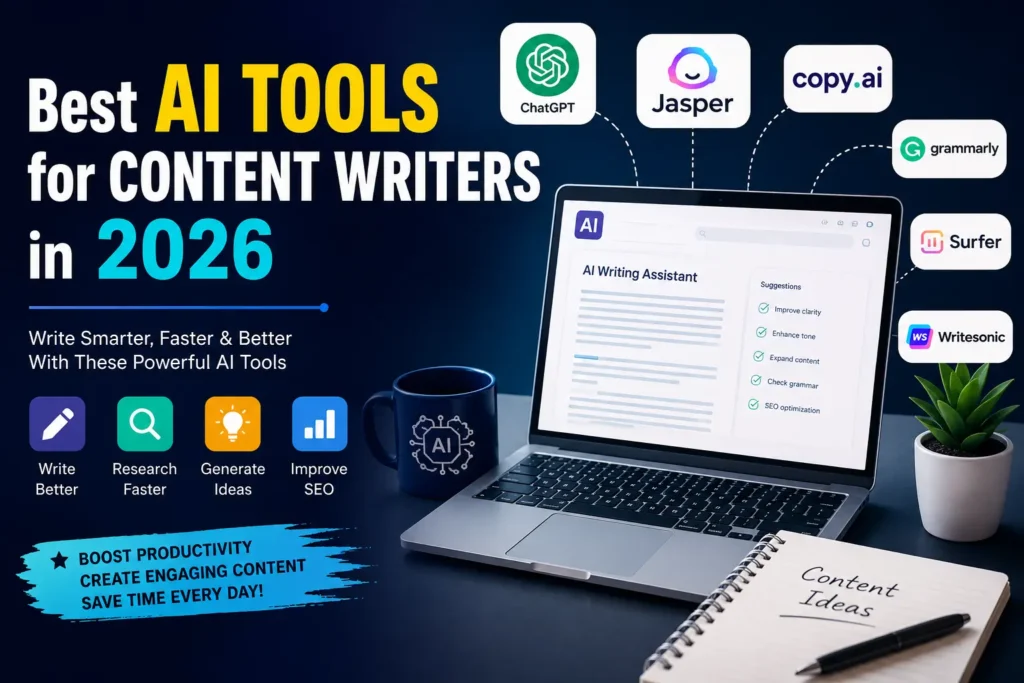
Content writing hasn’t slowed down in 2026 — if anything, the pressure to publish more, faster, and across more channels has only intensified. What has changed is the toolbox. The best AI tools for content writers in 2026 no longer just spit out generic paragraphs from a one-line prompt. They research competitors, build SEO-informed outlines, match brand voice, score content against ranking factors, and even track whether your articles get cited inside AI answer engines like ChatGPT, Perplexity, and Google AI Overviews.
If you’re a blogger, freelancer, marketer, or part of an in-house content team, choosing the right stack of AI writing tools 2026 has become almost as important as the writing itself. This guide breaks down the leading AI content writing software on the market today, organized by what each tool is actually good at — drafting, optimizing, editing, or all three — so you can build a workflow instead of just collecting subscriptions.
We’ll cover general-purpose AI writing assistants, dedicated SEO content optimization tools, niche tools for creative and long-form writing, and the free options worth having in your back pocket. By the end, you’ll know exactly which combination of tools fits your budget, your workflow, and the kind of content you’re producing.
Why AI Writing Tools Look Different in 2026
Three shifts have reshaped this category over the past year, and they explain why older “best AI writing tools” lists already feel outdated.
1. Long-form quality caught up with short-form speed: Early AI writing tools were great at headlines and product blurbs but fell apart over a 2,000-word article — losing structure, repeating points, or drifting off-topic. That’s no longer true of the top-tier models. Tools built on Claude, in particular, are now recognized for producing coherent, naturally voiced drafts even past the 5,000-word mark, which has made them a serious option for long-form blog work rather than just an idea generator.
2. Generation and optimization split into two distinct jobs: A tool that writes a draft and a tool that tells you whether that draft can actually rank are not the same thing anymore. Content teams increasingly use one platform to generate copy and a separate, purpose-built platform to grade it against real SERP data before hitting publish.
3. Getting cited by AI matters as much as ranking on Google: With AI search engines and answer boxes now sending a meaningful share of traffic, tools have started building “generative engine optimization” (GEO) tracking directly into their dashboards — showing whether your content is being surfaced or quoted by ChatGPT, Gemini, Perplexity, and Claude, not just where it sits in traditional search results.
Keep these three shifts in mind as you read the recommendations below — they’re the reason the tool you pick for drafting probably shouldn’t be the same tool you use for optimization.
Best AI Writing Tools for Drafting Content
These are the generators: give them a topic, a brief, or a rough outline, and they produce new text from scratch. This is where most writers start.
1. Claude (Anthropic)
Claude has become one of the strongest options specifically for long-form blog and article writing. It tends to produce first drafts that read as more naturally voiced compared to competitors, and it holds structure and tone consistently across long documents rather than losing the thread halfway through. For writers who need to maintain a consistent voice across an extended piece, or who are working on research-heavy content that requires synthesizing several sources coherently, Claude is generally considered one of the best AI tools for content writers in 2026.
Best for: Long-form articles, research-heavy writing, maintaining tone and voice across a full piece.
2. ChatGPT (OpenAI)
ChatGPT remains one of the most widely used AI content generators, and for good reason — it’s fast, flexible, and works well as an all-purpose drafting and brainstorming partner. It’s strong at outlining, quick copy, and iterative back-and-forth editing within a chat interface. Many writers use it as their first pass for ideation before moving a draft into a dedicated optimization tool.
Best for: Brainstorming, outlines, quick-turnaround copy, iterative editing.
3. Jasper AI
Originally launched as Jarvis and rebranded as Jasper, this tool has built its reputation on brand voice consistency across marketing channels — blogs, email, social, and ad copy all pulling from the same trained voice profile. Jasper is multi-model, meaning it can route a request to different underlying language models depending on the task, and it comes loaded with templates and a “Remix” feature for revising existing content. It handles long-form blog posts reasonably well, but it particularly shines on shorter, punchier formats like headlines, product descriptions, and social bios.
Best for: Marketing teams that need consistent brand voice across many content types and channels.
4. Writesonic
Writesonic is a well-rounded, user-friendly generator that covers everything from blog posts to landing pages and ad copy. It’s often recommended as an accessible entry point for writers who want AI drafting without a steep learning curve, and it’s increasingly paired with SEO features so writers don’t have to jump to a separate tool for basic optimization.
Best for: Beginners and small teams wanting an all-in-one generator with light SEO support.
5. Copy.ai
Copy.ai leans hardest into short-form and conversational content — social posts, email campaigns, and ad copy where speed matters more than depth. Its conversational interface makes it easy to iterate quickly, which is why many marketers keep it in rotation specifically for campaign-style work rather than long articles.
Best for: Social media captions, email campaigns, and ad copy at speed.
6. Sudowrite
Sudowrite is built specifically for creative writers — novelists, poets, and essayists — rather than marketers. It includes tools for rewriting, summarizing, and describing sensory detail, functioning more like an AI co-author than a content generator. If your writing leans fiction or narrative nonfiction rather than blog or marketing copy, this is one of the few tools purpose-built for that use case.
Best for: Fiction, poetry, essays, and other creative or narrative writing.
7. WordHero
WordHero is a lower-cost, lesser-known option that supports a surprisingly large number of content types — over 75, from long-form articles to startup ideas and book outlines. It’s popular with solopreneurs and bloggers who want a lifetime-deal-style pricing structure rather than an ongoing monthly commitment, and its biggest strength is speed: quick outputs from minimal input.
Best for: Solo creators and bloggers on a tight budget who need fast, low-effort drafts.
Best AI Tools for SEO Content Optimization
Generating a draft is only half the job. These tools analyze your content against real search-ranking data — competitor pages, keyword coverage, and semantic relevance — to tell you what’s missing before you publish.
8. Surfer SEO
Surfer’s Content Editor remains one of the most respected optimization tools available, built around a real-time Content Score that analyzes top-ranking pages for keyword density, NLP entities, and semantic relationships as you write. It’s particularly strong for content teams publishing frequently who want live feedback rather than a one-time audit, and it’s well suited to building topical maps for sites that need to demonstrate authority in a niche. The trade-off is a denser interface that takes more SEO fluency to use well, and it doesn’t generate publish-ready copy on its own — think of it as a scoring and guidance layer that sits on top of your writing, not a replacement for a drafting tool.
Best for: Frequent publishers who want live, on-page optimization scoring as they write.
9. Frase
Frase takes a research-first approach: it scrapes top SERP competitors, synthesizes a content brief and outline, and lets you either write the sections yourself or have its AI writer draft them. Its standout 2026 feature is built-in AI-visibility tracking, showing whether your content is being surfaced across engines like ChatGPT, Perplexity, Google AI Overviews, Gemini, and Claude — not just traditional rankings. That makes it a strong pick for teams specifically worried about AI-search citations, not just SERP position, and it’s generally priced more accessibly than Surfer.
Best for: Lean teams and solo writers who want strong content briefs plus AI-search visibility tracking.
10. Clearscope
Clearscope is often recommended as the simpler, more intuitive option for writers who aren’t SEO specialists but still need clear content grading. It doesn’t have the same depth as Surfer or the brief-generation focus of Frase, but its straightforward scoring makes it a good fit for teams onboarding writers who are new to SEO and need clear, actionable signals rather than a dense dashboard.
Best for: Teams with less SEO-experienced writers who need simple, actionable content grading.
11. MarketMuse
MarketMuse operates at a different altitude than the tools above — it’s built for large-scale topical planning and content strategy across an entire site, rather than optimizing a single article. It has a steeper learning curve, and it’s typically the right call for enterprise content operations that need to map topical authority across hundreds of pages rather than freelancers optimizing one post at a time.
Best for: Enterprise teams planning topical coverage and content strategy at scale.
12. Nightowl (by Nightwatch)
Nightowl bundles keyword research and clustering, AI content generation aligned to search intent, contextual optimization advice (including interlinking suggestions), and site auditing into a single platform built inside Nightwatch. It’s not a standalone tool — you need a Nightwatch subscription to access it — but for teams already using Nightwatch for rank tracking, it consolidates several jobs (strategist, writer, auditor) that would otherwise require three separate subscriptions.
Best for: Nightwatch users who want SEO strategy, generation, and auditing in one connected platform.
Best Free and Budget AI Writing Tools
Not every writer needs an enterprise-grade stack. These free or low-cost tools cover the essentials.
- Grammarly — Free-tier grammar, clarity, and readability checking that’s good enough for most day-to-day workflows; a natural first layer regardless of what you use for drafting or SEO.
- Hemingway Editor — A free web-based readability tool that’s one of the best final-pass checks available for tightening sentence structure before publishing.
- ChatGPT (free tier) — Solid for outlines and short drafts without a subscription.
- QuillBot — A useful paraphrasing and rewriting companion that pairs well with either Surfer or Frase for polishing tone without replacing the core optimization layer.
A reasonable rule of thumb: free tools are a fine starting point, but premium optimization tools like Surfer or Clearscope start earning their cost once you’re publishing four or more pieces a month and manual optimization is eating real hours out of your week.
Pricing Snapshot: What These AI Content Writing Tools Actually Cost
Budget is usually the deciding factor once a shortlist is narrowed down, so here’s a rough sense of where each category of tool sits price-wise in 2026. Exact numbers shift often, so treat this as a planning guide rather than a quote — always check the current pricing page before subscribing.
- General AI chat assistants (Claude, ChatGPT): Free tiers cover light use; paid individual plans typically sit in the $20/month range, with higher tiers for teams and heavier usage limits.
- Marketing-focused generators (Jasper, Copy.ai, Writesonic): Entry plans often start around $39–$49/month for individuals, scaling into the low hundreds for team and brand-voice features.
- Budget generators (WordHero): Some budget tools offer lifetime-deal pricing instead of a subscription, with entry costs around $10/month equivalent depending on word-count limits.
- SEO optimization platforms (Surfer SEO, Frase, Clearscope): Entry-level plans generally start around $39–$49/month, with add-ons like AI writing credits, audits, or extra content briefs priced separately on some platforms.
- Enterprise strategy tools (MarketMuse): Typically quote-based, aimed at larger content operations planning topical coverage across an entire site rather than single articles.
- Free tools (Grammarly, Hemingway, ChatGPT free tier): No cost for core functionality, with paid upgrades unlocking deeper style checks, higher usage limits, or team features.
A sensible way to budget: start with a free-tier generator and a free grammar checker while your publishing volume is low. Once you’re consistently publishing four or more pieces a month and manual optimization is costing real hours, that’s usually the point where a paid SEO tool starts paying for itself.
AI Tools by Content Type: A Quick-Reference Breakdown
Different content formats reward different tools. Here’s how the landscape breaks down by the type of writing you’re actually producing.
Long-form blog posts and articles (1,500+ words): Claude and ChatGPT are the strongest generators for holding structure and voice over a longer piece. Pair either with Surfer SEO or Frase for a competitive-analysis pass before publishing.
SEO landing pages and pillar content: Surfer SEO’s Content Score and Frase’s brief-generation are both built specifically for this — start with a brief, draft against it, then optimize before launch. MarketMuse is worth the learning curve if you’re mapping an entire content cluster rather than a single page.
Email campaigns and newsletters: Copy.ai and Jasper both handle short, punchy, conversational copy well, and their template libraries speed up repetitive campaign work.
Social media captions and ad copy: Copy.ai remains a go-to for speed here, with Writesonic and Jasper as close alternatives depending on which brand-voice features matter most to your team.
Creative writing, fiction, and narrative essays: Sudowrite is purpose-built for this and remains one of the only tools in this list genuinely designed for creative co-authoring rather than marketing copy.
Product descriptions and e-commerce copy: Jasper and WordHero both support high-volume, templated formats like this well, with WordHero being the more budget-friendly of the two.
Technical or research-heavy writing: Claude’s ability to synthesize multiple sources coherently over a long document makes it a strong fit for whitepapers, in-depth guides, and research-backed articles.
Common Mistakes Writers Make With AI Tools
Even with the best AI tools for content writers at your disposal, a few recurring mistakes undercut the results:
Publishing the first draft as-is: AI-generated first drafts are a starting point, not a finished product. Content that goes out without a human editorial pass tends to read as generic and is increasingly filtered out by both search engines and AI answer engines that prioritize original, experience-backed writing.
Skipping the brief: Jumping straight into a generator without a competitive brief or outline often produces content that covers the topic superficially. Tools like Frase exist specifically to close this gap by grounding the draft in what’s already ranking.
Treating optimization scores as the goal instead of a proxy: A high Content Score in Surfer or Clearscope correlates with better ranking potential, but it isn’t a guarantee. Chasing the score at the expense of readability or genuine usefulness to the reader tends to backfire.
Using one tool for every job: Expecting a single subscription to handle drafting, SEO scoring, grammar checking, and brand voice all equally well usually means it does none of them particularly well. The strongest workflows combine two or three specialized tools rather than relying on one generalist.
Ignoring AI-search visibility: With a growing share of readers getting answers directly from AI engines rather than clicking through to a website, ignoring GEO tracking (available in tools like Frase) means flying blind on a traffic channel that’s only going to matter more.
How to Choose the Right AI Tool for Your Content Workflow
With this many AI content writing software options on the market, the right choice depends less on which tool is “best” overall and more on where your workflow is actually slow. A few questions worth asking before you subscribe to anything:
What’s your actual bottleneck? If research and outlining eat most of your time, a brief-first tool like Frase solves a different problem than a live-scoring tool like Surfer. If drafting itself is the slow part, an AI generator like Claude or Jasper is the fix — buying an optimization tool won’t help if the real issue is brief quality.
How long is your typical piece? For short-form marketing copy — headlines, ads, social captions — Jasper or Copy.ai are built for that pace. For long-form articles over 2,000 words, Claude and ChatGPT hold structure and voice more reliably.
Do you need SEO scoring, or just clean prose? If your content lives or dies on search rankings, pair a generator with a dedicated optimizer like Surfer, Frase, or Clearscope. If you’re writing for a newsletter or internal audience where ranking isn’t the goal, a generator plus Grammarly may be all you need.
Are you tracking AI-search visibility? If getting cited inside ChatGPT, Perplexity, or Google AI Overviews matters to your traffic strategy, prioritize a tool like Frase that has GEO tracking built in from the entry-level plan, rather than treating it as an afterthought.
What’s your skill level? Clearscope and Frase are generally considered more intuitive for writers new to SEO, while Surfer and MarketMuse have steeper learning curves that pay off more at higher content volumes.
A workflow that reflects these answers might look like: outline and research in Frase, draft in Claude, run the draft through Surfer for a Content Score pass, and finish with a Grammarly or Hemingway readability check before publishing.
A Word on Humanizing AI-Assisted Content
One trend worth taking seriously heading into the rest of 2026: generic, obviously AI-written content is increasingly filtered out by both Google’s helpful content systems and by AI search engines themselves, which preferentially cite content carrying real signals of human experience — first-person perspective, original opinions, specific data points, and demonstrated author authority.
That doesn’t mean abandoning AI tools. It means using them differently — as a drafting and research accelerant rather than a finished product. The strongest workflows treat AI-generated text as a first draft that a human writer then shapes with their own opinions, examples, and editorial judgment, rather than publishing raw AI output. Whichever tools you choose from this list, that final human pass is what keeps your content both original and genuinely useful to readers.
Frequently Asked Questions
What is the best AI tool for content writers overall in 2026? There isn’t a single best tool across every use case. For long-form drafting, Claude and ChatGPT lead the pack. For SEO optimization, Surfer SEO and Frase are the strongest picks depending on budget and whether you need AI-search visibility tracking.
Are AI writing tools good enough to replace human writers? No — the tools in this guide are best understood as co-pilots that speed up research, drafting, and optimization, not full replacements for editorial judgment, original opinion, and fact-checking.
Which AI tool is best for SEO blog content specifically? Surfer SEO and Frase are the two most commonly recommended tools for SEO-focused blog content, with Surfer favored for real-time content scoring and Frase favored for research briefs and AI-search visibility tracking.
Is there a free AI writing tool worth using? Grammarly’s free tier and Hemingway Editor’s web version are both genuinely useful for grammar and readability, and ChatGPT’s free tier is a solid starting point for outlines and short drafts.
Final Thoughts
The best AI tools for content writers in 2026 aren’t defined by which one can generate the most words the fastest — they’re defined by which ones fit into a workflow that still ends with a human editorial pass. Whether you land on Claude for long-form drafting, Surfer or Frase for optimization, or a budget-friendly combination of ChatGPT and Grammarly, the goal is the same: use AI to remove the friction of research, structure, and first drafts, so you can spend your time on the parts only a human writer can actually do well — original insight, real experience, and a voice readers trust.




[…] Best AI Tools for Content Writers in 2026 […]
[…] latest technology trends of 2026 tell a consistent story: the age of pure experimentation is giving way to an era of […]
[…] is more than just a name. It is an idea — a simple path that helps everyday people understand technology, use AI tools, and build strong careers in the tech world. Whether you are a student, a working […]
[…] a developer, a marketer, a student, or a business owner, you will walk away knowing exactly which artificial intelligence tools deserve a spot in your daily workflow. We will cover AI chatbots, AI writing tools, AI coding […]
[…] example, content professionals can explore different AI tools for content writers to improve research, writing, editing, and […]
[…] aap specifically writing aur content creation ke liye AI tools explore karna chahte hain, to Best AI Tools for Content Writers in 2026 bhi check kar sakte […]
[…] If you also need AI tools for writing scripts, editing drafts, or planning content, read our article on Best AI Tools for Content Writers in 2026. […]