

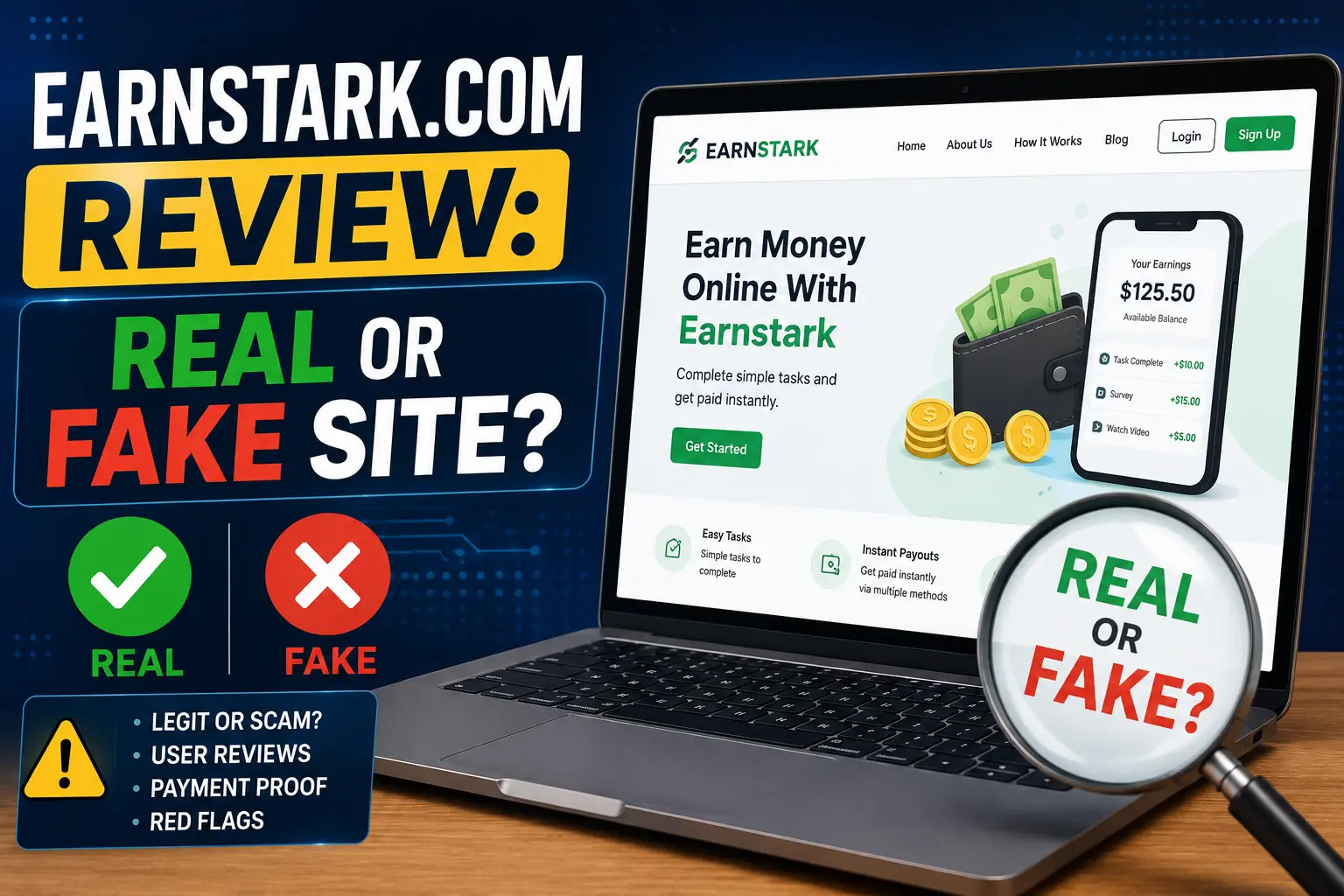
Earnstark.com markets itself around two very different pitches at once: a “Fantasy App, Free Recharge, Insta Password, WhatsApp Tracker and Call Details” tool on one hand, and a daily-income earning platform promising payouts for watching ads, inviting friends, and buying “packages” on the other. Neither pitch holds up well under scrutiny, and the site’s own domain situation adds a third layer of confusion on top of both.
What Is Earnstark.com?
Depending on which page or domain variant you land on, Earnstark presents itself differently. One version frames it as a utility app offering free mobile recharge, a “WhatsApp tracker,” Instagram password recovery, and call-detail access. A separate framing positions it as an online earning platform, promising daily income through simple actions — watching ads, referring friends, staking funds, or purchasing “packages” that supposedly generate passive returns, often framed as a modern fintech or ad-revenue-sharing hub.
Adding to the confusion, Earnstark operates across at least four distinct domain variants we found evidence of: earnstark.com, earn-stark.com, go.earnstark.com, and earnstark.co — each independently scanned and scored, with meaningfully different trust results depending on which one you check.
The WhatsApp Tracker and Free Recharge Claims Are False
Let’s address this directly, because it’s the most immediately actionable finding here: claims of a “WhatsApp Tracker” that lets you view someone else’s private messages or call details are false, full stop. WhatsApp uses end-to-end encryption, meaning only the sender and recipient of a message can read it — not even WhatsApp itself has access to that content, let alone a third-party website. No tool can legitimately bypass this by asking for a phone number. The same applies to “free Instagram password” claims — no legitimate service can retrieve someone else’s account password, and any tool claiming to do so is either non-functional bait for ad clicks or an attempt to harvest the information you enter while trying to use it.
These specific claims exist to generate clicks and engagement, not because the underlying feature works as advertised — the same conclusion we reached investigating similarly-themed claims on other sites.
The Earning-Platform Side Shows Classic Red Flags
If you encountered Earnstark specifically through its “earn daily income” pitch, the pattern here matches several well-documented warning signs associated with unsustainable earning schemes:
Aggressive referral incentives. Rewards weighted heavily toward recruiting new users rather than genuine product engagement is one of the clearest tells that a platform’s revenue depends on new sign-ups rather than any real underlying business activity.
Withdrawal friction. Minimum withdrawal thresholds, sudden KYC (identity verification) demands, or unexpected “maintenance fees” that appear specifically when users try to cash out are a consistent pattern across earning-app schemes that eventually fail to pay.
Fresh domains and rebrand patterns. Recently registered domains, frequent name changes, and cloned site templates — all present to varying degrees across Earnstark’s multiple domain variants — are consistent with a pattern of relaunching under new names once trust in a previous version erodes.
Social proof farming. Bots, stock photography, and scripted messaging-app screenshots showing “successful payouts” are commonly used to manufacture the appearance of legitimacy before real scrutiny catches up.
It’s worth being precise here: some early users of schemes like this genuinely do receive payouts, particularly those who promote the platform to others. That’s not evidence of legitimacy — it’s simply evidence that cash is flowing in from new deposits today. The real question is sustainability: if returns depend on continuously recruiting new depositors rather than external revenue, the model is structurally fragile regardless of what early participants experience.
What Independent Scanners Actually Show
Scam Detector identifies earnstark.com as suspicious, while Scamadviser rates it as likely legitimate; however, the separate domain earn-stark.com is flagged for low traffic and hosting with unreliable sites. Additionally, earnstark.co is marked as a likely scam, whereas go.earnstark.com has a cautiously positive assessment, with its recent registration prompting caution.
In plain terms: automated scanners disagree with each other depending on which exact domain you check, which is itself a red flag. A single, legitimate, well-established business doesn’t typically generate this much scanner disagreement across its own domain variants.
Content Quality Concerns
Independent review coverage of earnstark.com has also flagged that much of the site’s blog content appears to be AI-generated, with limited traffic (roughly 3,000 monthly visitors as of one 2024 measurement) — consistent with a low-authority content operation rather than an established, trusted platform with genuine editorial investment.
Our Verdict
Earnstark.com sits across two separate, both concerning categories: a utility-app pitch built on technically false claims (the WhatsApp tracker and free-recharge features cannot work as described), and an earning-platform pitch that displays several classic warning signs associated with unsustainable, recruitment-dependent schemes. The situation is complicated further by at least four different domain variants generating inconsistent, sometimes contradictory trust signals from independent scanners.
Our recommendation: Do not enter your WhatsApp number, Instagram credentials, or any personal information expecting the tracker or password-recovery features to work — they can’t, by design of the platforms they claim to access. If you’re considering Earnstark specifically for its earning-platform features, treat the aggressive referral structure, any withdrawal friction you encounter, and the site’s multi-domain rebrand pattern as serious warning signs before depositing any money.
How to Protect Yourself From Similar Platforms
Never believe a tool that claims to access someone else’s encrypted messages. This is a technical impossibility for legitimate services, regardless of how convincing the marketing looks.
Be skeptical of any “earning platform” weighted toward recruitment over genuine activity. If the primary way to increase your returns is referring new users rather than using an actual product or service, you’re likely looking at a structure that depends on new deposits to pay existing users.
Check multiple domain variants if a brand operates several. As this case shows, scanning just one version of a site’s domain can give you an incomplete or misleading picture — cross-check every variant you can find before trusting any of them.
Treat withdrawal friction as a major red flag, not a minor inconvenience. Sudden fees, unexpected verification demands, or shifting withdrawal thresholds that appear specifically when you try to cash out are a well-documented pattern in schemes that ultimately don’t pay.
Frequently Asked Questions
Is Earnstark.com a scam?
The evidence points toward serious caution rather than outright confirmation either way. Its WhatsApp tracker and free-recharge claims are technically false, and its earning-platform pitch displays multiple classic red flags associated with unsustainable, recruitment-dependent schemes. Independent scanner results are also inconsistent across its various domain variants, which is itself a warning sign.
Can Earnstark.com really track someone’s WhatsApp messages?
No. WhatsApp’s end-to-end encryption means no third-party website or app can access private messages or call details, regardless of what any site claims. Treat any such claim as false by default.
Why does Earnstark.com have so many different domains?
We found at least four variants — earnstark.com, earn-stark.com, go.earnstark.com, and earnstark.co — each independently scored by safety scanners with meaningfully different results. This pattern is sometimes associated with rebrand cycles common to earning-app schemes that relaunch under new names as trust in previous versions erodes.
Is it safe to deposit money into Earnstark’s earning platform?
Exercise significant caution. The referral-heavy structure, potential withdrawal friction, and multi-domain rebrand pattern are all consistent with recruitment-dependent schemes where early participants may get paid using money from later depositors, a structure that isn’t sustainable long-term.
We investigate platforms like this regularly here at Tech Demis, especially ones combining fake utility claims with earning-app pitches. If you’re researching a similar site, our Reviews section has a growing collection of these breakdowns, including Filmy4App.com, which uses a strikingly similar WhatsApp tracker claim, and Golden Tech Consulting, a more elaborate case built around the same recruitment-dependent structure.
If you want to know more about tech reviews and site safety in general, you can head over to Tech Demis and read more.
This article is based on independent research into publicly available information as of mid-2026, including domain registration data and third-party safety scanner results across multiple domain variants. Website content and ownership can change — always verify current details directly, and never share personal information or deposit funds based on unverified claims.

1 Comment
Pingback: How to Spot Fake Tech Products Online: A Complete Guide