
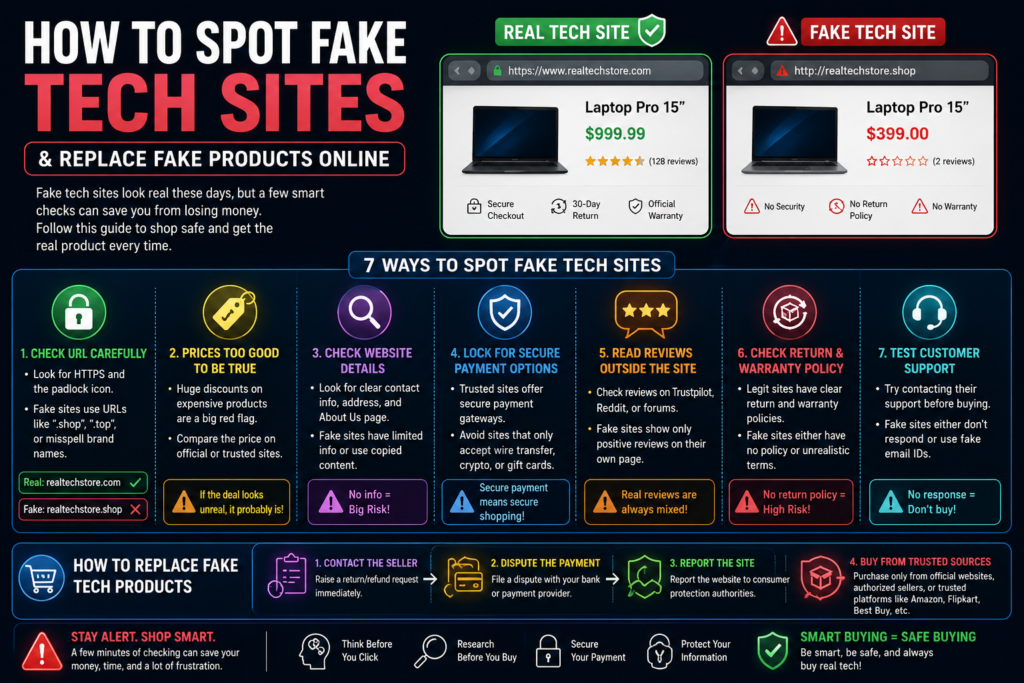
Every few weeks, a new “revolutionary platform” or “must-try tool” starts showing up across dozens of unrelated blogs — all describing it in eerily similar language, all glowing, all vague on the specifics that would actually let you verify it’s real. We’ve run into this pattern repeatedly while investigating tools and platforms for this site, and it’s common enough that it deserves its own breakdown: what this pattern actually looks like, why it exists, and how to spot Fake Tech Products before you waste time — or worse, personal information — on something that isn’t what it claims to be.
The Pattern, in Plain Terms
Here’s the basic shape it takes almost every time. A phrase that sounds plausible as a product or platform name — something like “Turbo Media Site” or “UploadBlog” — starts appearing as the subject of articles across a wide range of otherwise unrelated blogs. Each article describes the “fake tech products” slightly differently: one calls it a social media tool, another calls it a media optimization platform, a third calls it something else entirely.
None of them agree on core details. None of them link to a working product you can actually verify, sign up for, or meaningfully test. What they do share is tone: confident, promotional, packed with buzzwords like “revolutionary,” “seamless,” and “AI-driven,” and light on anything concrete — no pricing, no company registration, no founder, no independent user reviews outside the cluster itself.
This is what’s often called templated or AI-generated content produced at scale — articles built from a shared template or shared source material, published across many low-authority sites, designed to capture search traffic around a phrase before anyone else claims it. Sometimes there’s a real, if modest, product behind the noise. Often there’s nothing verifiable at all.
Case Studies: What We’ve Actually Found
We’ve investigated several examples of this pattern directly, and the findings are worth knowing about specifically:
Turbo Media Site Demis Tech turned up across at least eight to ten unrelated sites, each describing it differently — a “social media platform,” a “digital marketing tool,” a “media optimization system” — with no consistent description, no verifiable company, and no real product to sign up for anywhere. Our full investigation is available in our Turbo Media Site Demis Tech review.
UploadBlog presented a more complicated case: a real, functioning free publishing platform does appear to exist, but it’s surrounded by a sprawling network of near-identical promotional articles, unverifiable testimonials, and suspiciously round “case study” statistics across multiple regional domains and satellite review sites. Not fictional, but the hype around it is artificially inflated — details are in our UploadBlog review.
Tech Yugle showed a related but distinct pattern: a real, low-quality content site, but with a cluster of near-identical glowing “reviews” published across unrelated blogs using the exact same phrases, alongside at least one genuinely independent review that told a very different story. That comparison is worth reading in our Tech Yugle review.
Three different specific cases, three slightly different flavors of the same underlying pattern — but the diagnostic signs, once you know them, are strikingly consistent.
Why This Happens
The financial incentive is straightforward. Ranking for a search term — even an invented one nobody else is competing for — drives traffic, and traffic can be monetized through ads, affiliate links, or lead generation, regardless of whether the underlying “product” is real. Coining a plausible-sounding but made-up name sidesteps competition entirely: there’s no established authority already ranking for it, no Wikipedia page to compete with, nothing to outrank. A network of low-effort articles can dominate page one simply because nothing better exists yet.
This is closely related to a broader, well-documented problem across the web: fake reviews and templated content designed to manipulate rankings and consumer trust rather than reflect genuine experience. Independent research into this space has found that platforms like Amazon remove hundreds of millions of suspicious reviews annually, and Google actively penalizes sites built primarily around thin, duplicated, or manipulative content — yet the financial incentive keeps the practice alive, because the potential payoff for the people running these networks generally outweighs the risk of getting caught.
The Diagnostic Checklist
Based on the pattern across every case we’ve investigated, here’s what actually works to identify it:
Check for consistency across sources. If five different articles describe the same “product” in five different, contradictory ways, that’s one of the strongest signals available. Genuine products get described consistently because they’re, well, one real thing.
Search for verifiable basics. A real company has a findable registration, a real website you can actually use, transparent pricing, and independent reviews on platforms unaffiliated with the product itself — Trustpilot, the App Store, genuine user forums. The complete absence of any of this, especially all of it at once, is a major flag.
Watch for buzzword density without specifics. Phrases like “revolutionary,” “cutting-edge,” “AI-powered,” and “seamless experience,” repeated without any concrete detail about what the thing actually does, are a hallmark of templated filler content written to sound impressive while saying very little.
Look for duplicate phrasing across “independent” sources. If multiple articles use the same unusual phrase or structure — not just similar ideas, but near-identical sentences — that’s a sign they share a common template or source, not independent authorship.
Treat one genuinely critical review as more valuable than ten glowing ones. Across every case we’ve looked at, the most trustworthy source was consistently the one willing to name a real drawback or concern, not the one offering unqualified praise.
What to Do If You’re Not Sure
If you land on a “product” that fits this pattern and you’re still not certain, the safest defaults are simple: don’t enter payment information or sensitive personal data, don’t download anything outside an official app store, and don’t take the glowing reviews as independent confirmation — they may well be part of the same promotional cluster you’re trying to verify. If a specific need brought you there in the first place — a publishing platform, a marketing tool, a social media utility — searching for that underlying need directly, rather than the specific invented product name, will usually surface established, verifiable alternatives with a real track record.
Final Thoughts
This pattern isn’t going away, because the financial math behind it still works for the people running these networks. But it’s genuinely learnable to spot, once you know what to look for — and the more of these cases we investigate, the more consistent the signals turn out to be: contradictory descriptions, no verifiable specifics, buzzword-heavy language, and a suspicious cluster of nearly identical praise. If something you’re researching shows two or more of these signs at once, that’s reason enough to slow down before trusting it.
Frequently Asked Questions
How can I tell if a tech product review is fake or templated?
Look for consistency across multiple independent sources describing the same product — genuine products get described the same way repeatedly, while templated content produces contradictory, vague descriptions. Also check for verifiable basics: a real company registration, working website, transparent pricing, and reviews on platforms unaffiliated with the product itself.
Why do fake or templated tech products get so much search visibility?
Coined product names with no existing competition are easy for low-effort content networks to dominate in search results, since there’s no established authority to outrank. This drives traffic that gets monetized through ads or affiliate links, regardless of whether a real product exists behind the content.
Is it safe to visit websites describing these templated “products”?
The articles themselves are typically low-quality promotional content rather than active security threats, but you should avoid entering personal information, payment details, or downloading files from unverified sources associated with any product that shows signs of this pattern.
What’s the single most reliable way to spot this pattern?
Search for the exact same unusual phrase used to describe the “product” across multiple sources. If several supposedly independent articles use identical or near-identical wording, that’s one of the clearest signs they share a common template rather than reflecting genuine, independent coverage.
This article draws on our own independent investigations into specific cases, alongside broader published research on fake reviews and templated SEO content, as of mid-2026.




[…] you’ve come across, our Reviews section has more of these breakdowns, including our look at how fake tech products get built to look real online. Worth a look before you take anything at face […]
[…] and if you want the fuller picture of how these copycat review clusters form, our breakdown of how to spot fake tech products online covers the mechanics in more […]