

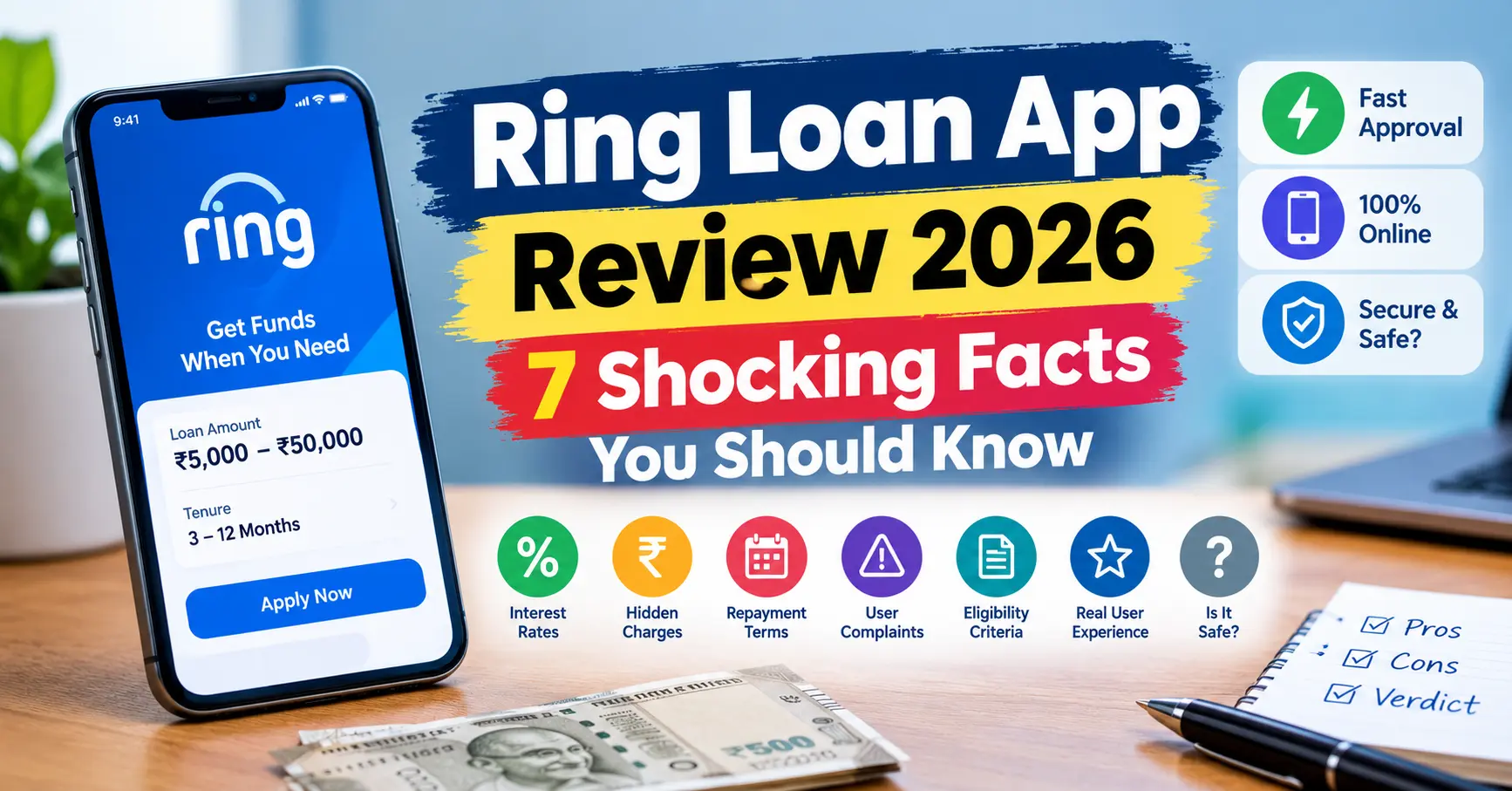
Quick answer, since this is what most people actually want to know: Ring Loan App is a real, RBI-registered lending platform, not a fictional app someone invented to scam people. It’s owned by Onemi Technology Solutions Pvt. Ltd., part of the Kissht group, and lends through registered NBFC partners. That said, “real company” and “safe to use without caution” aren’t the same thing — and this specific app comes with two separate concerns worth understanding before you install it: a pattern of genuine user complaints about fees, and a documented scam where fraudsters impersonate the real app entirely.
Let’s go through exactly what’s true, what’s a red flag, and what you actually need to watch out for.
Is Ring Loan App Legit?
Yes, in the sense that matters most: it’s a real, operating business with verifiable ownership. Ring (also marketed as “Pay With RING”) is run by Onemi Technology Solutions Pvt. Ltd., and it partners with RBI-registered NBFCs to actually issue credit — a genuine regulatory detail that distinguishes it from the fully fictional lending apps we’ve investigated in other reviews. The app offers two main products: a standard personal loan (commonly cited in the ₹5,000–₹10,000 range) and a larger “Power Loan” option for amounts up to ₹1,00,000–₹2,00,000, with credit limits generally reported between ₹30,000 and ₹35,000 depending on income and profile.
So if your question is simply “does this app exist and is it operated by a real, identifiable company” — yes. That’s a meaningfully different answer than you’d get for a genuinely fabricated app.
But Real Users Report Real Problems
Being a legitimate, registered company doesn’t mean every user experience has been good — and the complaint pattern here is specific enough to take seriously.
Fees that don’t match the marketing. Ring Loan App advertises 0% interest for the first six months and claims of “0% transaction fee, 0% limit increase fee, 0% hidden fee.” Multiple user complaints directly contradict this framing, describing transaction fees around 10%, along with limit-increase fees, membership fees, and platform fees added on top — despite paying on time. One detailed complaint described a pre-approved credit limit of over ₹1 lakh that, once actually clicked through, only offered a fraction of that amount, with the total payable amount reportedly increasing multiple times as the payment deadline approached.
Aggressive collection tactics. Independent reviews have flagged harassment-style collection practices as a recurring theme in user feedback, alongside a general lack of transparency around how fees are actually calculated once a loan is active.
How it actually disburses funds. It’s worth understanding the mechanic here, since it’s a little different from a typical loan app: instead of transferring loan money directly to your bank account, Ring is structured to let you shop and make purchases using loan credit, with repayments then directed back through methods like phone number, Paytm, or Google Pay scanning options — a structure that adds a layer of complexity compared to a straightforward cash disbursement loan.
None of this means every user has a bad experience — plenty of lending apps generate mixed feedback simply because credit products are inherently stressful when money is tight. But the specific, repeated nature of the fee-transparency complaints here is worth taking seriously before you commit.
The Bigger Risk: Fake “Ring” Apps Impersonating the Real One
Here’s the part of this story that matters most, and it comes directly from the company itself, not just outside reviewers: Pay With RING has published its own public fraud alert warning users about scammers impersonating the platform.
According to that official alert, the real Ring app will never ask you to download a separate app or additional software to process a payment. If someone asks you to do this, treat it as a scam that could put your money or personal information at risk.
The company also warns users never to share their card PIN, CVV, OTP, or internet banking password with anyone contacting them unexpectedly by call, SMS, or email.
You should also never make a payment to a personal UPI ID, third-party payment link, or someone’s personal bank account instead of using the company’s official payment channels.
Another important warning is to avoid using screen-sharing apps during a transaction. You should also be cautious if someone pressures you to make an immediate payment during a phone call.
According to the company, legitimate repayments should only be made through the official RING app or through a payment link received by SMS from the sender ID “PWRING.” If someone claiming to represent Ring asks you to pay through a different channel, treat the request as potentially fraudulent.
This is a genuinely important distinction to understand: the complaints about Ring’s own fees are a service-quality and transparency issue. The impersonation scam is a completely separate, more dangerous threat where criminals use the real app’s name and reputation to trick people into installing malware or handing over banking credentials directly.
What About “Ring-a-Loan.com”?
If you’ve come across a similarly-named site called ring-a-loan.com, it’s worth being clear this is a different domain entirely, not confirmed to be affiliated with Ring Loan App / Onemi Technology Solutions. Scamadviser’s automated assessment rates ring-a-loan.com as likely legitimate based on an analysis of around 40 public data points, but that domain has seen very limited scan activity and search interest, and no clear connection to the Kissht-owned Ring platform has been established. Given how often similarly-named finance domains create genuine confusion — something we’ve documented repeatedly in our site investigations — treat “Ring Loan App” and “ring-a-loan.com” as two separate things to verify independently, not interchangeable names for the same service.
How to Read the “0% Fees” Marketing Claim Correctly
This is worth a dedicated explanation, because it’s the single most common source of confusion in Ring Loan App reviews, and it applies to a lot of instant-lending apps beyond just this one. When an app advertises “0% interest” or “0% hidden fees,” that claim is often technically accurate while still leaving room for charges that aren’t classified as “interest” at all — processing fees, platform fees, membership fees, and limit-increase fees can all exist entirely outside the interest-rate calculation, meaning a 0% interest claim and a real, meaningful total cost of borrowing aren’t contradictory in the way they sound.
The practical fix isn’t avoiding every app that advertises 0% interest — it’s asking for the full fee schedule before borrowing, not just the headline interest rate, and getting that fee schedule in writing or as a screenshot before you accept the loan. If a support representative can’t clearly break down every fee you might be charged over the life of the loan, treat that as a signal to pause rather than proceed.
Our Verdict

Ring Loan App is a real, RBI-registered lending platform with identifiable ownership — it is not a fictional scam app. But “real” doesn’t mean “risk-free.” A documented pattern of user complaints about fees not matching marketing claims, combined with an active, company-acknowledged impersonation scam targeting its users, means real caution is still warranted.
Our recommendation: If you use Ring Loan App, read the fee structure carefully before borrowing, keep records of what you were quoted versus what you’re actually charged, and treat any request to download a separate app, share your OTP or PIN, or pay through a personal UPI ID or third-party link as an immediate red flag — regardless of how convincing the caller sounds.
If you’re also researching other products and services before making a decision, check out our WeatherTech FloorLiner Review: Features, Pros, Cons & Buying Guide for a detailed look at its features, advantages, disadvantages, and buying considerations.
How to Protect Yourself With Any Lending App
Verify you’re using the official app. Download only from the official Google Play Store or Apple App Store listing, and double-check the developer name matches the company you expect, rather than a similarly-named clone.
Never install a second app to “complete” a payment. This is one of the clearest, most consistent scam patterns across lending-app fraud — legitimate companies process payments within their own official app or website, not through a separately installed tool a caller directs you to.
Screenshot your loan terms at the moment of approval. If a platform later claims a different fee structure than what you were originally shown, having a timestamped record makes disputing the charge significantly easier.
Be skeptical of any inbound call, SMS, or email creating urgency around a loan payment. Real lenders don’t typically pressure you into an immediate, unverified payment method over a phone call — this is one of the most common scam patterns in Indian lending-app fraud specifically, a pattern we’ve also detailed in our broader guide on free Instagram followers tools and similar app-based scam risks.
Frequently Asked Questions
Is Ring Loan App real or fake?
Ring Loan App is real. It’s operated by Onemi Technology Solutions Pvt. Ltd., part of the Kissht group, and lends through RBI-registered NBFC partners. It is not a fictional or fabricated app, though genuine user complaints about fee transparency exist.
Is Ring Loan App RBI-registered?
Yes. Ring partners with RBI-registered NBFCs for lending, which makes it a regulated lending platform rather than an unregulated or unlicensed one.
Why do people say Ring Loan App is a scam?
Most complaints describing Ring as a “scam” relate to fee transparency — users reporting transaction fees, membership fees, and platform fees despite marketing claims of “0% hidden fees,” along with reports of the payable amount increasing as the payment deadline approaches. Separately, a genuine impersonation scam exists, where fraudsters pretend to be Ring and ask victims to download unrelated apps or share banking credentials.
How do I know if I’m talking to the real Ring Loan App or a scammer?
According to the company’s own fraud alert, the real Ring app never asks you to download a separate app for payment processing, never requests your PIN, CVV, OTP, or banking password over an unsolicited call or message, and only accepts repayment through the official RING app or an SMS payment link from the sender ID “PWRING.” Any other payment request should be treated as fraudulent.
Is ring-a-loan.com the same as Ring Loan App?
This isn’t confirmed. Ring-a-loan.com is a separate domain with no established connection to Onemi Technology Solutions or the Kissht-owned Ring platform. Treat the two as separate services to verify independently rather than assuming they’re the same company.
We investigate lending apps and financial platforms regularly here at Tech Demis, since the stakes for getting this wrong are higher than almost any other review category. If you’re researching similar platforms, our Reviews section covers more of these cases, including our breakdowns of Workzly.in and Earnstark.com, two platforms with their own distinct sets of financial red flags worth knowing about.
If you want more honest tech and app reviews, head over to Tech Demis and read more.
This article is based on independent research into publicly available information as of mid-2026, including the company’s own published fraud alert, user complaint records, and third-party safety scanner data. Loan terms, fees, and company policies can change — always verify current details directly with the app before borrowing, and never share OTPs, PINs, or banking passwords with anyone contacting you unsolicited.
