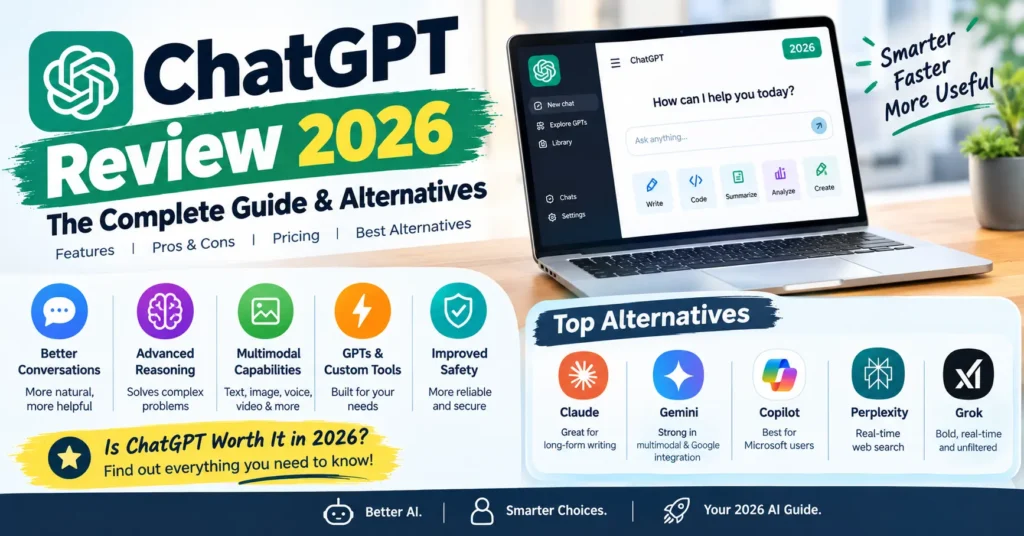
ChatGPT stopped being a simple chatbot a while ago. As of September 2026, it runs on OpenAI’s newest model family, ships with an autonomous coding agent built in, and offers six different pricing tiers that each answer a slightly different question about how much AI you actually need. This review breaks down what ChatGPT actually does today, what each plan gets you, where it genuinely leads, where it falls short, and which alternatives are worth considering instead.
What Is ChatGPT, Exactly?
ChatGPT is OpenAI’s consumer AI assistant, accessible through a web app, desktop app, and mobile apps. What started as a text-in, text-out chatbot has expanded into what OpenAI now positions as an execution platform — a single interface for writing, research, coding, data analysis, image generation, and increasingly, taking multi-step actions on your behalf rather than just describing how to do something.
What Models Power ChatGPT Right Now?
The most significant recent shift is the GPT-5.6 model family — Sol, Terra, and Luna — which reached ChatGPT on July 9, 2026. GPT-5.6 Sol is the flagship model available to Plus, Pro, Business, and Enterprise users, while Luna powers the free tier, and Terra is reserved for ChatGPT Work and Codex.
On September 3, 2026, OpenAI released GPT-6 Astra, its new frontier model, currently available in regular chat only on the Pro plan (on Plus, it’s limited to ChatGPT Work and Codex). GPT-6 Astra is priced roughly 2.5 times higher than the previous flagship on the API side, reflecting the jump in capability OpenAI is charging for.
How Much Does ChatGPT Cost in 2026?
OpenAI currently sells six plans:
- Free ($0/month) — Since August 6, 2026, the free tier runs GPT-5.6 Luna with unlimited text chat, though file uploads, image generation, and other tools remain capped. OpenAI has also begun showing ads on the free tier in certain countries.
- Go (~$8/month) — A budget paid tier with more volume than Free, but still limited features, and ads persist in some regions.
- Plus ($20/month) — The plan most reviewers consider the practical sweet spot: advanced reasoning, expanded file handling, deeper research tools, Projects, scheduled tasks, custom GPT creation, and Codex access.
- Pro ($100–$200/month) — Aimed at founders, developers, analysts, and heavy users. This is the only consumer tier with regular-chat access to GPT-6 Astra. Notably, the $200/month top tier was paused for new sign-ups and upgrades as of September 10, 2026.
- Business (~$20–25/seat) — The one plan that guarantees your conversations stay out of OpenAI’s training data by default, a meaningful distinction from the consumer tiers.
- Enterprise (custom pricing) — Negotiated terms for organizations needing custom security, governance, and support.
One quirk worth knowing: there’s no ChatGPT family plan as of September 2026. The workarounds are giving each household member their own free account, or setting up a Business workspace, which has a two-seat minimum.
Given how often this pricing structure shifts — it’s already changed multiple times in 2026 alone — always check OpenAI’s own pricing page before budgeting around any specific number here.
What Can ChatGPT Actually Do?
The feature list has grown well past “answer questions”:
- Web search and up-to-date information, available even on the free tier
- File and image uploads, with the ability to analyze documents and data
- Image generation, including a “Thinking” mode on higher tiers for more deliberate output
- Codex, OpenAI’s autonomous coding agent, available across all paid plans — a tool built for exactly the kind of agentic, multi-step work covered in our explainer on what agentic AI actually means
- Custom GPTs, letting users build and share tailored versions of the assistant for specific tasks
- Deep research mode, for longer, more thorough investigative tasks than a standard chat response
- A cloud browser, giving the assistant reach into the live web on eligible paid plans
- Scheduled tasks and Projects, for recurring or multi-session work that needs to persist over time
Where Does ChatGPT Genuinely Excel?
Breadth is ChatGPT’s clearest advantage. Independent review platforms consistently praise how approachable the interface is combined with how much ground it covers — writing, coding, research, and data work inside one tool, with a low barrier to getting useful output on your very first prompt. For a lot of users, that combination of ease and range is worth more than any single benchmark score.
Codex is also a genuine standout for anyone doing lighter coding work who doesn’t want to adopt a dedicated, standalone coding tool. If your coding needs are more serious, though, it’s worth comparing Codex specifically against dedicated agentic coding tools — our breakdown of Claude Code, Cursor, and GitHub Copilot covers how purpose-built coding assistants stack up against a general-purpose tool’s coding mode.
Where Does ChatGPT Fall Short?
A few consistent complaints show up across independent reviews:
- Factual reliability remains inconsistent. Like every large language model, ChatGPT can produce confident-sounding answers that are wrong, and this hasn’t fully gone away even as the underlying models have improved.
- Pricing has gotten genuinely complicated. Six tiers, two different plans both marketed under the “Pro” label in places, and usage limits that shift based on which model you’re routed to make it harder than it should be to know what you’re actually paying for.
- Output quality can be inconsistent across different task types, even within the same conversation.
- Free tier limitations go beyond the headline “unlimited text chat” — file uploads, image tools, and advanced features stay capped, and ads have started appearing in some regions.
Is ChatGPT Safe to Use With Sensitive Information?
It depends heavily on which plan you’re using. Business and Enterprise plans exclude your conversations from model training by default, along with admin controls and custom data-retention options. Consumer plans — Free, Go, Plus, and Pro — don’t carry that same default guarantee, so if you’re working with sensitive personal or business information, it’s worth reviewing OpenAI’s current data-control settings directly rather than assuming a paid consumer plan behaves like a Business one.
What Are the Best ChatGPT Alternatives?
ChatGPT’s biggest competitors each lead in a different area rather than simply being “better” or “worse” overall:
- Anthropic’s Claude is frequently cited as a strong alternative for users who prioritize careful, well-reasoned long-form output and coding work — our comparison of Claude Code against Cursor and GitHub Copilot is a useful reference point if coding is your primary use case.
- Google Gemini has the deepest native integration with Google’s own ecosystem — Docs, Sheets, Search, and Android — which matters most if you’re already living inside that ecosystem daily.
- Perplexity focuses specifically on search-style, citation-backed answers rather than general-purpose assistance, and tends to be the pick for people who want an AI tool that behaves more like a research assistant than a conversational one.
If you’re weighing whether a general-purpose chat subscription is worth paying for at all versus a narrower tool, our breakdown of Is ChatGPT Plus Worth It in 2026? goes deeper into that specific decision.
Who Should Actually Pay for ChatGPT?
A few practical scenarios:
You use AI occasionally for simple tasks. The Free tier’s unlimited text chat now covers a lot of casual, everyday use — you may not need to pay at all.
You write, code, and research regularly. Plus, at $20/month, remains the plan most reviewers point to as the best value — it covers the vast majority of what a working professional needs without stepping into Pro-tier pricing.
You’re a founder, developer, or heavy daily user. Pro’s access to GPT-6 Astra in regular chat is the differentiator — but note the $200/month tier is currently closed to new sign-ups, so check current availability before assuming it’s an option.
You’re running a team. Business is worth the seat cost specifically for the training-data exclusion guarantee, which the consumer tiers don’t offer by default.
Bottom Line
ChatGPT in 2026 is best understood less as “a chatbot” and more as a general-purpose execution platform — one that trades some pricing simplicity for genuine breadth across writing, coding, research, and increasingly autonomous task completion. It remains a strong default choice for most people specifically because of that breadth, even where more specialized tools beat it in any single category. Whether it’s worth paying for comes down to how much of that breadth you’ll actually use, and whether a narrower, cheaper, or more specialized tool would serve your specific workflow better.
Frequently Asked Questions
What is the best ChatGPT plan for most people?
Plus, at $20/month, is the plan most reviewers recommend for regular users — it covers advanced reasoning, file handling, research tools, and Codex access without the cost or complexity of the Pro tier.
Is ChatGPT free to use?
Yes. The Free tier offers unlimited text chat on the GPT-5.6 Luna model as of August 2026, though file uploads, image generation, and advanced tools remain capped, and ads have started appearing in some regions.
What is GPT-6 Astra?
GPT-6 Astra is OpenAI’s newest frontier model, released September 3, 2026. It’s available in regular ChatGPT conversations only on the Pro plan, with limited access through ChatGPT Work and Codex on Plus.
Is ChatGPT safe for business use?
Business and Enterprise plans exclude conversations from model training by default and include admin controls, making them the safer choice for sensitive company data. Consumer plans don’t carry the same default protection.
What’s the biggest weakness of ChatGPT in 2026?
Reviewers consistently point to factual reliability and increasingly complex, confusing pricing as the two most common criticisms, alongside inconsistent output quality across different task types.
Is there a ChatGPT family plan?
No, not as of September 2026. The available workarounds are separate free accounts for each person, or a Business workspace with a two-seat minimum.
This article reflects publicly available pricing and feature information as of September 2026. OpenAI updates ChatGPT’s plans, models, and pricing frequently — verify current details on OpenAI’s official pricing page before making a purchasing decision.