Every business eventually reaches a point where its internal team can’t keep pace with the technology decisions in front of it. Maybe the cloud bill has spiraled out of control. And a cyberattack narrowly missed doing real damage. Maybe leadership wants to bring AI into daily operations but has no idea where to start. This is the moment when companies start searching for “golden tech consulting” — not necessarily a specific company, but the idea of a technology consulting partner that is trustworthy, capable, and genuinely golden-standard in how it operates.
That search matters more than it might seem. The phrase “tech consulting” covers an enormous range of quality, from world-class advisory firms that reshape entire industries to hollow operations that promise more than they can deliver — and, in the worst cases, outfits that use the language of “consulting” as a front for something else entirely. This guide walks through what real, gold-standard tech consulting looks like, the services it typically includes, the trends shaping the industry in 2026, and — importantly — how to tell a legitimate technology consulting partner apart from an imitation.
Why “Gold-Standard” Tech Consulting Matters Right Now
Technology consulting has never been more central to how businesses operate. The global market for IT consulting and services was estimated at $2.15 trillion in 2025, with continued expansion projected through 2031 as companies invest more heavily in software and technology to improve efficiency and customer experience. In the United States alone, the IT consulting industry is forecast to grow at a compound annual rate of 2.9% through 2026, reaching roughly $821 billion, with 3.9% growth expected in 2026 alone.
That growth isn’t happening in a vacuum. Global technology consulting revenue is expected to pass $400 billion for the first time in 2026, with growth accelerating from 4% to 6%, following a slower stretch in 2024. Much of that momentum comes from companies opting to upgrade their technology stacks, with a strong majority of buyers telling researchers they plan to modernize their systems within the next year.
In other words: demand for consulting help is surging, and so is the number of firms and freelancers claiming to offer it. That combination — high demand, low barriers to entry — is exactly the environment where genuinely excellent consultants and opportunistic operators end up competing for the same search terms and the same client attention. Knowing what separates the two isn’t just useful; it protects your budget, your data, and sometimes your entire digital infrastructure.
What Does “Golden” Tech Consulting Actually Mean?
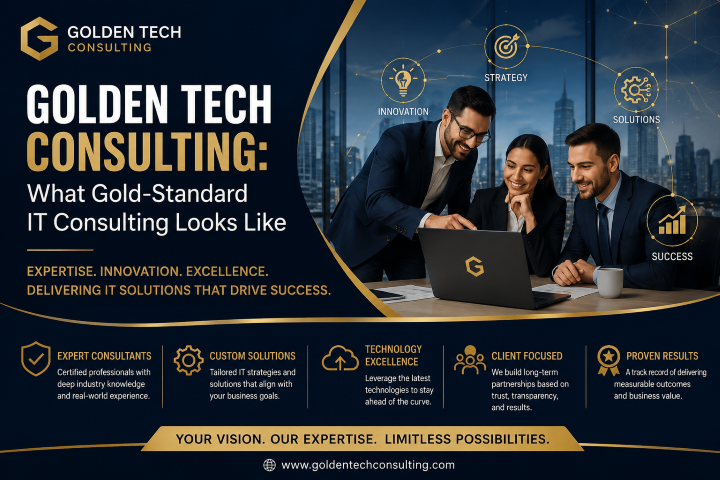
There’s no official certification called golden tech consulting. Instead, think of it as a standard — a shorthand for the qualities that define the best technology advisory relationships:
- Transparency about ownership, pricing, and outcomes. A legitimate firm tells you who runs it, what it charges, and what results are realistic.
- Deep technical expertise paired with business judgment. The best consultants don’t just know the technology — they know how to tie it to a measurable business outcome.
- A track record you can verify. Case studies, references, and reviews that hold up under scrutiny.
- No dependency on recruiting new clients or members to generate income. Legitimate consulting revenue comes from delivering services, not from signing up new “consultants” beneath you.
That last point deserves emphasis, because it’s the clearest dividing line between real consulting and disguised pyramid or multi-level marketing (MLM) schemes that borrow consulting language to sound credible. More on that below.
Core Services You Should Expect From a Real Tech Consulting Partner
A genuine technology consulting firm typically offers some combination of the following:
1. IT Strategy and Roadmapping
This is the foundational layer — assessing where your technology stands today, where the business wants to go, and building a realistic, phased plan to close the gap. Good consultants avoid “rip and replace” approaches in favor of incremental modernization that doesn’t destabilize existing operations.
2. Cloud Migration and Optimization
Moving workloads to the cloud, restructuring existing cloud environments for cost efficiency, and managing multi-cloud or hybrid-cloud setups. This remains one of the most requested services across the industry, driven by ongoing pressure to reduce infrastructure costs while improving scalability.
3. Cybersecurity and Risk Advisory
Security has moved from an afterthought to a first-conversation topic. This includes vulnerability assessments, compliance support (HIPAA, SOC 2, GDPR, and similar frameworks depending on industry), incident response planning, and increasingly, guidance on securing AI systems themselves.
4. AI Strategy and Implementation
Every serious consulting practice now has some form of AI offering — helping businesses figure out where AI genuinely adds value versus where it’s simply hype, then implementing and governing those systems responsibly.
5. Managed IT Services
Ongoing, day-to-day support: help-desk services, network management, backup and disaster recovery, patching, and monitoring. This is especially common among smaller regional providers that combine consulting advice with hands-on operational support.
6. Digital Transformation and Process Automation
Redesigning business processes around modern tools rather than bolting new software onto old workflows. This often includes legacy system modernization, workflow automation, and data platform consolidation.
7. Staffing and Talent Augmentation
Some firms operate primarily as technical staffing partners — placing developers, architects, and engineers with client teams on a contract or contract-to-hire basis, rather than delivering advisory projects directly.
Major Trends Shaping Tech Consulting in 2026
If you’re evaluating consulting partners this year, it helps to know what the leading edge of the industry actually looks like, so you can spot firms that are keeping pace versus those coasting on outdated playbooks.
- AI moves from pilot to production: AI has become the biggest driver of consulting demand, with companies now hiring consultants not just to design AI strategy but to implement, scale, and govern AI across their organizations. At the same time, adoption is more measured than headlines suggest — even as firms rush to present themselves as “AI-native,” research suggests generative AI.
- Outcome-based pricing is replacing pure hourly billing: Clients increasingly want to pay for measurable results — reduced downtime, lower unit costs, faster processing — rather than simply paying for consultant hours. This shift rewards firms that can prove impact and penalizes those that can’t.
- Consulting firms are packaging services like products: Instead of fully bespoke engagements, many firms now offer defined service bundles — pre-built cloud “landing zones,” monitoring packages, or integration kits — that reduce the time from design to deployment.
- FinOps and sustainability are now standard line items: Cloud spend continues to grow, and boards face pressure to cut waste and report environmental impact, pushing FinOps and green IT considerations into standard proposals rather than side conversations.
- Consolidation is reshaping the competitive landscape: Large global firms continue acquiring specialized boutiques to fill capability gaps, while lean, AI-enabled boutique consultancies increasingly compete for work that once required much larger teams. Mid-sized generalist firms, caught between the two, face the most competitive pressure.
How to Choose a Genuinely Golden Tech Consulting Partner
Use this checklist when evaluating any technology consulting firm, whether it’s a global name or a small regional shop.
1. Ask who owns and runs the company: A credible consulting firm will readily name its leadership, share their professional backgrounds, and often list them publicly on the website. If ownership is vague, hidden behind a shell entity, or the company avoids the question, treat that as a serious warning sign.
2. Request references you can actually contact: Case studies are useful, but a direct conversation with a past or current client tells you far more about how the firm actually operates under pressure.
3. Look for a clear, describable service — not just “membership:” Real consulting firms sell expertise applied to your specific problem: a cloud migration, a security audit, a custom software build. Be cautious of any offering where the primary “product” is the opportunity to join and recruit others, rather than a deliverable service.
4. Understand exactly how you’ll be billed: Hourly rates, fixed project fees, retainers, and outcome-based pricing are all legitimate models. Rates for IT consultants commonly range from roughly $50 to $300 per hour depending on expertise, project complexity, and location, with some consultants offering fixed project rates, monthly retainers, or discounted rates for long-term engagements.
5. Check the domain and public footprint: A quick look at when a company’s website domain was registered, whether it’s privately shielded from public records, and where its actual web traffic originates can reveal a lot.
6. Evaluate technical depth, not just sales polish: Ask specific, technical questions about your actual environment. A firm with real expertise will engage substantively; one without it will pivot back to generic pitches and urgency (“act now,” “limited spots”).
A Word of Caution: Consulting Language Isn’t Always Consulting
It’s worth being direct about something that comes up when researching this space: not every business calling itself a “tech consulting” opportunity is actually offering technology consulting services. Watchdog investigators have documented cases where operations market themselves using consulting terminology — “Independent Consultants,” membership tiers, and mentorship language — while their actual structure is a recruitment-based commission scheme with no underlying product or client-facing service. Common warning signs in these cases include:
- Payment required in cryptocurrency to “activate” a membership or unlock earning tiers
- Commissions generated primarily by recruiting other members into a matrix or downline structure, rather than by delivering any service to an outside client
- Anonymous or shell-company ownership, often paired with a virtual mailing address
- Marketing that emphasizes “earning potential” and passive income over any concrete deliverable
- A domain registered relatively recently and privately shielded from public ownership records
None of this means every small or new-sounding consulting firm is suspect — plenty of legitimate boutique consultancies are young, lean, and privately held. The distinguishing factor is always the same: does the company generate revenue by solving a real technical problem for a paying client, or does it generate revenue primarily by recruiting more people into the company itself? If you can’t clearly answer that question after reading a company’s website, that’s worth treating as a signal to dig deeper before engaging — and definitely before sending any payment.
The Business Case: What You Gain From the Right Partner
When the vetting process above checks out, a strong technology consulting relationship delivers real, measurable value:
- Faster, safer modernization: Instead of guessing at cloud architecture or AI adoption, you get a roadmap built on patterns that have worked elsewhere, adapted to your specific constraints.
- Reduced risk exposure: Proactive security assessments and compliance support catch problems before they become breaches, fines, or outages.
- Access to specialized skills without full-time headcount: Few companies need a full-time quantum-security specialist or a dedicated FinOps analyst — but many need that expertise periodically. Consulting gives you access without the overhead of a permanent hire.
- Objective outside perspective: Internal teams are sometimes too close to legacy decisions to see better alternatives clearly. An outside consultant brings pattern recognition from dozens of other engagements.
- Better resource allocation: Businesses are increasingly advised to tie every consulting engagement to a specific, measurable business outcome rather than pursuing technology for its own sake — and a good consultant will help you define and track exactly that outcome.
Which Industries Rely Most Heavily on Tech Consulting?
While virtually every sector uses some form of technology consulting, a few stand out for the depth of their engagement:
- Financial services — driven by strict compliance requirements, fraud prevention, and growing interest in real-world asset tokenization and post-quantum security preparation.
- Healthcare — where data privacy regulation, interoperability standards, and legacy system replacement remain persistent challenges.
- Manufacturing — increasingly focused on robotics, industrial IoT, and what some in the industry now call “physical AI,” where software-driven intelligence controls physical equipment.
- Retail and e-commerce — reliant on consulting support for platform migrations, personalization engines, and supply chain automation.
- Government and public sector — where legacy modernization, cybersecurity mandates, and procurement complexity make experienced outside advisors especially valuable.
What Should You Budget for Tech Consulting?
Costs vary widely depending on scope, but a few general patterns hold across the industry:
- Hourly consulting typically falls in the $50–$300+ per hour range, with the higher end reserved for specialized expertise (security architecture, AI governance, enterprise-scale cloud migrations).
- Fixed-fee projects are common for well-defined deliverables, such as a security audit or a specific system migration, and offer more budget predictability.
- Monthly retainers suit ongoing advisory relationships or managed services, where the consultant functions closer to an extended part of your internal team.
- Outcome-based pricing is growing in popularity, tying consultant compensation to measurable results like cost savings or downtime reduction rather than time spent.
Whatever the model, get it in writing before work begins, and be skeptical of any arrangement that requires you to pay to become part of the company rather than to receive a service from it.
Getting the Most Out of a Tech Consulting Engagement
Choosing the right partner is only half the equation — how you work with them shapes whether the engagement actually delivers value.
- Define success before the project starts: Vague goals like “modernize our systems” are hard to measure. Specific targets — “reduce cloud spend by 15% within two quarters” or “cut average ticket resolution time by 30%” — give both sides something concrete to work toward and make it easy to tell whether the engagement succeeded.
- Assign an internal owner: Even the best external consultant needs a counterpart inside the business who can make decisions, provide context about internal politics and constraints, and keep the project moving when priorities shift.
- Ask for knowledge transfer, not just deliverables: A strong consulting relationship leaves your internal team more capable than it was before the engagement — through documentation, training sessions, or shadowing — rather than creating long-term dependency on the consultant for basic maintenance.
- Build in regular check-ins, not just a final report: Monthly or biweekly reviews catch scope drift early and give you the chance to redirect effort before a project veers off course.
- Treat the relationship as iterative: The best consulting partnerships aren’t one-off transactions; they evolve as your business and its technology needs change. A consultant who understands your systems and culture from a previous project can move faster and more accurately on the next one than a new firm starting from zero.
- Watch how the firm handles disagreement: A consultant who only ever tells you what you want to hear isn’t adding much value. Look for firms willing to push back on a flawed plan or flag a risk you hadn’t considered — that kind of candor is often the clearest sign you’re working with a genuinely gold-standard partner rather than one simply trying to extend the contract.
Common Mistakes Businesses Make When Hiring a Tech Consultant
Even well-intentioned companies stumble into avoidable problems during the selection process:
- Choosing based on price alone: The cheapest bid is sometimes cheap because it cuts corners on security review, testing, or documentation — costs that resurface later, often at a higher price than the savings up front.
- Skipping the reference check: Case studies on a website are curated by definition; a five-minute call with a past client often reveals far more about communication style, reliability, and how the firm handles setbacks.
- Failing to clarify data ownership and access: Before work begins, confirm who owns the code, configurations, and data produced during the engagement, and make sure you retain administrative access to your own systems throughout.
- Not planning for the end of the engagement: Clarify upfront what happens when the contract ends — who maintains the systems, whether there’s a transition period, and what documentation you’ll be left with.
- Assuming bigger always means better: A large global firm brings scale and brand recognition, but a smaller boutique consultancy may bring more attention, deeper specialization, and lower overhead costs for a project that doesn’t need enterprise-level scale.
Frequently Asked Questions
Is “Golden Tech Consulting” a specific company? The phrase is used by several different, unrelated organizations — ranging from legitimate regional IT service providers to at least one operation that independent watchdog reviewers have identified as a cryptocurrency-based recruitment scheme rather than a real consulting service. Always verify the specific company behind any name before engaging, rather than assuming the name alone guarantees legitimacy.
How do I verify a tech consulting firm is legitimate? Check for named, verifiable leadership; a service you can clearly describe in one sentence; client references you can actually contact; transparent pricing; and a domain registration history that isn’t recently created and privately shielded. Independent review sites and Better Business Bureau listings can also help confirm a track record.
What’s the difference between IT consulting and managed IT services? IT consulting typically focuses on strategy, advice, and project-based work — designing a cloud migration plan, for example. Managed IT services involve ongoing, day-to-day operational support, like help-desk services and system monitoring. Many firms offer both.
Do I need a tech consultant if I already have an internal IT team? Often, yes — not to replace your team, but to supplement it during specific initiatives (a major migration, a security overhaul, an AI rollout) that require specialized expertise your internal team doesn’t use often enough to maintain in-house.
How long does a typical tech consulting engagement last? This depends heavily on scope. A focused audit might take two to four weeks; a full cloud migration or digital transformation program can run six months to two years, often broken into phased milestones rather than a single continuous project.
Final Thoughts
Golden tech consulting isn’t a brand — it’s a standard. It describes technology advisory relationships built on transparency, real expertise, verifiable results, and revenue tied directly to service delivery rather than recruitment. As global demand for IT and technology consulting keeps climbing, that standard becomes more important, not less, because more players — both excellent and exploitative — are entering the market to meet that demand.
Before signing an engagement letter or making a payment, apply the checklist above: verify ownership, request real references, understand the pricing model in plain terms, and ask what specific, describable problem the company is going to solve for you. Firms that meet that bar earn the “golden” label. Ones that can’t clearly answer those questions probably don’t deserve your business — or your data.