

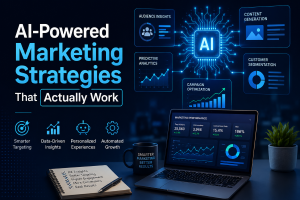
Every marketing conference, LinkedIn feed, and vendor pitch deck in the last two years has promised that artificial intelligence will transform your marketing overnight. Some of that is true. Most of it is noise. The gap between marketers who are getting real results from AI and those who are just bolting a chatbot onto their website and calling it “innovation” is enormous — and it’s widening.
This isn’t another listicle of AI tools you should try. In this guide, Tech Yugle takes a practical, experience-grounded look at the AI-powered marketing strategies that are producing measurable results for real businesses right now: better conversion rates, lower customer acquisition costs, faster content production, and stronger customer retention. We’ll also be honest about where AI falls short, because knowing the limits of these tools is just as important as knowing their strengths.
Why “AI-Powered Marketing” Means Something Different Now
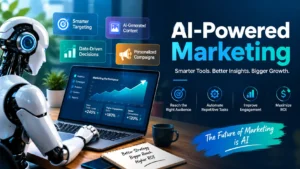
A few years ago, AI in marketing mostly meant recommendation engines and basic email automation. Today, the landscape includes generative content tools, predictive customer analytics, real-time personalization engines, conversational AI, and automated campaign optimization that can adjust bids, creative, and targeting in near real time.
The strategies that “actually work” share a common thread: they use AI to do something a human team genuinely cannot do at scale — not to replace human judgment entirely, but to extend it. The marketers seeing the best results treat AI as a force multiplier for strategy, not a replacement for strategy itself. That distinction matters more than any specific tool you choose.
1. Predictive Analytics for Customer Behavior
One of the highest-ROI applications of AI in marketing isn’t glamorous, but it’s foundational: predictive analytics.
Predictive models analyze historical customer data — purchase patterns, browsing behavior, engagement history, seasonal trends — to forecast what customers are likely to do next. This isn’t guesswork; it’s pattern recognition at a scale no analyst could manage manually.
Where this actually pays off:
- Churn prediction: Instead of reacting after a customer cancels, predictive models flag accounts showing early warning signs (declining engagement, support ticket spikes, reduced usage) weeks before churn happens. Marketing and customer success teams can intervene with targeted retention offers before it’s too late.
- Customer lifetime value (CLV) forecasting: Not all customers are equal, and predictive CLV models help marketers identify which segments deserve premium acquisition spend versus which are better served with low-cost, automated nurture sequences.
- Next-best-action recommendations: E-commerce and SaaS companies use predictive models to determine the ideal next touchpoint for a given customer — whether that’s a discount, a product recommendation, or simply more time before the next email.
The practical takeaway: if your company has more than a few thousand customers and reasonably clean historical data, predictive analytics is often the single highest-leverage AI investment you can make, because it improves the efficiency of everything downstream — your ad spend, your email cadence, your retention programs.
2. Hyper-Personalization at Scale
Personalization used to mean inserting someone’s first name into an email subject line. That’s not personalization anymore — that’s table stakes. Real AI-powered personalization goes several layers deeper.
Modern personalization engines analyze real-time behavioral signals — what a visitor is browsing, how long they linger, what device they’re on, their location, their purchase history — and dynamically adjust content, offers, and even page layout to match. This happens in milliseconds, for every visitor, individually.
What this looks like in practice:
- Dynamic website content: A returning visitor who previously browsed running shoes sees running-related content and offers on their next visit, while a first-time visitor sees a broader introductory experience.
- Personalized email send-time optimization: AI models learn when each individual subscriber is most likely to open an email and adjust delivery time accordingly, rather than blasting everyone at 9 a.m.
- Product recommendation engines: These have matured well beyond “customers who bought this also bought that.” Modern systems factor in browsing session context, seasonality, inventory levels, and even weather data for certain retail categories.
The businesses getting the most out of personalization aren’t necessarily using the most sophisticated tools — they’re the ones with the cleanest, most unified customer data. AI personalization is only as good as the data feeding it.
3. AI-Assisted Content Creation (With Heavy Human Oversight)
This is the most publicly visible and most misunderstood AI marketing application. Generative AI tools can produce blog drafts, ad copy variations, social captions, and email subject lines in seconds. The mistake most brands make is treating the raw output as a finished product.
What actually works:
- First-draft acceleration, not final-draft replacement: The marketers getting real value use AI to eliminate the blank-page problem — generating outlines, initial drafts, and structural frameworks that a human writer then substantially rewrites for voice, accuracy, and nuance. This can cut content production time by 40–60% without sacrificing quality, as long as the human editing step isn’t skipped.
- Ad copy variation testing at scale: Instead of writing three headline variations, AI tools can generate dozens of on-brand variations for A/B and multivariate testing, letting the data — not a single copywriter’s intuition — determine what resonates.
- Repurposing content across formats: A single long-form article can be automatically restructured into social posts, email snippets, and video scripts, dramatically increasing the output-to-effort ratio for content teams.
- SEO-informed content briefs: AI tools that analyze search intent, competitor content gaps, and semantic keyword clusters can generate detailed content briefs that make human writers significantly more efficient and strategically targeted.
Where this goes wrong: Brands that publish AI-generated content without substantial editing tend to produce generic, forgettable material that reads the same as every competitor using the same tools. Search engines have also become better at identifying low-effort AI content, and audiences are increasingly skeptical of anything that feels templated. The winning formula isn’t “AI writes, human approves” — it’s “AI drafts, human genuinely rewrites and adds original insight, data, or perspective that the model couldn’t have generated on its own.”
4. Conversational AI and Intelligent Chatbots
Chatbots earned a bad reputation in their early years — clunky, scripted, and more frustrating than helpful. Modern conversational AI, built on large language models, is a different category of tool entirely.
Effective applications:
- Pre-sales qualification: Instead of a generic contact form, an AI chat assistant can ask qualifying questions, answer product questions using your actual documentation, and route high-intent leads directly to a sales rep — often converting visitors who would have simply left the site.
- 24/7 customer support triage: AI assistants handle common questions instantly and escalate complex issues to human agents, reducing response time from hours to seconds for the majority of inquiries.
- Post-purchase engagement: Conversational AI can proactively check in on order status, gather feedback, and surface relevant upsell opportunities in a way that feels helpful rather than salesy — when it’s tuned correctly.
The key differentiator between chatbots that help and chatbots that annoy is scope discipline. The best-performing implementations are narrow and well-trained on a specific domain (your product, your policies, your FAQ) rather than trying to be a general-purpose assistant. A chatbot that confidently gives wrong answers damages trust faster than no chatbot at all.
5. Programmatic Advertising and Real-Time Bid Optimization
AI has quietly become the backbone of digital advertising. Platforms like Google Ads and Meta Ads use machine learning to optimize bidding, audience targeting, and creative delivery in real time — often more effectively than manual campaign management.
Where marketers should lean in:
- Automated bidding strategies (target CPA, target ROAS, maximize conversions) generally outperform manual bidding once a campaign has enough conversion data to train the algorithm — usually after 20–50 conversions.
- Dynamic creative optimization automatically tests combinations of headlines, images, and calls-to-action, serving the best-performing combination to each audience segment.
- Predictive audience expansion identifies “lookalike” audiences that share behavioral traits with your best existing customers, often uncovering profitable segments a human media buyer wouldn’t have targeted manually.
Where marketers should stay hands-on: Creative strategy, brand voice, and campaign structure still require human judgment. AI optimizes within the boundaries you set — it can’t tell you whether your offer is compelling or whether your brand positioning makes sense. Treat AI as the optimization engine and keep strategic decisions in human hands.
6. Marketing Mix Modeling and Attribution
As third-party cookies phase out and privacy regulations tighten, traditional last-click attribution has become increasingly unreliable. AI-driven marketing mix modeling (MMM) and multi-touch attribution are filling that gap.
These models use statistical and machine learning techniques to estimate the true incremental impact of each marketing channel — accounting for factors like seasonality, external market conditions, and diminishing returns on spend — without relying on individual-level tracking.
Why this matters now: Marketing budgets are under more scrutiny than ever, and the ability to demonstrate which channels genuinely drive revenue (versus which simply get credit because they’re last-touch) is becoming a core competitive advantage. Companies using AI-driven MMM are reallocating budget more efficiently and can often reduce overall media spend by 10–20% while maintaining the same revenue output, simply by cutting channels that were being over-credited by outdated attribution models.
7. Customer Segmentation That Goes Beyond Demographics
Traditional segmentation groups customers by age, location, or purchase history. AI-driven segmentation identifies behavioral and psychographic patterns that aren’t obvious from raw demographic data — clustering customers based on how they actually engage with your brand.
This might reveal, for example, that your highest-value segment isn’t defined by income or age at all, but by a specific combination of browsing frequency, price sensitivity, and content engagement style. Marketing campaigns built around these AI-discovered segments consistently outperform demographic-only targeting because they reflect actual behavior rather than assumed correlation.
8. Sentiment Analysis and Social Listening
AI-powered sentiment analysis tools scan social media, reviews, and customer support interactions to gauge public perception of your brand in real time — at a scale no human team could monitor manually.
Practical uses:
- Detecting emerging PR issues before they escalate, based on sentiment shifts in mentions
- Identifying which product features or campaign elements are generating genuine enthusiasm versus polite indifference
- Surfacing unfiltered customer language that can inform more authentic messaging and copywriting
This is particularly valuable for product marketing teams trying to understand the actual words customers use to describe pain points and benefits — language that’s often far more persuasive than internally generated marketing copy because it reflects how real people actually talk.
What This Looks Like in Practice: Three Realistic Scenarios
Abstract strategy is easier to absorb with a concrete picture of how it plays out. Here are three composite scenarios, representative of patterns seen across different business types, that illustrate how these strategies come together.
- Scenario one: A mid-sized e-commerce brand: A home goods retailer with a healthy but plateauing email list implements predictive send-time optimization and dynamic product recommendations. Instead of one weekly newsletter blast, each subscriber receives content at their individually optimal time, with product recommendations drawn from their specific browsing and purchase history rather than a generic “bestsellers” block. Within a few months, email-driven revenue increases meaningfully — not because more emails are sent, but because each one is more relevant.
- Scenario two: A B2B SaaS company: A mid-market software company struggles with a high volume of low-quality inbound leads consuming sales team bandwidth. They implement a conversational AI assistant trained specifically on their product documentation, pricing structure, and common buyer questions. The assistant qualifies visitors in real time, answers technical questions instantly rather than making prospects wait for a callback, and routes only genuinely qualified leads to sales reps.
- Scenario three: A consumer subscription service: A subscription box company facing rising customer acquisition costs shifts advertising budget allocation using AI-driven marketing mix modeling. The model reveals that a channel long assumed to be their top performer, based on last-click attribution, was actually receiving credit for conversions that would have happened anyway through brand searches. Reallocating that spend toward channels the model identifies as genuinely incremental reduces blended customer acquisition cost significantly over two quarters, without reducing overall customer volume.
Frequently Asked Questions
Does using AI in marketing require a large budget or data science team? No. Many of the strategies above — automated ad bidding, AI writing assistants, chatbot platforms, email send-time optimization — are available through existing marketing tools your team may already use, often at little to no additional cost.
Will AI-generated content hurt my SEO rankings? Search engines don’t penalize content simply for being AI-assisted; they penalize low-quality, unhelpful content, regardless of how it was produced. Content that’s been substantially edited, fact-checked, and enhanced with genuine expertise and original insight performs the same as any well-written human content.
How much of my marketing budget should go toward AI tools? There’s no universal percentage, but a useful principle is to fund AI tools proportional to the size of the problem they solve. If churn is costing you significant revenue, a predictive churn model that reduces it by even a few percentage points likely pays for itself many times over.
Is it necessary to disclose AI use to customers? Increasingly, yes — both as a matter of building trust and, in some jurisdictions and industries, as a matter of emerging regulation. Being transparent about chatbot interactions or AI-assisted content generally doesn’t hurt engagement, and it protects against the reputational risk of customers feeling misled if they discover AI involvement was hidden.
Common Mistakes That Undermine AI Marketing Efforts
Even with the right tools, many teams fail to see results. The recurring failure patterns are worth naming directly:
Treating AI as a strategy instead of a tool: “We’re using AI” is not a marketing strategy. AI should serve a clearly defined goal — reducing churn, increasing conversion rate, improving content velocity — not exist for its own sake.
Feeding AI systems poor-quality data: Predictive models and personalization engines are only as good as the data they’re trained on. Fragmented CRMs, inconsistent tracking, and siloed customer data will produce mediocre AI output regardless of how sophisticated the underlying model is.
Removing humans from the loop entirely: The strongest results consistently come from human-AI collaboration, not full automation. AI handles scale and pattern recognition; humans handle judgment, brand voice, ethics, and strategic nuance.
Ignoring the trust factor: Consumers are increasingly aware of AI-generated content and interactions. Transparency about AI use, combined with genuinely helpful (not manipulative) applications, builds trust. Opaque or deceptive AI use — fake reviews, manipulative dark patterns, deceptive chatbot personas — erodes it quickly and can cause lasting brand damage.
Chasing every new tool: The AI marketing tools landscape changes weekly. Teams that constantly switch platforms in search of the “next best thing” rarely build the institutional knowledge or clean data pipelines needed to get real value from any single tool.
Building an AI Marketing Strategy That Actually Works
If you’re starting from scratch or reassessing your current approach, a disciplined sequence tends to work better than trying everything at once:
- Start with a clean data foundation: Before investing heavily in AI tools, ensure your customer data is unified, accurate, and accessible. This single step often has more impact on AI performance than the choice of tool itself.
- Pick one high-leverage use case first: Rather than deploying AI across every channel simultaneously, choose the application with the clearest, most measurable ROI for your business — often predictive churn modeling or ad bid optimization — and prove value before expanding.
- Keep humans in strategic and creative control: Use AI for scale, speed, and pattern recognition. Keep brand voice, ethical judgment, and strategic direction firmly in human hands.
- Measure incrementality, not just output: More content or more personalized emails isn’t automatically better. Track whether AI-driven changes actually move the metrics that matter — conversion rate, retention, revenue per customer — not just activity volume.
- Stay honest with your audience: Disclose AI use where it matters to trust (like AI-generated content or chatbot interactions), and avoid applications that feel manipulative rather than helpful.
The Bottom Line
AI-powered marketing isn’t magic, and it isn’t hype either — it’s a genuinely powerful set of tools that reward teams with clean data, clear strategy, and disciplined execution. The companies seeing real results aren’t the ones with the flashiest AI stack; they’re the ones who identified a specific, measurable problem — churn, content velocity, ad inefficiency, poor personalization — and applied the right AI tool to solve it, with human judgment guiding the process at every step.
The strategies outlined here — predictive analytics, hyper-personalization, AI-assisted content, conversational AI, programmatic advertising, marketing mix modeling, behavioral segmentation, and sentiment analysis — aren’t speculative. They’re being used right now by marketing teams generating measurable, defensible ROI. The difference between those teams and the ones still chasing hype is simple: they treat AI as an amplifier of good strategy, not a substitute for it.
Start with one use case. Get the data right. Keep humans in the loop. Measure what actually matters. That’s the whole playbook — and it’s the reason these strategies actually work, while so many others don’t. For more insights like this, keep following Tech Yugle com.
